



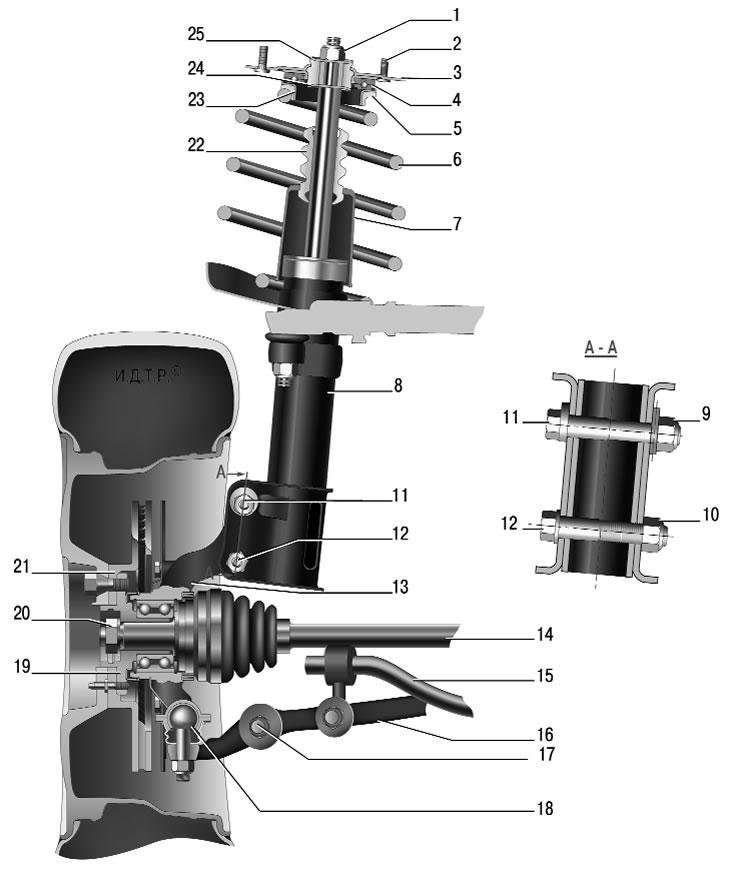
Figure 7.1. Front suspension assembly: 1 – nut for fastening the upper support of the rack; 2 – bolt; 3 – upper support of the front suspension strut; 4 – upper support bearing of the rack; 5 – upper spring insulating gasket; 6 – front suspension spring; 7 – protective cover; 8 – telescopic stand assembly; 9, 10 – nuts for fastening the strut to the steering knuckle; 11 – bolt with eccentric; 12 – bolt; 13 – steering knuckle; 14 – front wheel drive shaft; 15 – stabilizer bar; 16 – lever; 17 – stretching; 18 – ball joint; 19 – hub; 20 – hub mounting nut; 21 – brake disc; 22 – front suspension compression buffer; 23 – upper spring cup; 24 – upper strut support compression stroke limiter; 25 – upper support travel limiter
The main element of the suspension is a hydraulic telescopic shock absorber strut 8 (figure 7.1), the lower part of which is connected to the steering knuckle 13 by two bolts 11 and 12. The upper bolt 11, passing through the oval hole of the rack bracket, has an eccentric belt and washer. Turning the top bolt changes the camber of the front wheel.
A coiled barrel spring 6, a polyurethane foam buffer 22 for compression stroke and an upper support 3 of the strut assembled with a bearing 4 are installed on the telescopic strut.
The upper support is secured with three self-locking nuts to the mudguard pillar of the body. Due to its elasticity, the support ensures the strut swings during suspension movements and dampens high-frequency vibrations. The bearing built into it allows the stand to rotate together with the steered wheels. The body of the rack contains parts of a telescopic hydraulic shock absorber.
The lower part of the steering knuckle is connected by a ball joint 18 to the lower arm 16 of the suspension. The braking and traction forces are perceived by longitudinal stretchers 17, which are connected through rubber-metal hinges to the lower arms and to the front supports of the cross member of the front suspension. Adjusting washers are installed at the points where the tensioner connects to the lever and the front support, which regulate the longitudinal tilt angle of the pivot axis.
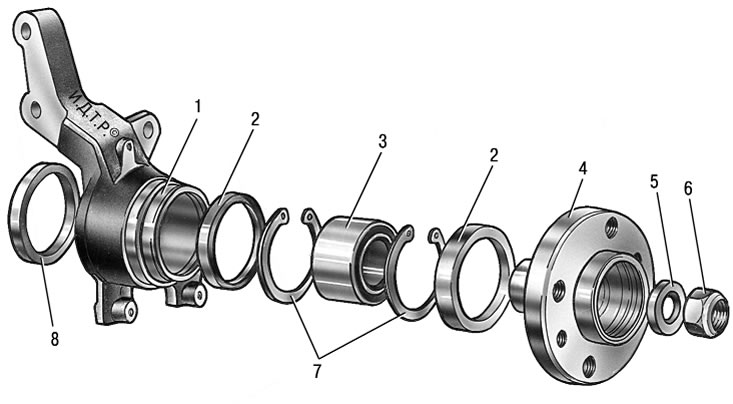
Figure 7.2. Steering knuckle and front wheel hub parts: 1 – steering knuckle; 2 – outer mudguard ring; 3 – hub bearing; 4 – wheel hub; 5 – thrust washer; 6 – nut; 7 – retaining rings; 8 – Inner mudguard ring
In the steering knuckle (figure 7.2) a double-row radial thrust bearing 3 of a closed type is attached, on the inner rings of which the wheel hub 4 is installed with tension. The bearing is tightened with a nut 6 on the tailpiece of the outer joint housing of the wheel drive and is not adjustable. All front and rear wheel hub mounting nuts are identical and have right-hand threads.
[Article based on information from the website www.LadaMan.ru]
The anti-roll bar is a 15 bar (see figure 7.1), the knees of which are connected to the lower arms 16 of the suspension through struts with rubber and rubber-metal hinges. The average (torsion) part of the rod is attached to the body with brackets through rubber cushions.