Modern bearings are designed for a long service life. For example, under ideal operating conditions, the service life of wheel hub bearings for passenger cars is 200-300 thousand km, for commercial vehicles - about 1 million km. In addition to product defects, premature bearing failure usually occurs due to improper installation, damage, deviations of mating elements and units, and violations of operating rules.
When a bearing is severely damaged or even destroyed, it is in most cases no longer possible to determine the cause of its premature failure. It is important to carry out diagnostics at the slightest sign of a malfunction. Timely bearing dismantling and correct diagnostics can significantly reduce repair costs.
In addition to diagnosing faults in bearings, associated components and systems, installation guidelines must be followed carefully. All surfaces must be cleaned from dirt and corrosion, have no scratches, and the wear of mating parts must be within tolerance. In particular, before installing the hub bearing, it is necessary to check the condition of the steering knuckle and the runout of the brake disc.
When installing bearings, it is extremely important to maintain the correct tightening torque. Fasteners must be new, torque wrenches must be calibrated at least once a year. A force deviation of just 1 Nm from the required parameters reduces the bearing life by approximately 1000 km! Tightening of threaded connections must be carried out in several stages in accordance with the instructions. When installing a bearing, the hub must be rotated, this is true for all types of bearings, but is especially critical for tapered ones, since this is the only way to ensure optimal clearance and correct installation.
Nowadays, ball bearings are used more often. Their advantage is that they do not block even when critically worn. However, they also have a disadvantage - limited load capacity. When replacing a bearing, it is important to follow the manufacturer's recommendations and not install the part if the factory packaging is badly damaged. There is no point in checking the gap of the part manually before installation - after installation this value will change. If necessary, the gap and vibration can be checked on a special stand under load.
It is not recommended to rotate the pump bearings before installation: they should only work with coolant. When installing a new pump, be sure to flush the system and completely replace the coolant. However, not everything is so simple here, since car manufacturers have recently been frequently changing the composition of antifreezes. If it is unknown what type of antifreeze was previously added to the cooling system, flushing with distilled water is recommended.
It is even better in such cases to perform a double replacement of the coolant, that is, after replacing the pump, fill in new antifreeze, drive on it for some time and then replace it again.
In conclusion, we will list some of the most common reasons why a bearing may fail prematurely:
1. Fatigue failure, surface and subsurface.
2. Wear, abrasive and adhesive. Abrasive occurs as a result of the ingress of foreign bodies (for example, dirt particles), adhesive - against incorrect loading and slippage.
3. Corrosion, chemical and frictional. Chemical corrosion - rust - can occur as a result of damaged seals or improper bearing installation. In turn, frictional corrosion comes in several types. One of them, the so-called fretting corrosion, occurs as a result of microvibrations and oxidation of wear products on the surface of the part. Another type of frictional corrosion is false brinelling. This defect appears as potholes on the rolling tracks, most often due to vibration acting on the bearing at rest, for example when transporting a car on a railway platform.
4. Erosion due to current or voltage. When damaged by current, due to local overheating, stripes appear along the perimeter of the ring and rolling elements. When exposed to stress, craters may form on the metal. This defect may be due to improper grounding of the welding equipment, for example, when carrying out body repairs. The likelihood of such damage is higher in electric motors and electric vehicles, which is why bearings with a special dielectric coating are used there.
As you can see, there are quite a few possible reasons for premature bearing failure, and, as a rule, they are not related to the design of the part itself. If the vehicle's faults are not eliminated as a whole, it is impossible to achieve correct operation of any particular unit, which is why careful diagnostics are required when performing repair work.
Wheel hub bearing faults
External manifestation of malfunction/breakdown/problem: Damage to the rolling track.
Probable cause: Impact on the inner ring during bearing installation.
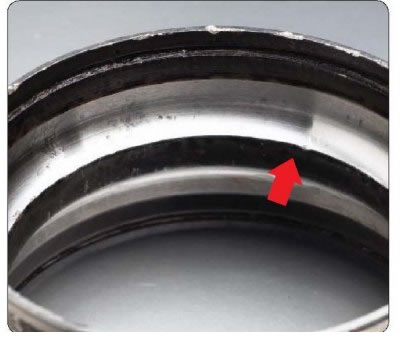
External manifestation of malfunction/breakdown/problem: Damage to the rolling track.
Possible Cause: Incorrect tightening torque was selected when installing the bearing, resulting in too little clearance, causing damage to the raceway.
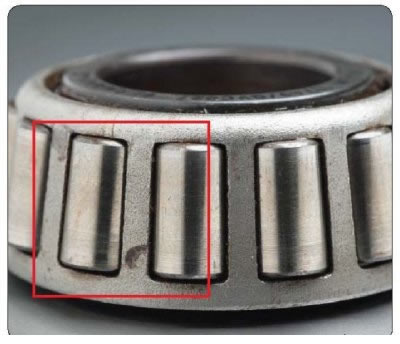
External manifestation of malfunction/breakdown/problem: Damage to the rolling track.
Probable cause: Foreign object entering the bearing.
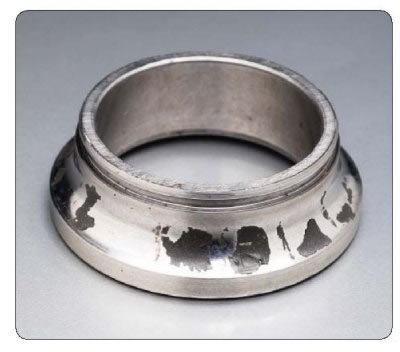
External manifestation of malfunction/breakdown/problem: Darkening of the surface of the outer ring of the bearing.
Probable cause: Incorrect installation of the bearing in the knuckle, resulting in fretting corrosion of the outer ring surface and its darkening. For units of this type, LGAF 3 antifretting paste should be used.
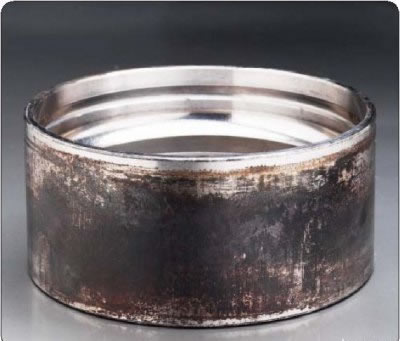
External manifestation of malfunction/breakdown/problem: Damage to the rolling track.
Probable cause: A foreign object entering the bearing, causing wear and subsequent chipping of the ring surface.
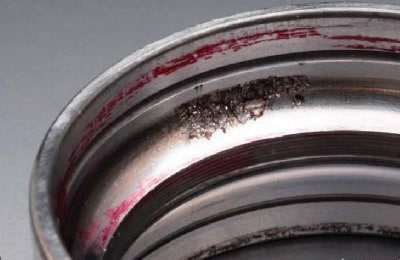
External manifestation of malfunction/breakdown/problem: Breakage, chipped outer ring.
Probable Cause: Impact on housing/outer ring during bearing installation.
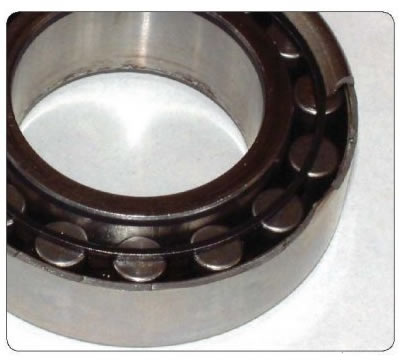
External manifestation of malfunction/breakdown/problem: Water ingress.
Probable Cause: Water penetration through the seal causing corrosion on the inner surface of the outer ring.
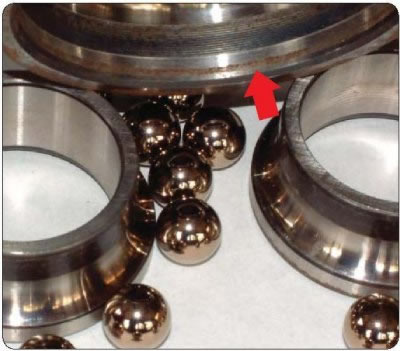
External manifestation of malfunction/breakdown/problem: Peeling of the raceway surface.
Probable cause: Violation of installation technology: inappropriate installation force, which caused excess preload in the bearing.
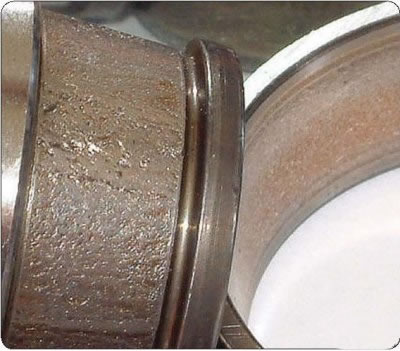
External manifestation of malfunction/breakdown/problem: Dents on the seal.
Probable Cause: Seal damage most likely caused by impact during bearing installation.
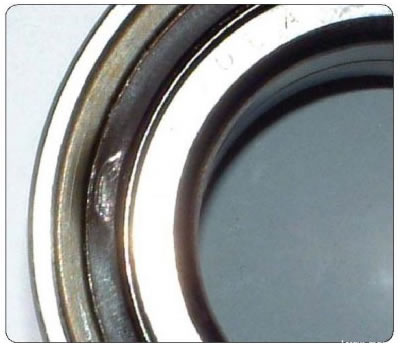
External manifestation of malfunction/breakdown/problem: Peeling of the raceway surface.
Probable Cause: Misalignment during bearing installation caused raceway damage that progressed to the point of surface peeling.
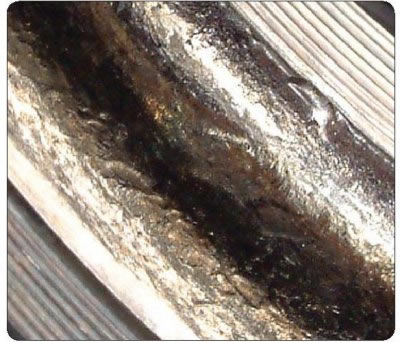
External manifestation of malfunction/breakdown/problem: Seal displacement.
Probable cause: Impact action on the bearing during installation resulted in damage to the edges of the inner ring, the raceway surface and displacement of the seal from its original position.
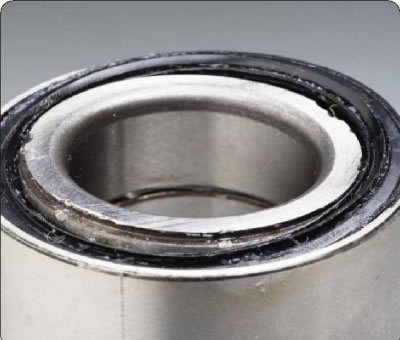
External manifestation of malfunction/breakdown/problem: Plastic deformation of the track surface.
Probable cause: Plastic deformation occurs under loads that exceed the tensile strength of the material. Static or impact overloads cause plastic deformations with the formation of dents on the surfaces of the bearing raceways, located according to the pitch of the rolling elements.
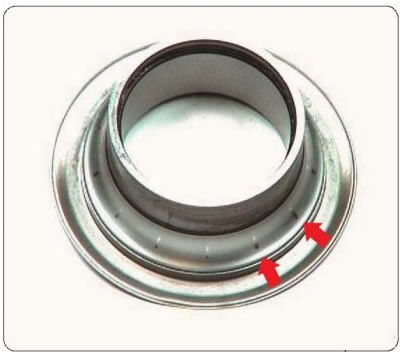
External manifestation of a malfunction/breakdown/problem: An increased width trace of a characteristic color on the track from the rolling elements towards the flange.
Original text on the website (www.Ladaman.ru)
Probable cause: During operation, the clearance in the bearing increases, which causes a significant change in the width of the track from the rolling elements.
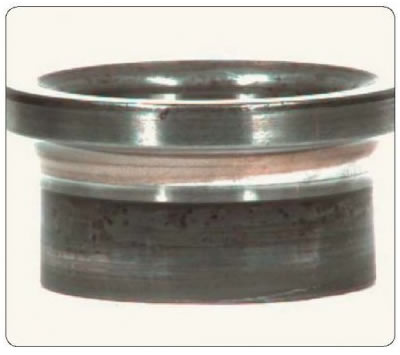
External manifestation of malfunction/breakdown/problem: Plastic deformation of the surface of the inner ring.
Probable Cause: This type of raceway deformation indicates increased shaft vibration.
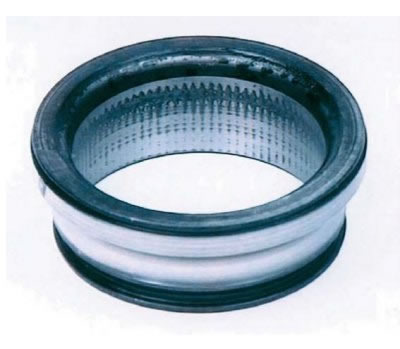
External manifestation of malfunction/breakdown/problem: Damage to the seal.
Probable cause: Violation of installation technology, most likely impact on the bearing during installation.
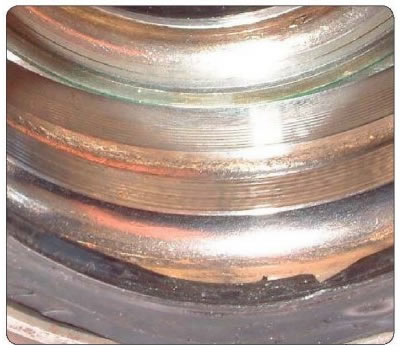
External manifestation of malfunction/breakdown/problem: Damage to the seal.
Probable Cause: The damage was most likely caused by misalignment during bearing installation, which resulted in the seal coming into contact with the threaded portion of the shaft.
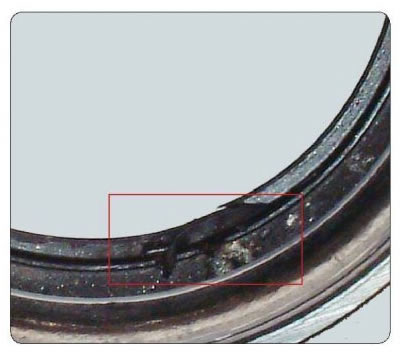
External manifestation of malfunction/breakdown/problem: Surface chipping.
Probable cause: Misalignment during bearing installation, resulting in chipping of the raceway and outer ring surfaces.
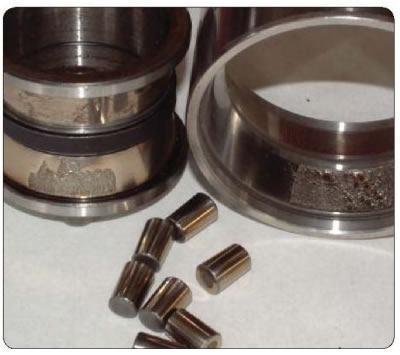
External manifestation of malfunction/breakdown/problem: Water ingress/rust.
Probable cause: Damage to the seal, most likely due to non-compliance with the technology during installation.