



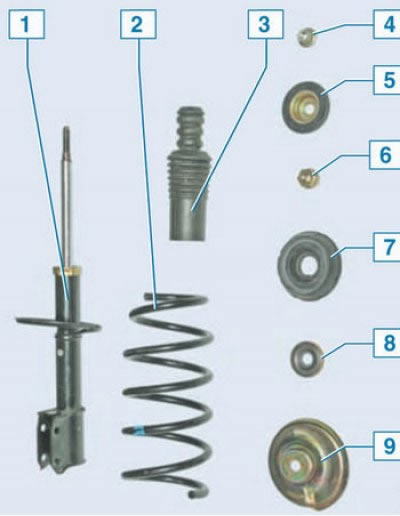
Front shock absorber strut: 1 - telescopic stand; 2 - spring; 3 - compression stroke buffer with protective cover; 4 - nut for fastening the rack to the body; 5 - support washer; 6 - upper support mounting nut; 7 - upper support of the rack; 8 - Upper support bearing; 9 - upper spring cup
Removal
We remove the steering knuckle from the eye of the rack bracket.
While holding the rack from falling, we finally unscrew the nut of its upper mount.
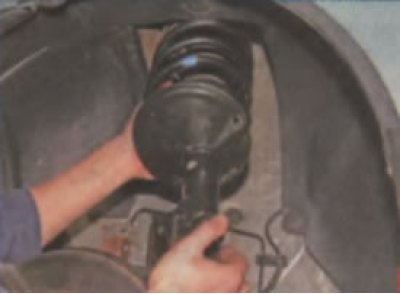
We remove the shock absorber strut.
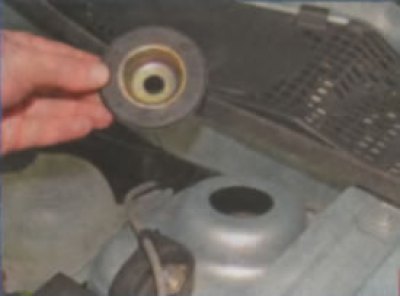
We remove the rubber-metal support washer of the upper shock absorber mount.
To disassemble the rack, install two spring clamps diametrically opposite each other so that they engage four turns of the spring.
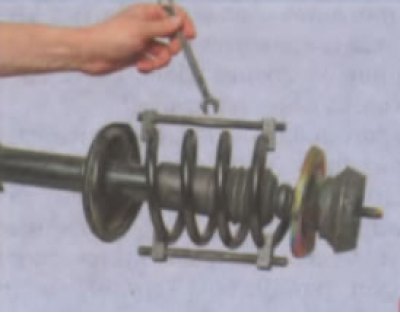
By rotating the tie rod screws evenly, we compress the spring.
Care must be taken when handling a compressed spring.
After the spring stops pressing on the support cups...
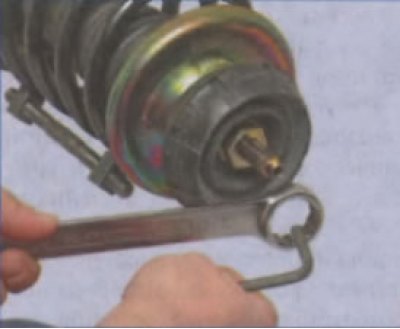
...using a 27 mm open-end wrench, unscrew the upper support mounting nut, holding the rod from turning with a 6 mm Allen key.
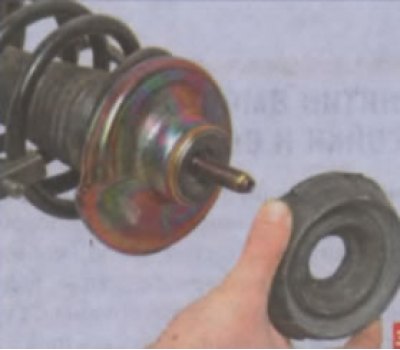
We remove the rack support...
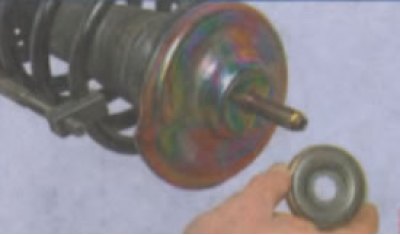
...upper support bearing...
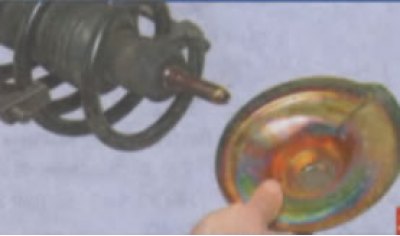
...and the upper spring cup.
We remove the spring with clamps.
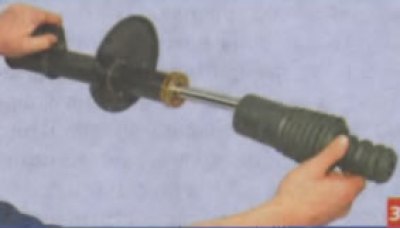
...compression buffer with protective cover.
We assemble and install the rack in the reverse order. We install the spring like this...
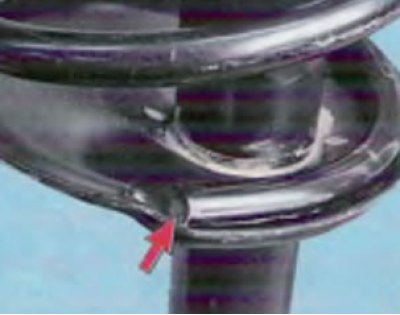
...so that its lower turn rests against the protrusion of the lower cup of the spring...
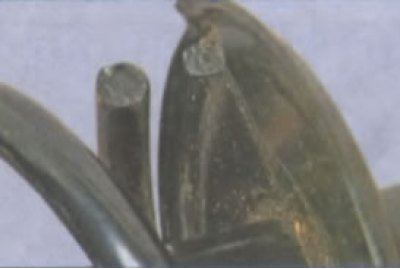
...and the upper coil rested against the stamping of the upper cup of the spring.
Tighten the nut securing the upper support of the strut and the nuts of the bolts securing the strut to the steering knuckle to the prescribed torques. We finally tighten the nut that secures the rack to the body to the prescribed torque in the "car on wheels" position
Tightening torques (Nm)
Upper shock absorber strut mount nut to body - 44
Upper shock absorber strut support mounting nut - 62
Nut for mounting bolt of shock absorber strut to steering knuckle - 105
About repair of modern shock absorbers
The shock absorber, or shock absorber strut, was not a particularly complex product before, but now times have changed, and ubiquitous marketing is trying to limit the possibility of repairing any component of the car. However, against the backdrop of the significantly increased cost of dampers, the relevance of their repair has again increased significantly.
The economic crisis in Russia has already had its impact here, but don't think that the restoration of components and assemblies is something that only we do; this practice is widespread throughout the world. Okay, fuel injection pump or generator, but do they really restore shock absorbers too? Perhaps this will seem surprising to someone, but it is true, moreover, for example, in the original VAG program restored units and parts are designated by the letter "X" at the end, a well-known fact, i.e. a client wishing to save money can order restored dampers directly through official channels. This is, of course, not our path, but such an opportunity exists.
However, it is worth starting from the very beginning, namely with the problem that has arisen, and only then outline the possibilities for solving it. Car manufacturers often say one thing, and assembly line suppliers say another, but everyone agrees on one thing - a shock absorber, like any mechanical device, has its own service life. If we talk about classic schemes without new-fangled electronic bells and whistles, the damper lives no more than 80,000-100,000 km, this is the limit. It is quite possible that even after this mileage the shock absorber will remain functional, but only partially. This "partially" is where the main problem lies - the damping level of such struts can decrease by 50% or more, and this is safety of control in borderline modes - do you need it? You should not perceive the above as a guide to action: "Aha, my shock absorbers have only gone 40 thousand, so everything is fine with them." This is not a fact - everything depends on where, how, at what speed and with what load you drive. It is possible to completely destroy the suspension of a modern car even a thousand kilometers away, especially in the corresponding directions - a stupid and simple matter, so the functionality of the damping elements must be determined in other ways.
The funniest thing is that there aren't that many of them. The best diagnostic device is a master diagnostician with 10 years or more of experience, who does not participate in corporate marketing programs. You can determine for yourself that the shock absorbers have failed or will soon completely fail - by the behavior of the car, and, of course, by the only method generally accepted by the masses: first rock the front, then the rear of the car. If the car has rocked more than once, it definitely needs to be replaced. This is understandable, but there are a lot of nuances here, so you need sufficient experience or a diagnostic stand. Of course, experience is better, since a universal stand will not diagnose the dampers separately, but the suspension as a whole, so this is not a solution either. Naturally, there are also specialized stands with strain gauges, created specifically for testing the effectiveness of damping, but here's the problem - in order to test the shock absorbers, they will have to be removed from the car. Okay, the rear ones, although this has become difficult lately due to the widespread use of multi-links, with the front ones it is even worse, especially in the case of the McPherson type, and after installing them in place you will also have to do wheel alignment, so the cost of disassembly-assembly-installation with related work can easily be compared with the cost of new conventional shock absorbers.
But this is the case with old-school classics - gas or gas-oil dampers without electronic control. When the car has an electronically controlled design, the situation changes, since one shock absorber, depending on the brand, can cost a thousand euros or two, so here the question of a different order arises in full - how to repair the car without destroying the family budget? It is not customary to drive premium equipment for a long time - usually this continues until a new generation of this model appears in the price lists of dealers. After this, as a rule, the car goes to the secondary market with its nascent ailments, and its owners are by no means Gazprom shareholders or people's deputies. That is why shock absorber repair has recently reached a new level - well-known companies in their field even claim that the service life of restored dampers is comparable to the service life of new ones. Is this true? Another question immediately arises: maybe it is worth buying a repaired spare part from Europe? There are good roads and conscientious workers there. The statistics accumulated over the past few years answer, in general, all questions. Reconditioned shock absorbers from Europe have their own characteristics, it should be noted, not the most attractive, and you shouldn't think that "there" they do it well, but here it's bad, everything depends on a specific employee or the company's policy. I have come across original restored dampers ordered through official dealers, which were not of the best quality, and this could be determined even by eye. The scourge of shock absorbers that have been used on good roads is a very long service life and insignificant piston rod travel. As a result, the chrome rod constantly rubs against the seal and guide bushings in the same place, and the abrasive is everywhere. During repairs, the rod is not changed - there is no point, the maximum that can be done with it is to polish it slightly, so, having seen a restored shock absorber with a worn belt, with a high degree of probability it can be assumed that it is from Europe. And a damper with a worn rod will not last long - micro-irregularities will quickly disable the seal and then with all the ensuing consequences.
Once upon a time, in the good old days, the designer-developer of any unit during the work process also thought about how, if necessary, to repair a failed mechanism with minimal expenditure of effort and money. Remember the penny bushings, jets, seals, bearings, etc., sold both separately and in repair kits. Today, the design engineer has the exact opposite task - to make repairs impossible or as difficult and extremely expensive as possible. If earlier, when, for example, the front McPherson shock absorber strut failed, you could do something very simple - remove the strut, unscrew its top nut, take out all the insides, pour out the oil, insert a new cartridge into the released cylinder and tighten the nut back, now everything has changed. From a logical point of view, the old approach is more understandable - really, why change a huge rack entirely when you can limit yourself to a cartridge - it's cheaper and easier.
However, cheaper, simpler and more logical does not mean more profitable, so now all shock absorbers are non-separable - welded or rolled, and this is a general trend. Cartridges are still being produced by some companies, but for classic struts it is cheaper to buy a completely new part than to cut the old one, weld a spacer and cut a thread. But in the case of complex structures with electronic control, repairs are still cheaper, and several times cheaper, so there are still a number of companies involved in the restoration of shock absorbers.
Shock absorbers that have been used on Russian roads usually fail due to broken guides, torn dust boots and worn seals. Often, dirt gets into the electronically controlled valves and solenoids, causing them to stick and stop working properly. Due to impact loads, the seals of the working piston suffer, therefore, in most cases, repairs can quite easily give the desired result. The main thing is that there is no damage to the chrome rod, otherwise this whole undertaking will become economically unfeasible. And dirt? No matter the dirt, any damper components are easy to remove, wash and clean. Repairmen always have repair kits and the necessary equipment for disassembling and assembling an initially unrepairable structure. First, the upper part of the shock absorber with the seal is cut off, then the rod with the piston is removed. Regardless of the result of the defect detection, all sealing elements of the structure are replaced with new ones, and then the master checks the control devices for operability, and the cylinder and rod for scuffs and wear. The valves themselves are the most reliable part of the controlled shock absorber, so the matter is usually limited to cleaning.
The assembly process is, in principle, not complicated, but welding work has to be used - welding a thick-walled bushing in place of the cut-off upper part and cutting an internal thread to install a threaded plug with a seal. Depending on the gas pressure, either adapters or cut-in fittings are used to create the required pressure in the system. After filling with oil and gas, the restored shock absorber is tested on a stand for all parameters; now this is not difficult to do, since it has already been removed. Usually, after repairs, self-respecting companies provide a one-year warranty on the restored product. On the one hand, this is not much, but on the other hand, it is the suspension that suffers first and foremost from inadequate users - I had to deal with clients who were capable of killing even premium-segment dampers in a month, consumer extremism is already a well-established concept. So from this side the warranty period is quite acceptable. In addition, the fact that it will be much easier and, what is important, cheaper to restore the rack a second time speaks in favor of repair.
When buying advanced modern technology, it is worth remembering one significant point. It will be expensive not only at the time of purchase, but also during operation, this is how modern marketing works, and the suspension of a modern car on our roads is in the main risk zone.