



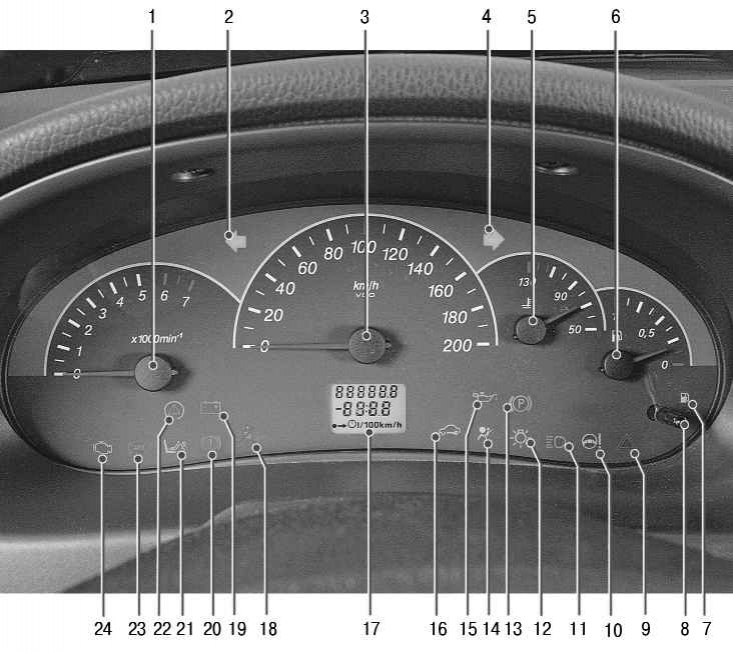
Figure 1.7. Instrument cluster
The arrangement of instruments and indicators in the instrument cluster is shown in the figure 1.7.
The following instruments and indicators are installed in the instrument cluster.
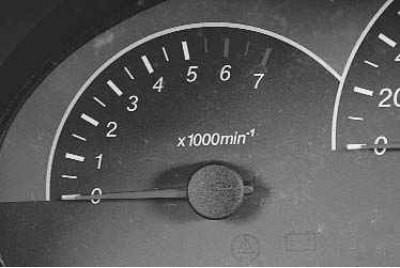
1 – tachometer. Shows the engine crankshaft speed. The scale has divisions from 0 to 7, the division value is 0.5. In order to find out the crankshaft rotation frequency in min⁻¹, you need to multiply the tachometer readings by 1000. The red scale zone is a dangerous operating mode for the engine. Do not exceed the maximum permitted engine crankshaft speed (threshold – 6000 min⁻¹).
2 – left turn signal indicator light (with a green filter in the form of an arrow) lights up with a flashing light when the left turn signal is turned on (in sync with him). Flashing of the indicator lamp at double the frequency indicates that the lamp in one of the direction indicators has burned out.
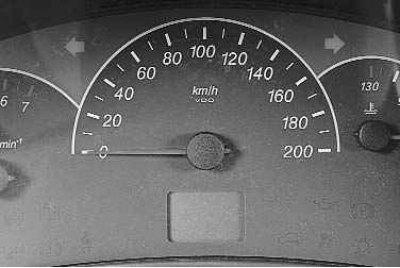
3 – induction type speedometer shows how fast the car is currently moving. The scale is graduated from 0 to 200 km/h, the division value is 10 km/h. The speedometer drive is electric from a sensor installed on the gearbox housing.
4 – right turn signal indicator light (see point 2).
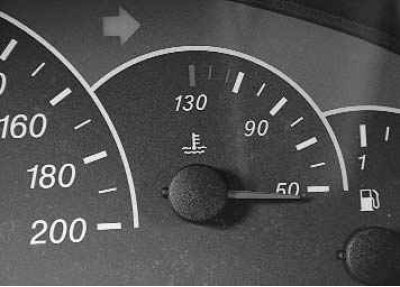
5 – engine cooling system fluid temperature indicator. If the pointer enters the red zone (more than 115°C), which means the engine is overheating, a constant sound is heard (within 5 sec) sound signal. It will repeat until the needle leaves the red zone (less than 110°C). If the needle is in the red zone, you should stop, let the engine cool down and eliminate the cause of overheating.
Warning! Do not operate the vehicle with an overheated engine, as this will lead to serious engine damage.
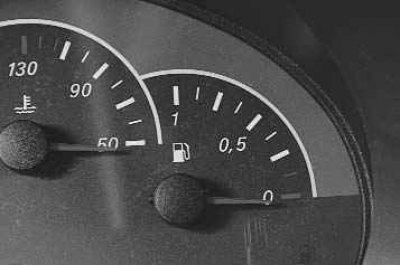
6 – fuel level indicator. When the arrow moves into the red zone of the scale, it indicates the need for refueling to avoid interruptions in engine operation.
7 – reserve remaining indicator light fuel. Lights up orange when the vehicle needs refueling to avoid interruptions in engine operation. At the same time as the signal lamp lights up, an intermittent sound is heard (2 repeated on/off cycles lasting 0.25 s) sound signal.
Warning: Never allow the fuel to run out completely. This could result in damage to the fuel pump and an emergency situation due to your vehicle being stalled on the road.
8 – button for resetting the daily mileage counter and switching the operating modes of the trip computer liquid crystal display. By pressing the button when the vehicle is stationary, the daily mileage counter in the liquid crystal display is set to zero or the daily or total mileage display mode is selected.
9 – hazard warning light indicator (with red light filter). Flashes when the hazard warning lights are on.
10 – Electric power steering indicator lamp (connected if the vehicle is equipped with electric power steering). Lights up orange when the ignition is turned on and goes out after the engine starts.
Caution! If the electric power steering indicator lamp comes on while the engine is running, this indicates a fault in the electric power steering that must be corrected. Operating a vehicle with faulty steering is life-threatening.
11 – High beam indicator lamp (with blue filter) indicates that the high beam headlights are on.
12 – control lamp for switching on external lighting (with green filter) indicates that the parking lights in the headlights and taillights are on.
13 – Parking brake indicator light (with red filter) lights up when the ignition is on and the vehicle is braked with the parking brake.
14 – Airbag warning light (connected if the car is equipped with airbags). Lights up orange when the ignition is turned on and goes out after the engine starts.
Warning! If the warning light comes on in all other cases, contact the service immediately. In addition to possible failure in an emergency, it may unexpectedly operate while driving, which will lead to serious consequences.
15 – Oil pressure emergency drop indicator light (with red filter) lights up when the ignition is turned on and warns that the pressure in the engine lubrication system is below normal.
When the engine is running, the indicator lamp is lit and the light is constant (within 5 sec) the buzzer signal indicates insufficient pressure in the engine lubrication system.
Warning! Operating a vehicle with a faulty lubrication system can lead to serious engine damage.
16 – immobilizer control lamp. Lights up orange and displays the immobilizer status, for more details see. "Control of the electronic anti-theft system").
17 – liquid crystal display. The top line displays the total or daily mileage, and the bottom line displays the time, outside temperature or trip computer functions.
18 – Driver's seat belt warning light (can be connected in a variant design). Lights up red when the ignition is turned on if the driver's seat belt is not fastened. At the same time as the lamp lights up, an intermittent sound is heard (5 repeat cycles) buzzer signal.
19 – Low battery indicator light (with red filter) lights up when the ignition is turned on. The lamp burning is accompanied by intermittent (5 repeated on/off cycles of 0.5 sec) buzzer signal. The light should go out immediately after starting the engine. If the lamp is on or glows dimly when the engine is running, this indicates a lack of charging current, caused by a faulty generator or voltage regulator, or weak tension (breakage) of the generator drive belt.
Warning! Driving the car with the light on is prohibited, as, in addition to a completely discharged battery, this may indicate a short circuit in the charging circuit, which may cause a fire.
20 – brake system emergency status indicator lamp (with red light filter). Lights up when the ignition is turned on and goes out after the engine starts. Lighting of the brake system emergency status lamp and buzzer signal (5 re-enablements) with the engine running, indicate that the brake fluid level has dropped below the "MIN" mark on the brake master cylinder reservoir.
Attention! It is prohibited to operate a vehicle with a faulty braking system.
21 – Front passenger airbag deactivated indicator light (connected in a variant design).
22 – Electronic brake force distributor malfunction indicator lamp (connected in a variant design). The lamp lights up red when the ignition is turned on and goes out after 2 seconds (self-test mode).
23 – Anti-lock braking system warning light (connected as an option if the vehicle is equipped with an anti-lock braking system). The lamp lights up red when the ignition is turned on and goes out after 2 seconds (self-test mode). If the lamp lights up while the engine is running, this indicates a malfunction in the anti-lock braking system.
Attention! In all other cases, the anti-lock braking system warning light indicates a malfunction that must be repaired at a specialized service station, since braking occurs without the participation of ABS.
24 – "CHECK ENGINE" warning light. Lights up orange when the ignition is turned on and goes out after the engine starts.
Note: If the "CHECK ENGINE" indicator light comes on while the engine is running, this is due to a malfunction in the engine management system (fuel injection systems). This does not mean that the engine must be stopped immediately, since in this case the engine management system switches to emergency modes, allowing the engine to operate under conditions close to normal. However, the cause of the malfunction must be eliminated as quickly as possible, because prolonged operation of the car with the lamp on can lead to increased fuel consumption, deterioration of the car's traction characteristics and engine failure.