



To perform the work you will need: a special socket wrench for 16 mm spark plugs with an extension cord. A rubber sleeve must be installed in the head of the key that holds the candle.
Remove the ignition coil of the first cylinder (see «Ignition coil - check and replacement»).
Using a socket wrench for task candles by 16 mm, unscrew the candle and remove it from the socket.
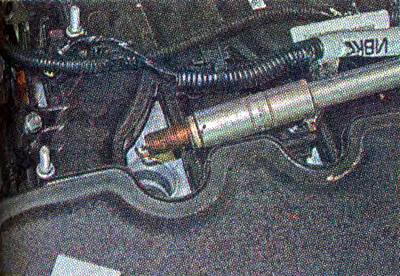
3. We take out the candle from the key head.
Comment. By the appearance of the candle, you can assess the technical condition of the engine and its systems. In a serviceable engine, the spark plug insulator should have a gray or brownish coating.
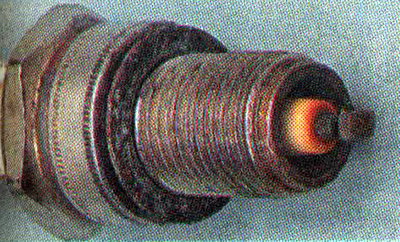
Red or red plaque is caused by the operation of the car on gasoline with a high content of additives.
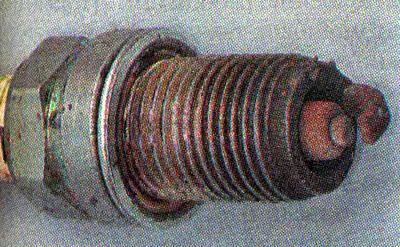
Black oily deposits can be caused by oil entering the combustion chamber. A candle will have a similar defect if it is more «cold», than recommended.
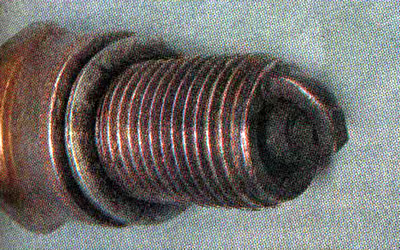
If the candle is over «hot», than recommended, the electrodes may burn. Similar spark plug failures can be caused by a malfunction in the cooling system or the ignition system.
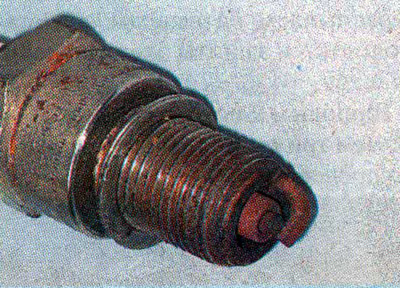
The cause of large deposits on the candle may be low-quality gasoline or oil.
Adjustment
4. Before installing the spark plug with a set of round probes, we check the gap between its electrodes. The gap should be 1.0-1.15 mm.
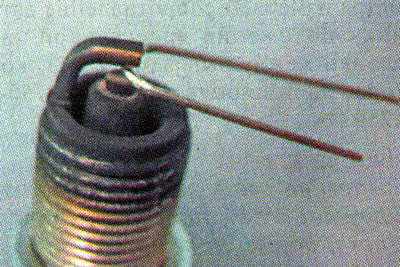
Warning! When checking the gap with flat feeler gauges, the measurement results will be incorrect.
5. We adjust the gap by bending the side electrode.
Installation
Warning! To avoid damage to the threads in the cylinder head, the spark plug must first be wrapped by hand and then tightened by inserting the wrench into the wrench extension. The tightening torque of the candle is 30-40 Nm.
We insert the candle into the key head and wrap it in the cylinder head.
Similarly, we replace the candles of the remaining cylinders.