



Which spark plugs to install: The manufacturer Lada Largus recommends installing spark plugs EYQUEM RFC58LZ2E or SAGEM RFN58LZ, as well as CHAMPION RC87YCL. Catalog numbers of standard spark plugs can be found here.
Replacement on 8 cl engine
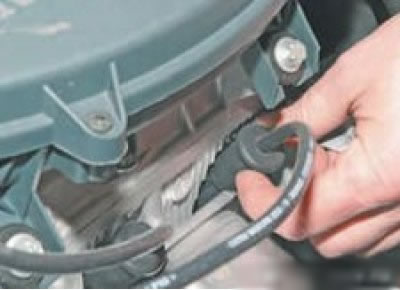 |
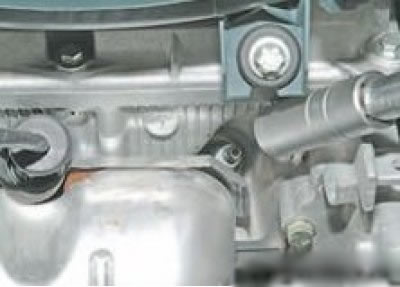 |
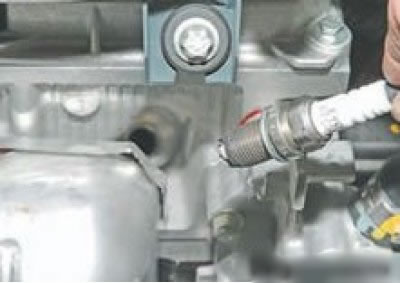
When replacing spark plugs, maintain cleanliness at all stages of the work, remove dirt around the spark plug well. Remove the high-voltage wire tip and unscrew the spark plug with a spark plug wrench or a high "16" head. The new spark plug is carefully screwed into a clean well. In this case, only the force on the key is used (i.e. without a ratchet, so as not to damage the engine threads with excessive force)
Replacement on a 16-valve engine
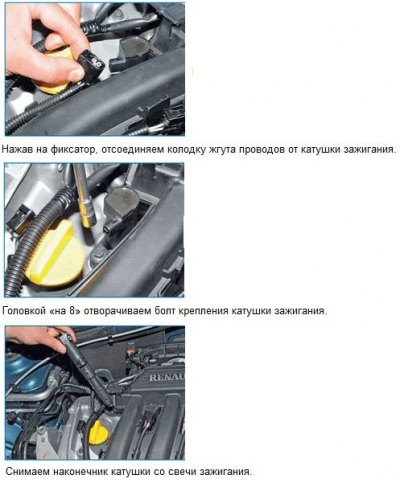
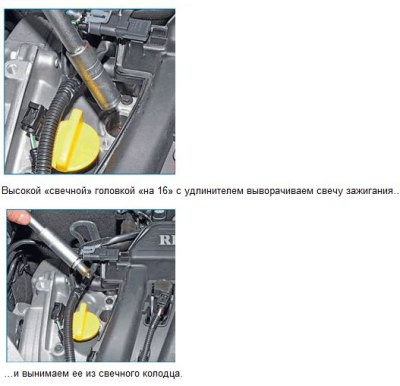
Installation of spark plugs is similar to that described above for 8-valve engines.
Description, types of candles and related information
A huge variety of spark plugs can be found in auto parts stores. The share of imported products, according to the most conservative estimates, reaches 30%, and in some regions even higher. This is largely due to the increase in the number of cars imported from abroad. As a rule, they are equipped with spark plugs from foreign companies. Domestically produced spark plugs are significantly cheaper than imported ones, but their use in foreign cars is limited, despite the economic and technical feasibility. There are many reasons for this phenomenon, but three main ones can be identified.
The range of candles produced in the former USSR was significantly limited, and the technical level of the products was inferior to the world level. A significant share of the production volume was made up of candles of outdated designs, manufactured using technologies from the 50s and 60s. At the beginning of perestroika, against the backdrop of a general decline in production in the country, the quality of the products deteriorated. As a result, many consumers have formed the opinion that domestic spark plugs are less reliable than foreign ones.
The second reason is the operating conditions of domestic cars. where spark plugs of Russian manufacture are mainly used, they are much tougher than on foreign cars, given the actual technical condition of this sector of the vehicle fleet and the quality of the fuels and motor oils used. Experience with the use of foreign-made spark plugs has shown that their reliability when used on domestic cars, especially older ones, is also significantly reduced, even if they are selected correctly based on thermal characteristics.
It is very important to note that the amount of information available to most candle consumers is clearly insufficient. The available technical information is of a specific nature and is contained in standards and nomenclature reference books that are not readily accessible to the general reader. Unlike foreign companies, domestic manufacturers are just mastering the production of advertising brochures and catalogues.
Consumers are not sufficiently informed that at present, due to growing demand, spark plug production in Russia is actively developing. The range of products is being expanded to meet the needs of the domestic and foreign markets. The volume of exports to countries not only near but also far abroad is increasing. Most of the domestic candles currently produced correspond to their foreign counterparts in terms of quality and technical level.
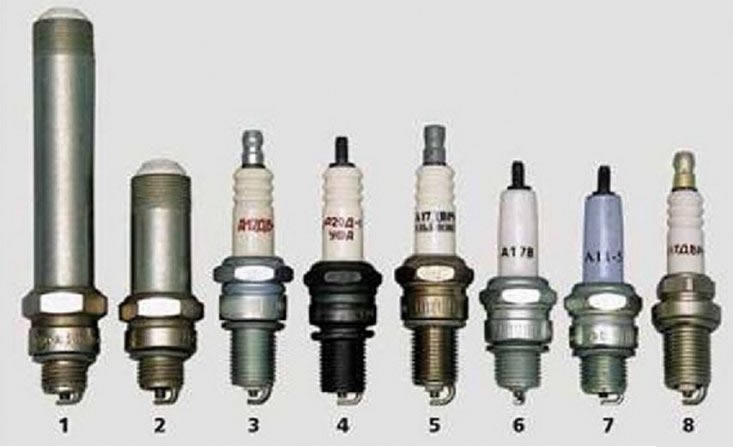
Figure 1. Shielded (1,2) and unshielded (3-8) spark plugs: 1-CH307V; 2-CH302A; 3 - A17DV-10; 4 - A20DV-g; 5 - A17DVRM; 6 - A178; 7 - A11-5; 8 - AU17D8RM
Spark plugs are the most important element of the ignition systems of internal combustion engines. They are designed to ignite the combustible mixture in the cylinders using a spark discharge. Spark discharge generated by the system
ignition, must have the energy necessary to ignite the combustible mixture in any engine operating mode under all operating conditions.
Candles vary in design, size and thermal characteristics (heat numbers). They may be unshielded. when their contact part protrudes from the metal housing, and shielded, in which the contact part is located inside the metal screen (Figure 1).
The spark discharge in most spark plugs is formed directly in the spark gap between the electrodes. In a sliding spark, the discharge occurs along the surface of the insulator installed between the electrodes. There are spark plugs with a combined discharge, in which one part of the spark is formed between the electrodes, and the other - along the surface of the insulator.
At high pressure and temperature values that occur during engine operation, spark plugs must reliably withstand the effects of chemically aggressive combustion products. In this case, the insulator must withstand high electrical voltage.
During operation, due to incomplete combustion in the wall zone, carbon deposits form on the working parts of the spark plug. Due to the possibility of ignition system bypass and spark failure, spark plugs must be self-cleaning, automatically maintaining the required operating temperature within temperature limits that ensure the removal of carbon deposits and eliminate the possibility of pre-ignition.
Spark plugs must ensure their functionality under conditions where electrical, mechanical and chemical loads compete with each other in intensity. During their entire service life, spark plugs must withstand tens of millions of operating cycles. The continuous growth of specific engine power with the tightening of exhaust gas toxicity standards places increasingly stringent requirements on spark plugs for reliability and durability.
The starting properties, reliability, power, fuel efficiency, and toxicity of exhaust gases significantly depend on the perfection of the design, quality of manufacture, and correct selection of the spark plug for the engine.
In turn, the performance of the spark plug depends on its compliance with the engine in terms of design, main dimensions, spark gap size and thermal characteristics. The technical condition of the engine, the nature and conditions of operation, the quality of fuel and engine oil have a decisive influence on the reliability and durability of the spark plug.
Domestic manufacturers of spark plugs are able to fully provide the domestic market and traditional export supplies with high-quality modern products in the required range. The peculiarity of the current stage of development of domestic candle production is that, along with large specialized enterprises producing tens of millions of candles per year. there are smaller producers. An important factor in creating a competitive environment is that some foreign companies not only import finished products, but also develop candle production in Russia.
Special terms
The upper temperature limit of the thermal characteristic is a value equal to the operating temperature of the spark plug at which glow ignition occurs.
"Hot" or "cold" spark plugs, all other things being equal, have a higher or lower operating temperature, respectively.
Detonation is an abnormal combustion process that has an explosive nature with a sharp local increase in temperature and the formation of a shock wave. It is accompanied by a loud metallic knock caused by vibration of engine parts.
Sparking is the occurrence of a spark discharge in the spark gap of a spark plug during the period from breakdown to extinction.
Spark plug (spark plug, candle) - an electrical input in combination with a spark gap, designed to ignite the combustible mixture in the engine cylinder using a spark discharge in the gap between the electrodes.
Spark gap is the gap between the insulated central electrode and the ground side electrode.
Spark discharge (electric spark, spark) - a non-stationary electrical discharge in a gas that occurs in an electric field.
Pre-ignition is the ignition of a combustible mixture caused by individual overheated areas of the surfaces of the exhaust valve, piston, cylinder or spark plug.
The glow number of a spark plug is a conventional value numerically equal to the average indicator pressure in the cylinder of the test setup engine at which glow ignition occurs.
The contact part of the spark plug - elements on the high-voltage wire side: insulator head, contact head and contact nut.
Carbon deposits are products of incomplete combustion that form on the surface of the working part of the spark plug.
The lower temperature limit of the thermal characteristic is a value equal to the temperature of the working part of the spark plug at which the carbon deposit burns out.
Spark plug performance - ensuring uninterrupted spark formation and tightness under conditions specified by regulatory and technical documentation and standards.
The working chamber of the spark plug is a cavity formed by the inner surface of the housing and the outer surface of the thermal cone of the insulator, communicating with the combustion chamber of the engine.
Operating temperature of the spark plug is the temperature of the working part of the spark plug at a given engine operating mode.
The working part of the spark plug consists of elements located directly in the combustion chamber: the thermal cone of the insulator, the end of the central electrode and the side electrode.
Thermal cone of the insulator (shed) - a part of the insulator located in the working chamber of the spark plug, which receives the heat flow from the flame and hot burnt gases with its surface.
Thermal characteristics of a spark plug - dependence of the spark plug operating temperature on engine operating modes.
The spark plug base is a threaded part of the body, designed to install the spark plug in the engine and to connect the high-voltage electrical circuit of the ignition system to the ground.
Ignition system bypass - short circuit of the high-voltage circuit of the ignition system to ground due to current leakage through carbon deposits on the surface of the thermal cone of the insulator and (or) through the conductive bridge in the spark gap.
Electrically conductive (conductive) bridge - a carbon deposit that partially or completely fills the spark gap, has conductivity and creates an electrical circuit that closes the insulated central electrode to ground.