



The central electrode is installed in an insulator channel with a variable diameter. The head of the electrode rests on the conical surface of the insulator channel at the transition from a larger diameter to a smaller one. The working part of the central electrode protrudes from the insulator by 1.0 to 5.0 mm. The electrode is fixed in the insulator channel and this connection is sealed using glass sealant. It is a mixture of special technical glass and metal powder. Glass must have a coefficient of thermal expansion equal to that of ceramics. In this case, the sealing plug will not be destroyed by temperature changes during operation. Mohalla powder (copper or lead) added to glass to make it electrically conductive.
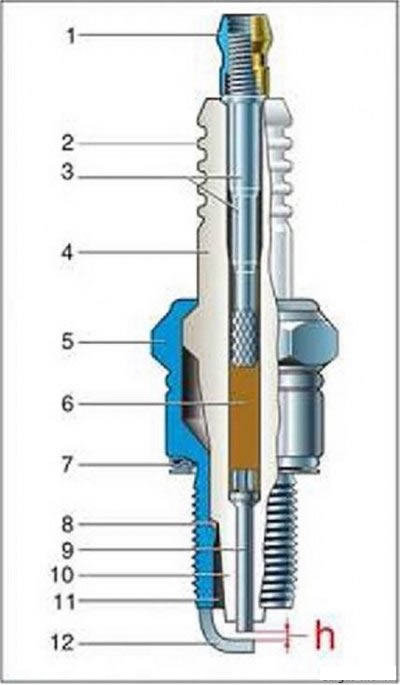
Figure 9 - Spark plug device: 1 - contact nut: 2 - insulator ribbing (barriers for duck current): 3 - contact rod: 4 - ceramic insulator: 5 - metal housing, 6 - glass sealant plug. 7 - sealing ring: 8 - heat-dissipating washer: 9 - central electrode. 10 - thermal cone of the insulator: 11 - working chamber: 12 side electrode -mass-: h - spark gap
Assembly of the core (insulator assembly with central electrode and contact rod) are carried out in the following order. The electrode is installed in the insulator channel and powdered glass sealant is poured on top or placed in the form of a tablet. Then the contact head is installed into the insulator channel. Before pressing, the glass sealant takes up more space than after this operation, and the contact rod cannot fully enter the insulator channel. It protrudes approximately one third of its length above the insulator. The workpiece is heated to a temperature of 700-900°C and with a force of several tens of kilograms the contact rod is inserted into the glass sealant softened by the temperature. In this case, it flows into the gaps between the insulator channel, the head of the central electrode and the contact head. After cooling, the glass sealant hardens and securely fixes both parts in the insulator channel. A sealing plug with a height of 1.5 to 7.0 mm is formed between the ends of the electrode and the contact head, completely blocking the insulator channel from gas breakthrough
If it is necessary to build electrical resistance into the central electrode circuit to suppress electromagnetic interference, a resistive glass sealant is used. After cooling, the sealing plug acquires the electrical resistance of the required value.
The core is installed in the spark plug body so that its conical surface touches the corresponding surface inside the body. A sealing "heat-dissipating" washer is installed between these surfaces (copper or steel).
The core is secured by rolling the flange of the housing onto the insulator belt. Sealing of the insulator-housing connection is carried out by the method of settling the housing in a heated state (thermal precipitation).
The side electrode of the "mass" of rectangular cross-section is welded to the end of the housing and bent towards the central one. A sealing ring is installed on the base of the housing with a stop against a flat support surface, designed to seal the spark plug-engine connection.
A contact nut is installed on the threaded part of the contact rod if this is required by the design of the high-voltage wire tip. In some spark plugs the contact rod does not have a threaded head, it is immediately stamped in the shape of a contact nut.
Insulator
To ensure uninterrupted spark formation, the insulator must have the required electrical strength even at high operating temperatures. The voltage applied to the insulator during engine operation is equal to the breakdown voltage of the spark gap. This stress increases with increasing pressure and gap size and decreases with increasing temperature. On engines with a classic ignition system, spark plugs with a spark gap of 0.5-0.7 mm are used. The maximum value of breakdown voltage under these conditions does not exceed 12-15 kV (amplitude value). On engines with electronic ignition systems, the installation spark gap is 0.8-1.0 mm. During operation, it can increase to 1.3-1.5 mm (both systems). In this case, the breakdown voltage can reach 20-25 kV.
The design of the insulator is relatively simple - it is a cylinder with an axial hole for installing the central electrode.
in the middle part of the insulator there is a thickening, the so-called "belt", for connection with the body. Below the belt there is a thinner cylindrical part - the neck - which turns into a thermal cone. At the transition point from the mouth to the thermal cone, there is a conical surface designed for installation between the insulator and the body of a sealing heat-dissipating washer. Above the belt there is a 'head', and at the transition point from the belt to the head there is a shoulder for crimping the flange of the body when assembling the spark plug.
The permissible wall thickness, taking into account the safety factor, is determined by the electrical strength of the insulator material. According to domestic standards, the insulator must withstand a test voltage of 18 to 22 kV (effective value), which is 1.4 times greater than the amplitude The length of the insulator head is determined by the surface overlap voltage and is performed within the range of 15 to 35 mm. For most car spark plugs, this value is about 25 mm. Further increase is ineffective and leads to a decrease in the mechanical strength of the insulator. To eliminate the possibility of electrical breakdown along the surface of the insulator, its head is provided with annular grooves (current barriers) and covered with a special glaze to protect against possible contamination.
The thermal cone performs the function of protection against surface overlap on the combustion chamber side. This most important part of the insulator, despite its relatively small dimensions, can withstand the above-mentioned voltage without overlapping the surface.
Initially, ordinary porcelain was used as an insulator material. but such an insulator had poor resistance to thermal effects and low mechanical strength.
As engine power increased, more reliable insulators were required. than porcelain ones. Mica insulators were used for a long time. However, when using fuels with lead additives, the mica was destroyed. Insulators began to be made of ceramic again, but not from porcelain, but from particularly strong technical ceramics.
The most common and economically feasible technology for the production of insulators is isostatic pressing, when granules of the required composition and physical properties are produced from pre-prepared components. Insulator blanks are pressed from granules under high pressure, ground to the required dimensions, taking into account shrinkage during firing, and then fired once.
Modern insulators are made from high-alumina structural ceramics based on aluminum oxide. This ceramic, containing about 95% aluminum oxide, can withstand temperatures up to 1600°C and has high electrical and mechanical strength.
The most important advantage of aluminum oxide ceramics is that it has high thermal conductivity. This significantly improves the thermal characteristics of the spark plug, since the main heat flow passes through the insulator, entering the spark plug through the thermal cone and the central electrode (figure 10).
Frame
The metal housing is designed to install the spark plug in the engine and ensures a tight connection with the insulator. A side electrode is welded to its end, and in designs with an annular spark gap, the body directly functions as the "ground" electrode.
The body is made by stamping or turning from low-carbon structural steels.
inside the body there is an annular protrusion with a conical surface. on which the insulator rests. On the cylindrical part of the body there is a ring groove, the so-called heat-settling groove. During the assembly process of the spark plug, the upper flange of the housing is rolled onto the insulator belt. It is then heated and pressed, whereby the heat-settling groove undergoes plastic deformation, and the housing tightly covers the insulator. As a result of thermal precipitation, the body is in a stressed state, which ensures the tightness of the spark plug for its entire service life.
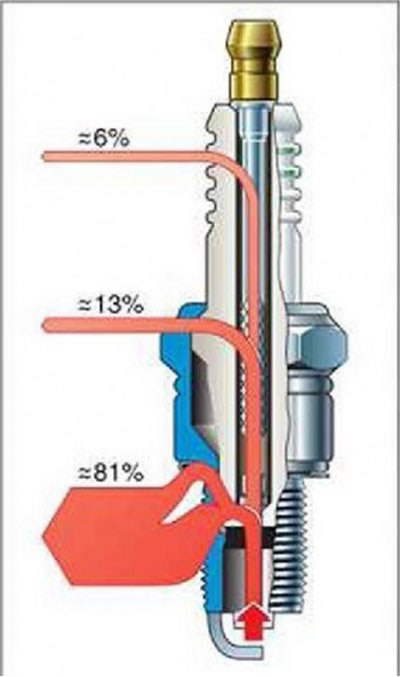
Figure 10. Heat flows in the spark plug insulator
Electrodes
As stated above, to improve ignition efficiency, the spark plug electrodes should be as thin and long as possible, and the spark gap should have the maximum permissible value. On the other hand, to ensure durability, the electrodes must be sufficiently massive.
Therefore, depending on the requirements for power, fuel efficiency and toxicity of engines, on the one hand, and the requirements for the durability of the spark plug, on the other hand, a specific design of electrodes was developed for each type of engine.
The emergence of bimetallic electrodes made it possible to solve this problem to a certain extent, since such an electrode has sufficient thermal conductivity. Unlike the usual "monometallic" one, it has a lower temperature when operating on the engine and, accordingly, a longer service life. In cases where it is necessary to increase the resource, two "ground" electrodes are used (figure 11). For this purpose, spark plugs of foreign manufacture use three or even four electrodes. The domestic industry produces spark plugs with this number of electrodes only for aviation and industrial gas engines. It should be noted that with an increase in the number of electrodes, resistance to carbon deposit formation decreases and cleaning from carbon deposits becomes more difficult.
The following requirements are imposed on the electrode material: high corrosion and erosion resistance: heat resistance and scale resistance: high thermal conductivity; sufficient plasticity for stamping. The cost of the material should not be high. Heat-resistant alloys are most widely used in the domestic industry for the production of central electrodes of spark plugs: iron-chromium-titanium, nickel-chromium-iron and nickel-chromium with various alloying additives
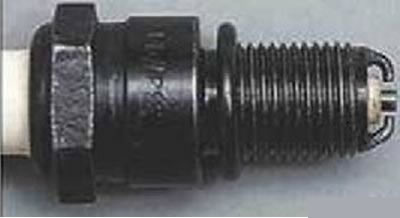
Figure 11. A26DV-1 candle with two "mass" side electrodes
The ground side electrode must have high heat resistance and corrosion resistance. It must have good weldability with ordinary structural steel from which the body is made, so a nickel-manganese alloy is used (for example. NMC-5). The side electrode must have good plasticity to ensure the possibility of adjusting the spark gap.
In order to reduce the damping effect of the electrodes when modifying spark plugs, grooves are made on the electrodes, and through holes are made in the "ground" electrode. Sometimes the side electrode is divided into two parts, turning a single-electrode spark plug into a two-electrode one.
Built-in resistor
Spark discharge is a source of electromagnetic interference, including radio reception. To suppress them, a resistor is installed between the central electrode and the contact head, which has an electrical resistance of 4 to 13 kOhm at a temperature of 25±10°C. During operation, a change in the value of this resistance in the range of 2-50 kOhm is allowed after exposure to temperatures from -40 to +300°C and high-voltage pulses.
Additional insulator
Even small losses of ignition energy lead to weakening of the spark with all the unpleasant consequences: worse starting, unstable idling, loss of engine power, excessive fuel consumption, increased toxicity of exhaust gases, etc. If the surface of the insulator is covered with carbon deposits, dirt or simply moisture, a current leak "to ground" occurs. It is detected in the dark as a corona discharge on the surface of the insulator. A leak along a contaminated thermal cone surface of an insulator in the combustion chamber of an engine can result in failure of spark generation. The most radical way to increase the electrical strength of the insulation is to install an additional insulator in the form of a ceramic sleeve between the body and the contact head of the spark plug. Thus, the spark plug acquires double protection against current leaks "to ground".
Pre-chamber spark plugs
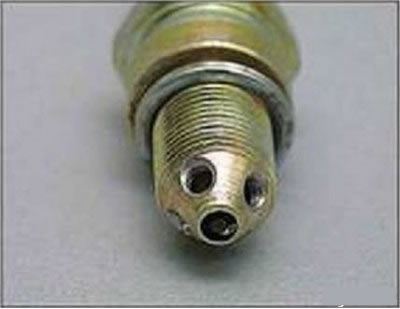
Figure 12. Prechamber spark plug
There are various known variants of spark plug design, in which the working chamber is designed as a pre-chamber. They are used to improve combustion of the working mixture. Pre-chamber spark plugs are similar to spark plugs for sports high-performance engines, where the electrodes are installed deep inside the working chamber of the housing to protect against overheating. The difference is that. what a hole. the connecting element connecting the working chamber (prechamber) with the engine cylinder is made of a special shape. During compression, fresh mixture enters the pre-chamber, a spark discharge occurs in the area of the vortex flow, and the formation of the primary ignition source becomes more intense. This ensures rapid flame propagation in the pre-combustion chamber. The pressure quickly increases and throws out a flame torch that penetrates the engine combustion chamber and intensifies the ignition of even a very lean working mixture.
When burning gases flow from the pre-chamber into the engine cylinder, due to the turbulence of the combustible mixture, the combustion process accelerates and becomes more efficient. This, in turn, can lead to improved fuel economy and exhaust gas toxicity.
The disadvantages of pre-chamber spark plugs are that the damping effect of the electrodes is great, and their resistance to carbon deposits is low. Ventilation of the pre-combustion chamber is difficult and the combustible mixture in it contains an increased amount of residual gases. When burning gases flow from the pre-combustion chamber into the cylinder, additional heat losses occur. One of the variants of the pre-chamber spark plug is shown in the figure 12.