



Lada Largus Maintenance Schedule
| Maintenance provided | Mileage or duration of operation (whichever comes first) | |||||||
| 15 thousand km. | 30 thousand km. | 45 thousand km. | 60 thousand km. | 75 thousand km. | 90 thousand km. | 105 thousand km. | 120 thousand km. | |
| 1 year | 2 years | 3 years | 4 years | 5 years | 6 years | 7 years | 8 years | |
| Engine and its systems | ||||||||
| Oil and oil filter change (see here) | + | + | + | + | + | + | + | + |
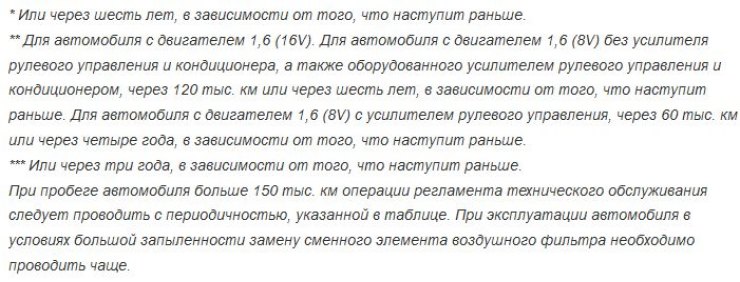
| Replacing the timing belt* (see here) | — | — | — | — | — | — | — | + |
| Replacement of auxiliary drive belt ** (see here) | — | — | — | — | — | — | — | + |
| Replacing the air filter element (see here) | + | + | + | + | + | + | + | + |
| Replacing spark plugs (see here) | — | + | — | + | — | + | — | + |
| Coolant Replacement*** (see here) | — | — | — | — | — | + | — | — |
| Diagnostics of the ECU | + | + | + | + | + | + | + | + |
| Checking the tightness of the cooling, fuel and exhaust systems, as well as the condition of the hoses, pipes and their connections | + | + | + | + | + | + | + | + |
| Transmission | ||||||||
| Checking the clutch | + | + | + | + | + | + | + | + |
| Checking the condition of the CV joint boots | + | + | + | + | + | + | + | + |
| Chassis | ||||||||
| Checking the condition of the tires and tire pressure (see here) | + | + | + | + | + | + | + | + |
| Checking the condition of bushings and cushions of anti-roll bars, silent blocks of suspension arms and ball joints | + | + | + | + | + | + | + | + |
| Checking the condition of the front and rear shock absorbers | + | + | + | + | + | + | + | + |
| Steering | ||||||||
| Checking the fluid level in the reservoir and the tightness of the power steering | + | + | + | + | + | + | + | + |
| Checking the condition of the steering gear boots and tie rod ends | + | + | + | + | + | + | + | + |
| Brake system | ||||||||
| Checking the brake fluid level in the reservoir (see here) | + | + | + | + | + | + | + | + |
| Checking the condition of the brake pads and discs of the front wheels (see here) | + | + | + | + | + | + | + | + |
| Checking the condition of the rear wheel brake pads (see here) | — | — | — | + | — | — | — | + |
| Brake fluid replacement *** (see here) | — | — | — | — | — | + | — | — |
| Electrical equipment | ||||||||
| Checking the battery | + | + | + | + | + | + | + | + |
| Checking external and internal lighting lamps | + | + | + | + | + | + | + | + |
| Checking the operation of the alarms in the instrument cluster | + | + | + | + | + | + | + | + |
| Body | ||||||||
| Checking the windshield and rearview mirrors | + | + | + | + | + | + | + | + |
| Checking the front and rear wiper blades | + | + | + | + | + | + | + | + |
| Checking the condition of the body paintwork | + | + | + | + | + | + | + | + |
| Checking and lubricating the hood and door locks | + | + | + | + | + | + | + | + |
| Checking and cleaning the air conditioning system | — | + | — | + | — | + | — | + |
Maintenance
Maintenance is divided into two categories: one is regular maintenance, which can be carried out directly by car owners, and the other is maintenance, inspection of technical condition and repair, which is carried out by authorized service stations.
Please carefully follow the rules for using engine oil, fuel, coolant and brake fluid as provided in this vehicle operating manual; otherwise, your vehicle may be damaged.
Self-service maintenance
Check the operating fluid levels regularly and add fluids as needed. Check lights, brakes and tire pressure. Check the alarm lights.
The brake coolant and power steering fluid reservoirs are translucent to make it easier to determine the amount of fluid when inspecting the vehicle.
The electronic ignition system contains high voltage, do not touch its components while the engine is running or when the ignition key is on.
Inflammation must be ruled out before working on the engine compartment. Even when the ignition key is turned off, the cooling fan may continue to operate automatically. Therefore, please avoid getting clothes (ties) caught in the fan or drive belt.
General requirements for vehicle maintenance
Wash your vehicle only in designated areas to prevent environmental pollution.
Used engine oil, brake fluid, coolant, battery and tyres should only be disposed of by qualified waste disposal companies or through consultation with the manufacturer and should not be disposed of with household waste or poured into the general drainage system. Everyone should care about protecting the environment and contribute to it.
Maintenance schedule
Daily Review:
- All internal and external lamps are in working order. Replace burned out or faded bulbs to ensure all lenses are clean.
Inspection when refueling:
- Engine oil level
- Brake fluid level
- Windshield Washer Fluid Level
- Tire pressure and condition (only when cold)
- Inspect all tubes and the engine crankcase ventilation system to ensure that there are no abrasions or breakages.
Monthly Review:
- Coolant level (engine cold)
- Leaks at the joints of the connection, tubes, hoses and fuel tank
- Brake fluid level
- Power steering fluid level
- Operating condition of the air conditioner
- Parking brake working condition
- Working state of the sound signal
- Loosen all seat belts
- Spare tire pressure
[Full article on the website: www.Ladaman.ru]