



I believe that a car living in a metropolis should go for maintenance more often than once every 15,000 km. Especially since the Largus under my control began to spend more time in the city. Sometimes we have to break through dead-end traffic jams, when the average speed drops to 15 km/h, and fuel consumption exceeds 13 l/100 km. Moreover, the runs are short - 10-12 kilometers one way and back. And only three not very long business trips indirectly confirmed that the car is in good working order and consumes 6.5 l/100 km on the highway.
I believe that one of the most correct ways to calculate the service life of motor oil is to assess the deterioration of its qualities depending on the duration of engine operation. I'm going to install an hour meter on my car to more accurately track this interesting parameter. According to my estimates, the engine has worked for about 350 hours since the last maintenance. And scientific literature recommends changing the oil after 250-300 hours of operation, and in normal, not stressed modes. Well, I'll try to compare theory with practice in the near future - I'll report on the results next time.
Among the most expensive operations during this maintenance is replacing belts. Discussions among car enthusiasts about the service life of timing belts do not subside. Many insist on intervention at 60 thousand kilometers, referring, for example, to Nissan's recommendations for similar K4M engines installed on Almeras. However, the Largus manual says change belt every 120 thousand kilometers. We obediently followed her, and, as it turned out, not in vain - the dismantled belt did not show any signs of fatigue. No burning of the outer surface, no undercutting of the teeth. However, a weak point in the timing drive was still discovered - these are the rollers (roller defects). The tensioner has still maintained its functionality, but the bypass one makes a sound when rotating, indicating that the lubricant has dried out. It is correct that the original belt kit includes both rollers.
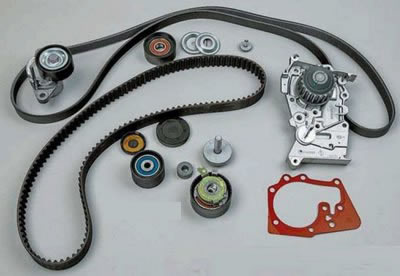
The main culprits of the "celebration" are the drive belt and timing belt with associated elements.
(The material was taken from a website: «LadaMan.ru»)
Another pressing question is whether to change it together with the timing belt coolant pump? Inspection of the pump is difficult when the engine is tightly packed in the engine compartment, and the beginning of its destruction can be missed. If you don't replace the pump now, it will have to work for up to 240 thousand kilometers. Risky! So I decided to change. Naturally, I updated the antifreeze to maintain good heat exchange between the cooling radiators and the heater. At the same time, I inspected the camshaft and crankshaft seals, the leakage of which can lead to oiling of the belt - they last the same amount of time!
I rejected the popular method of installing the belt, when they put marks on the shafts and use them as a guide. But I also consider the proprietary method - with fixing three shafts - too complicated. I settled on fixing the camshafts with a plate cut from a suitable piece of five-millimeter duralumin, and simply marked the position of the crankshaft. I recommend this method to anyone who is going to change the belt themselves.
Updating the spark plugs once again confirmed that you need to keep an eye on the cleanliness of the wells. Before removing old spark plugs, clean the wells with a vacuum cleaner with a narrow tube. After removing the spark plugs, vacuum the seating areas again and, having applied a little dry graphite to the threads, tighten the new spark plugs to the specified torque.
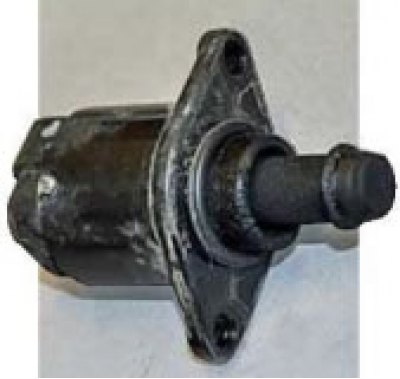
The idle speed control valve is covered with a thick layer of carbon deposits.
The car's idle speed controller lasted for about 100 thousand kilometers without any complaints. And then it started to malfunction: it didn't always accurately dose the air supply at idle, which led to fluctuating speeds. I had to remove it and thoroughly wash it with carburetor cleaning fluid - the defect went away. But, as if offended by the interference, the Check Engine light flashed. This did not affect the engine's operation in any way, so I turned off the teasing symbol using a primitive ELM 327 scanner. The light did not light up again. By the way, I highly recommend all car enthusiasts who do repairs to master this inexpensive and simple device.
An inspection of the chassis, brake system and steering only confirmed the legendary reliability of cars built on the B0 platform. Only the front brake pads asked to be replaced. The brake discs are, of course, a bit thin, but they will last until the next pad replacement.
Peeling of paint along with anti-gravel coating. But the threshold doesn't rust!
Few people remember this, but at every maintenance the body is supposed to be inspected for damage to the paintwork. Apart from small and non-blooming stone chips, everything is fine. But the peeling of a large piece of paint along with the standard anti-gravel coating in the rear part of the right threshold is surprising. And this is the place that neither the jack nor the lift paw touched. Perhaps the sandblasting from the front wheel is to blame. Moreover, there is nothing like this on the other side.