



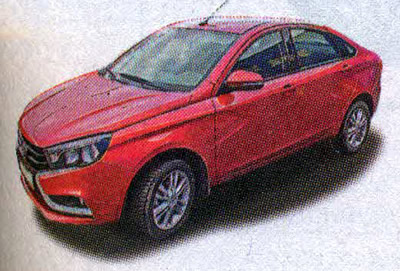
Lada Vesta
At the same time, the Lada Vesta is not a rebadged Nissan or Renault model, but AvtoVAZ's own development.
The car body is all-metal, load-bearing sedan type. In the future, production will be launched with two body types: hatchback and station wagon. The station wagon will be used as the base for the Cross variant, with increased ground clearance and protective pads on the doors, bumpers, fenders and sills. The concept model was shown at the Moscow Automobile Exhibition in 2015.
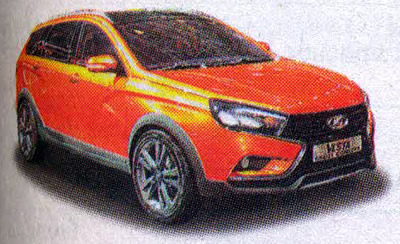
Lada Vesta Cross Concept
The power unit is located in the front of the car, transversely.
(Article copied from a web page: LadaMan.ru)
The engine for the basic configuration of the VAZ 21129 is a 16-valve, 1.6-liter engine that produces a maximum power of 106 hp. A modification with a Nissan HR16 engine with a power of 114 hp is also planned. This engine will be the most powerful in the Lada Vesta family. This engine is already installed on other cars of the Nissan-Renault alliance (for example, on the Nissan Sentra, assembled at a Russian plant). In the future, a budget version of the car with an 8-valve engine with a capacity of 87 hp of the VAZ 11189 model is envisaged.
Control system for all engines with electric throttle and electronic gas pedal. The engines comply with environmental standards not lower than Euro 5.
The car is available with three transmission options. At first, modifications with mechanical and automated units will be produced. The manual transmission (MT) is a five-speed, JH3 model developed by Renault, made in one housing with the main gear and differential. The clutch release drive is hydraulic.
Automated manual transmission (AMCP, more often it is called robotic) provides gear shifting without driver intervention depending on vehicle speed, crankshaft speed and load.
A transmission option with a continuously variable automatic transmission (CVT) is planned.
Drives - shafts with constant velocity joints transmit torque from the power unit to the front drive wheels. The front suspension is independent, MacPherson type. The rear suspension is on two longitudinal arms connected by an elastic cross beam, with cylindrical springs and hydraulic telescopic shock absorbers.
The vehicle's service brake system with dual-circuit diagonal hydraulic drive has a built-in vacuum booster. The front wheel brakes are ventilated disc brakes, and the rear wheel brakes are drum brakes. The cable-actuated parking brake acts on the brake shoes of the rear wheels.
Steering with rack and pinion type steering mechanism, with electromechanical power assistance and adjustable steering column.
The book examines the design, maintenance and repair of Lada Vesta family cars as of the beginning of 2016.