



Table 2.1. Wheel tire pressure
| Name | Front wheels | rear wheels |
| Tire pressure at partial load, kPa (bar) | 210 (2,1) | 210 (2,1) |
| Tire pressure at full load, kPa (bar) | 200 (2,0) | 220 (2,2) |
Warning! The tire pressure of a wheel is measured only when its temperature is equal to the ambient air temperature.
To check the pressure in the tire of the wheel, it is necessary to unscrew the protective cap of the nipple...
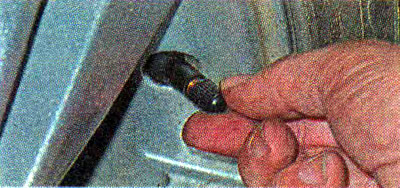
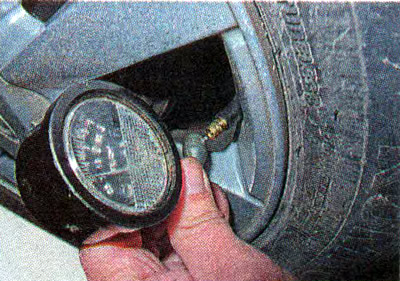
... firmly press the leg of the pressure gauge to the end of the nipple and hold it in this position for 1-2 s, then disconnect the pressure gauge from the nipple.
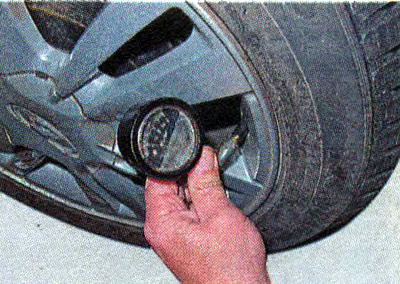
Then you should return the pressure gauge needle to zero by pressing the button and repeat the test.
If the pressure in the wheel tire is higher than normal, it is necessary to bleed the air by drowning the nipple axis with a special spike on the pressure gauge body or with a thin screwdriver blade.
If the tire pressure is lower than required, it must be brought to normal. When pumping, control the pressure according to the pressure gauge of the pump or compressor.
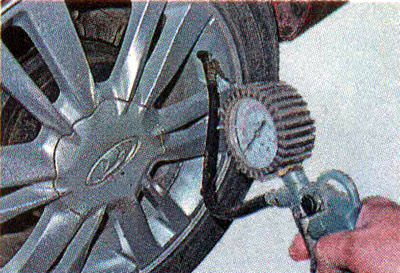
Warning! When inflating, the pressure gauge shows the pressure not in the tire, but in the air supply hose. To determine the true pressure in the tire, it is necessary to interrupt the inflation process.
If the wheel has to be pumped up more than once a week, then a tire puncture, damage to the disc or nipple are very likely. To find out the cause and eliminate it, it is better to contact a tire shop.