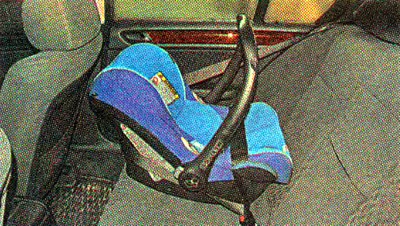
Babies (children weighing up to 10 kg) must be transported on special seats, where the child is in a reclining position facing backwards, because otherwise the cervical vertebrae may be damaged in an accident.
This type of seat must be secured with a diagonal lap belt, so it can only be installed on the back seat from the edge.
Warning! When installing this type of seat on the front passenger seat, on a car equipped with a passenger airbag, you must first deactivate the airbag (if it is provided for by the design of the car), as the airbag may injure the child in the event of an accident.
The switch is installed at the end of the instrument panel on the right side. To disable the front passenger airbag, open the right front door and turn the switch to the OFF position.
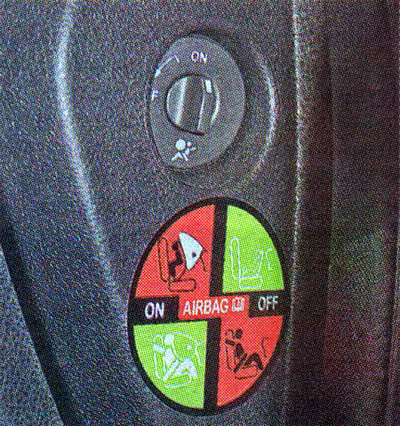
Warning! If the front passenger airbag does not deactivate, a child seat must not be installed in the front seat!
Children weighing from 9 to 18 kg must be transported in special seats in which the child is fastened with special seat belts.
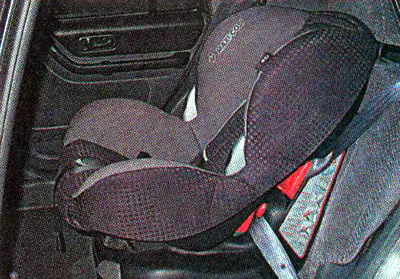
This type of seat can be installed on any seat in the car, since it can be secured both with a diagonal lap seat belt and only with a lap seat. When installing on the front seat in vehicles equipped with a front passenger airbag, the seat must be moved as far back as possible.
Children weighing from 17 to 25 kg and from 22 to 36 kg must be transported on special pillows...
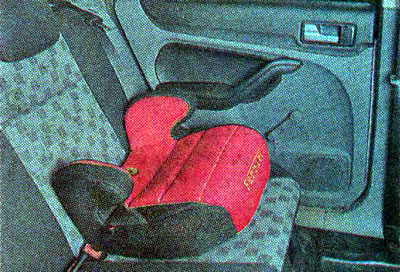
...or in special seats, thanks to which the car's seat belts are in the correct position on the child's body.
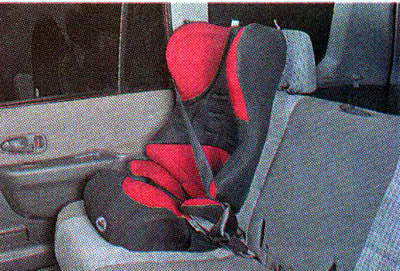
This type of seat can be installed on the front seat and on the rear seat at the edge, as it must be secured with a diagonal lap belt.
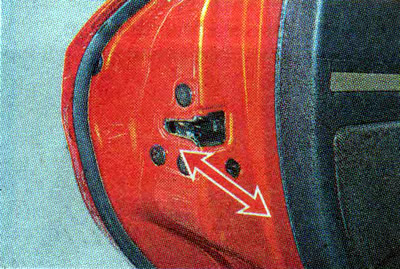
It is better to transport children in the back seat. The rear doors must first be locked so that children cannot open them from the inside. To do this, open the back door and move the lock lever down. To unlock the door lock, move the lever up.