



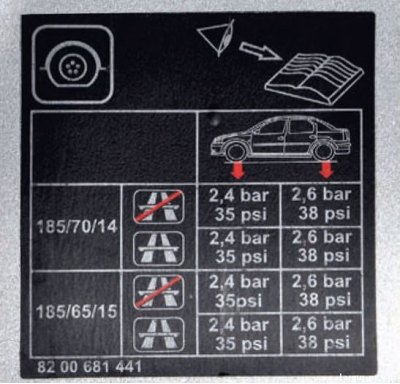
Photo of a plate installed on a Lada Largus
Pressure depending on modification
Modification Air pressure in tires, front/rear, MPa (kgf/cm²) Station wagon (R90) 0.24/0.26 (2.4/2.6) Station wagon (R90) Van (F90) 0.24/0.30 (2.4/3.0) Station wagon "CROSS" package 0.24/0.26 (2.4/2.6)
Proper tire pressure should be maintained especially during heavy or high-speed driving. When operating the vehicle with a full load and a trailer, the air pressure in the tires should be increased by 0.2 bar. Incorrect tire pressure reduces stability, increases rolling resistance and faster wear and even creates an emergency situation.
If you have inflated your tires incorrectly:
- when the pressure is reduced twofold relative to the normal value, the rolling resistance also doubles
- and more than 10% - fuel consumption;
- if the pressure is higher than normal, the braking distance increases,
- tires wear out,
- in addition, they make more noise: they hum if the pressure is low and whistle if it exceeds the correct value;
- and in general, driving becomes more dangerous: the tires can break!
Pound force
In Russia, tire pressure is usually measured in bars or atmospheres.
The unit of measurement psi came from the USA (pound-force per square inch, that is, pound-force per square inch). 1 bar is approximately equal to 1 kgf/cm², or 0.9896 atm, or 14.5 psi. The kilopascal unit is less commonly used:
- 1 kPa = 0.145 psi;
- 1 psi = 6.895 kPa.
How to inflate tires correctly
The required pressure depends on the type and size of the tire, the time of year and the outside temperature, the load on the vehicle, and the type of roads. Not everyone remembers that at negative temperatures the pressure in tires drops by 0.1 bar for every -10°C relative to 0°C, and in hot weather it increases, sometimes up to 1 atm. High-quality modern tires can withstand such overload, but they should not be used constantly in such a mode.
The normal pressure in a passenger car tire is in the range of 2-3 bar.
It is necessary to measure and adjust the tire pressure only when the tires are not warmed up, before driving. And regularly! And if you are going on a long trip, then the procedure becomes mandatory.
Detailed information on exactly how many atmospheres, bars or psi your tires should have can be found in your owner's manual, on the back of the gas cap, in the door opening or in the spare tire well.
About nitrogen pumping
Expensive inflation of tires with nitrogen does not protect against either increase or loss of pressure. Normal air contains about 78% nitrogen, so increasing its content by 20% cannot radically change the properties of tires.