



Only batteries with the same nominal voltage (12V) can be connected. Use jumper cables with insulated clips and cables of the appropriate size. Do not disconnect the battery from the vehicle's electrical system.
Connecting the wires for starting from a jump start source
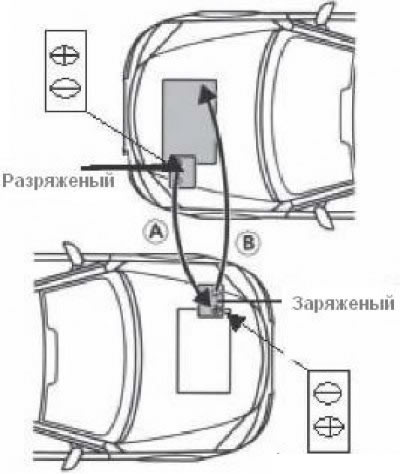
1. Position the vehicles so that they do not touch each other.
2. Stop the engine and turn off all other electrical equipment.
3. Connect the positive (+) terminal of the discharged battery to the positive (+) terminal of the charged battery using wire A.
4. Connect one terminal of wire B to the negative (-) terminal of a charged battery, and then disconnect the other terminal of wire B to a metal part of the engine to start. Install jumper wires so that they do not touch any running engine parts.
5. Make sure that the wires do not become entangled with moving parts of the engine.
The negative (-) terminal of a discharged battery must not be disconnected.
Starting the engine
1. The engine of a vehicle with a charged battery must operate at high speed.
2. Start the engine of the vehicle with the discharged battery. Try to start a vehicle with a dead battery for one minute.
3. Before disconnecting the wires, let the engine of both vehicles run for three minutes.
Disconnecting the jump start wires from the external source
First disconnect the (-) wire, and then the A (+) wire.
To reduce voltage surges during disconnection, please turn off the fan and rear window defroster of the vehicle with a discharged battery. Please do not turn on the headlights instead of the rear window heater, as the power surge may burn out and damage the bulbs.