



 |
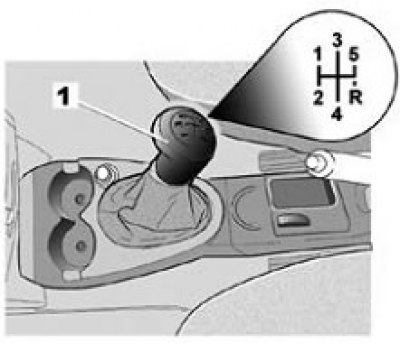 |
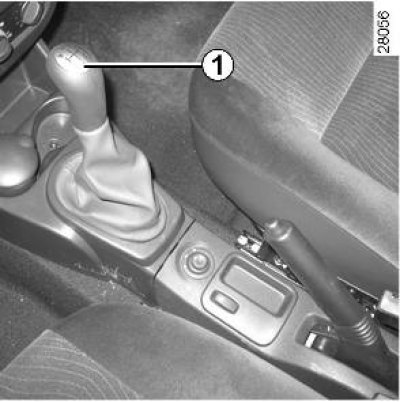
The gear shift pattern is shown on the lever handle: five gears are designated by numbers and reverse is designated by the letter R.
Directions for use and precautions:
- Depress the clutch pedal fully while shifting gears to disengage the transmission input shaft movement, and then operate the gearshift lever. To avoid noise when shifting into reverse gear, wait 3 seconds after fully depressing the clutch pedal when the vehicle is stationary. The engagement of reverse gear will be smoother.
- A lower gear should be used when going downhill or when turning. It is prohibited to move downwards without using the clutch.
- When shifting the transmission to a higher gear, do not skip gears; otherwise, it will affect the service life of the synchronizers.
- When changing gears, the method of abrupt shifting is prohibited (that is, pushing and abruptly releasing). The gear shift lever should be followed by hand to the end, which reduces wear on the synchronizer ring spring lock and reduces wear due to friction.
- Do not place your hand on the gearshift lever while the vehicle is moving. This may cause premature wear of parts or the shift fork.
- If you feel any unusual transmission operation during use, such as unusual sound and obvious difficulties in control, immediately stop the car to check for faults and continue driving after eliminating the problem.
Source link - website: LadaMan
Do not engage reverse gear while moving forward, otherwise it will damage the transmission.
Is it possible to drive with the gear off?
Many driving school instructors teach future drivers to coast, that is, when going downhill, approaching an intersection, etc., to move the gearshift lever to neutral or drive with the clutch pedal depressed. This is done in order to save gasoline, but such savings can lead to a dangerous situation.
A car in neutral is just a cart that rolls by inertia. It can't step on the gas and make a quick spurt if it suddenly needs to make a maneuver. Imagine that the car in front suddenly slows down or, say, a pedestrian runs out onto the roadway. To avoid an obstacle using only the steering wheel, skill and experience are required, and sometimes the width of the road does not allow this at all. Most novice drivers in such a situation instinctively press the brake pedal. And emergency braking, even in summer, on dry asphalt, can be risky, and even more so in winter, on slippery asphalt.
It's good if the car is equipped with ABS, which will prevent the wheels from locking on wet surfaces, ice, or snow slush. Then the car will stop quickly enough and without swerving. If there is no anti-lock braking system, the car will turn into something like a sled that slides uncontrollably along the road. From here to an accident is just one step.
In any case, it is better to make it a rule: "neutral" - only for shifting gears, and not for coasting! Especially in winter! Much more useful (this will not at all hinder owners of cars with ABS) master another technique - engine braking. In its simplest form, this means that, for example, when approaching a traffic light, you brake smoothly without touching the clutch pedal until the last moment. and you put it into neutral only just before you stop, when the engine is already starting to stall. Another way is to first shift into a lower gear (thereby you kind of "slow down" the engine, like a galloping horse), and then brake in the same way as in the first case. True, the car may jerk when switching. To avoid jerking, you need to release the clutch pedal and slightly increase the gas. This technique is more difficult to learn - you need to practice working the pedals.
Before descending a steep hill, it also makes sense to switch to a lower gear, and not touch the brake pedal unless absolutely necessary. The car will smoothly slide down the slope, "braking itself".
By the way, on cars with automatic transmission, engine braking is also possible in lower gears.