



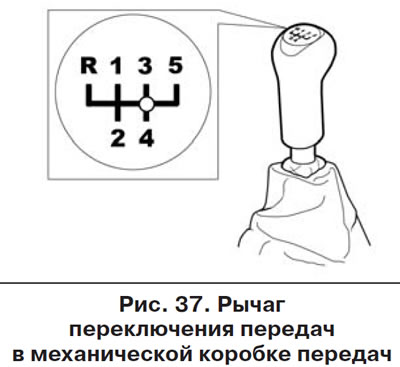
- 1, 2, 3, 4, 5 - first, second, third, fourth, fifth gear.
- R - reverse gear.
 |
 |
Neutral position is between third and fourth gear.
Before starting the engine, make sure the gear shift lever is in neutral position.
The vehicle is equipped with a mechanical lock for the reverse gear selection line. To reverse, stop the car, press the clutch pedal, and pause (not less than 3 seconds), "push" the gear shift lever down until it stops, then move the lever to the left until it stops and move it forward in the direction of the vehicle's movement.
If the transmission fails to engage, return the lever to neutral, release the clutch pedal, then depress the clutch again and try to engage the transmission again.
Pay attention to the complete disengagement of the clutch when changing gears, for which the clutch pedal should be pressed all the way down. Otherwise, it may be difficult to shift gears and wear out the synchronizers.
Engage the forward gears according to the diagram on the handle, without applying excessive force to the gear shift lever, or force that could cause the lever to "sink".
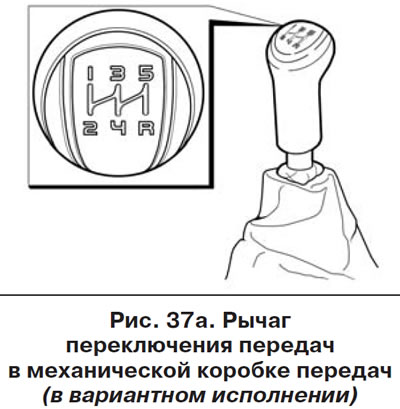
In the variant version, the manual gearbox has a cable control drive, the diagram of which is shown in Figure 37a. To engage reverse gear, move the gear shift lever from the neutral position to the right until it stops and move it back in the direction of the vehicle's movement.
Attention!
- Engage reverse gear only after the vehicle has come to a complete stop.
- Reverse gear is engaged only when the vehicle is stationary and not earlier than three seconds after the clutch pedal is depressed.
- Do not keep your hand on the gear shift lever while driving, as this may cause damage and premature wear of the gear shift parts (do not apply force to the gearshift lever handle).