



Interior ventilation
To provide ventilation of the passenger compartment (supplying unheated air to it) you need to do the following:
- in hot weather, ventilate the interior by opening the windows and doors for a short time;
- handle 4 (see figure 38) set depending on the desired flow direction;
- nozzles 1 and 4 (see figure 39) adjust the direction and strength of the flow (with the handle of switch 2, see figure 38), depending on the desired direction and strength of the flows;
- set the handle 1 of the heater electric fan operating mode switch to the desired air supply speed into the passenger compartment.
Preventing fogging of glass
If the humidity in the car interior or outside is high, for example during heavy rain, or if the air recirculation mode is used for a long time, the interior or exterior surfaces of the car windows may fog up. To prevent fogging of the inner surfaces of the glass, you must do the following:
- handle 3 (see figure 38 and figure 40) move to the extreme left position
 ;
; - handle 4 (see figure 38) set to position
 ;
; - nozzles 1 and 4 (see figure 39) point it at the corresponding side windows in the area of greatest fogging;
- handle 2 (see figure 38) set to the position of supplying the warmest air (red dot) in the cold season (maximum cold air during the warm season, in addition, it is recommended to turn on the air conditioner if available);
- handle 1 (see figure 38) set the speed depending on the degree of fogging of the glass.
Attention! When washing the car, do not turn on the air conditioning fan, which corresponds to the "0" position of the handle 1 (see figure 38).
To prevent fogging of the outer surfaces of the glass, it is necessary to use the glass washing and cleaning system; to clean the remaining glass, you need to park and use a soft cloth to wipe the glass.
Cleaning glass from snow and ice
To quickly clear the windshield and front door windows of snow and ice, we recommend the following:
- use a soft brush to brush snow and ice off the windows and air intake in front of the windshield (it is not recommended to use hard scrapers to clean ice from glass to avoid scratches on the glass);
- handle 2 (see figure 38) set to the position of supplying the warmest air;
- set handle 4 to position ;
- nozzles 1 and 4 (see figure 39) direct it to the corresponding side windows in the area of greatest icing;
- handle 1 (see figure 38) set the air supply speed to maximum.
Quick warm-up of the interior
To quickly warm up the interior, it is recommended to set the ventilation and heating system control unit handles to the following positions:
- handle 2 (see figure 38) set to the position of supplying the warmest air;
- set handle 4 to position
 ;
; - set the handle 1 of the heater fan mode switch to position "3";
- set handle 3 to the extreme right position
 (recirculation mode) for a short warm-up time. If fogging or freezing of the glass occurs, then set the handle 3 to the extreme left position
  (outside air supply).
Interior heating
In order for the temperature in the cabin (when heated air is supplied to it) maintained at the desired level, it is recommended to do the following:
- handle 4 (see figure 38) set the air flow direction to the desired position;
- set handle 1 to position "1" (or a higher position if desired);
- use handle 2 to set the desired temperature in the cabin.
Attention!
- To ensure efficient operation of the heating and ventilation system, regularly clear the fresh air intake openings located in front of the windshield of snow, ice and leaves.
- Do not allow the air humidity in the car to increase due to the evaporation of water and snow from carpets and rubber mats; clean them promptly. Keep your car windows clean, because dirty windows retain more moisture, increasing the time it takes to defrost.
- Do not obstruct the exhaust air outlets in the side trim of the luggage compartment.
- When the heating system is operating at maximum mode, it is not recommended to open windows.
- The trouble-free operation of the heating and ventilation system control is ensured by strict adherence to the stated sequence of switching its handles.
Features of climate control
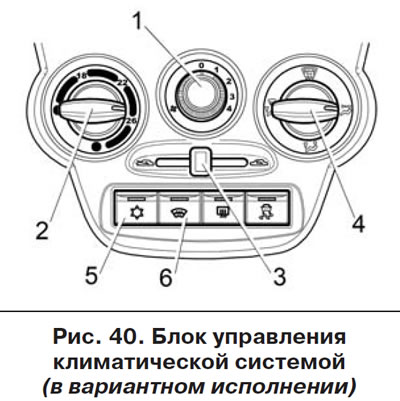
In a variant version (see figure 40) the air conditioning system has an additional air conditioning mode that provides cooling of the air supplied to the vehicle interior. Moreover, the logic and control algorithms described above for the ventilation and heating system are also true for the climate control system with air conditioning.
- 1 - handle for switching the operating modes of the air conditioning system fan.
- 2 - climate control system temperature control knob.
- 3 - recirculation mode control handle.
- 4 - air flow distributor control handle.
- 5 - air conditioning system on/off button.
- 6 - windshield heating on/off button (in a variant design).
Air conditioning mode in the cabin
To turn on the cooling function (air conditioning) with the windows closed:
- 1. Turn on the ignition (start the engine).
- 2. Turn on the fan by setting the handle 1 (see figure 40) in one of the positions "1", "2", "3" or "4".
- 3. Press button 5 of the air conditioner switch with the symbol
 . The control light indicator located on the button will glow green during the entire time the air conditioner is operating.
 - 4. Set the handle 4 with its mark opposite the symbol or in another desired position.
- 5. Set the handle 2 to the position corresponding to the blue zone of the scale depending on the desired degree of air cooling (the temperature will be maintained automatically within the limits of the air conditioning system's performance and the set tolerance).
When the air conditioner is turned on, glass defogging works more effectively, especially when the outside air humidity is high.
When the air conditioner is running, moisture may appear under the engine compartment. This is normal, as the car's air conditioning system removes moisture condensed on the air conditioner evaporator from the passenger compartment.
To turn off the cooling function (air conditioning) press button 5 again, the indicator light will go out.
Attention!
- The air conditioner operates only when the engine is running, when the outside air temperature is not lower than 5°C and when the handle 1 is set to one of the positions "1", "2", "3" or "4" (i.e. when the air conditioning fan is on).
- In position
- When the air conditioner is turned on, the noise inside the cabin may increase; this is due to the start of the air conditioner compressor and the activation of an additional engine cooling fan; when the air conditioning process in the cabin stabilizes, the noise level decreases.
To set the desired air temperature in the cabin, turn knob 2 (see figure 40) clockwise to increase, counterclockwise to decrease. The temperature will be maintained automatically within the capacity of the air conditioning system and the set tolerance.
Features of using the air recirculation mode in the cabin
To speed up the cooling (heating) of the air in the cabin, it is recommended to turn on the recirculation mode for a short time, for which move the handle 3 to the extreme right position
, while the supply of outside air stops and air is taken from the passenger compartment.
Warning! The recirculation mode can only be switched on for a short time, since fresh air does not enter the cabin, and people's breathing will eventually deteriorate the air quality in the cabin. This may cause drowsiness in the driver and passengers.
Economical operation of the air conditioning system
The air conditioning compressor is driven by the car engine, so its operation in air cooling mode affects fuel consumption. To reduce the time of using the air conditioner as much as possible, you should follow these recommendations:
- if the air temperature in the cabin is high, it is necessary to ventilate it before driving by opening the windows or doors for a short time;
- to improve cooling efficiency, always close windows and sunroofs when the cooling function is turned on;
- if a comfortable air temperature inside the car can be achieved without turning on the refrigeration unit, then it is preferable to use the ventilation mode.
Maximum cooling
It is used for maximum intensive cooling of the air in the passenger compartment in hot weather or after long-term storage of the car in the sun:
- 1. Ventilate the interior by opening the windows and doors for a short time.
- 2. Turn the handle 2 (see figure 40) counterclockwise to the left position until it stops (blue dot on the control unit).
- 3. Place handle 4 with its mark opposite the symbol . Nozzles 1 and 4 (see figure 39) instrument panels must be open.
- 4. Handle 1 (see figure 40) turn on the maximum speed of the air conditioning fan (position "4").
- 5. Turn on the air conditioner by pressing button 5 with the symbol . The control light indicator located on the button will glow green during the entire time the air conditioner is operating.
- 6. Turn on the recirculation mode by moving handle 3 to the extreme right position .
When the desired temperature level in the cabin is reached, by turning handles 2 and 1 you can select the optimal comfortable mode in the cabin.
In cooling mode it is not recommended:
- set the air temperature in the cabin with a difference from the outside air temperature of more than 10-12°C, especially during short trips in the urban cycle;
- direct streams of cool air towards the head, onto exposed areas of the body, as this can lead to hypothermia and subsequent illness;
- direct a flow of cooled air onto the windshield, which, due to the large temperature difference, can cause fogging or freezing of the glass.
Attention!
- Turning on the air conditioning system when driving in hilly terrain or under difficult road conditions with a trailer may cause the engine to overheat.
- Watch the coolant temperature indicator. If it indicates that the engine is overheating, turn off the air conditioner. Otherwise, damage or complete failure of the engine is possible.
- Since the air conditioning system compressor is driven by the car engine, slight changes in engine operation are possible when the air conditioner is running (change in idle speed of the engine crankshaft when the air conditioner is turned on/off, decrease in engine power while driving).
Maintenance
To ensure the efficiency of the air conditioning system, it must be turned on for a short time (5-10 minutes) at least once a month (at positive ambient temperature). The refrigeration machine is filled with coolant and is under high pressure. Self-troubleshooting of the system is not permitted. For advice, contact an official dealer or certified PSSS.
Electric heated windshield (EWHS)
In the variant version, the car is equipped with an EOWS system, which is used to quickly remove frost and moisture from the windshield.
To turn on/off the EOVS, press button 6 (see figure 40), when turned on, the indicator on the switch button lights up. The control light indicator located on the switch button will glow yellow during the entire time the electric heating system is operating. The EOS system only functions when the engine is running.
The EOVS system is switched off when one of the following conditions occurs:
- automatically after 6 minutes;
- when the switch button is pressed again while the system is running;
- when the voltage in the on-board network drops below the permissible level;
- when the engine speed drops below the permissible level;
- when the ignition is turned off.
If the ignition was turned off while the EOVS system was on, then the next time the ignition is turned on, the EOVS will not turn on.
If the system does not turn on or turns off automatically before the scheduled time, it is recommended to turn off some other consumers and turn it on again.
The greatest effect is achieved by using the EOWS together with the interior heating and ventilation system set to the mode of cleaning the glass from snow, ice or preventing fogging (see the relevant subsections of the manual).