



The shift actuator is installed in place in place of the standard cable shift mechanism.
A car with AMT transmission does not have a clutch pedal, all processes of clutch operation are automated, provided with electrical signals and are worked out by the clutch actuator.
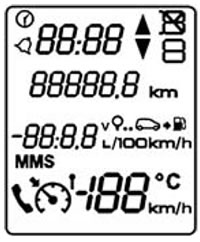
All transmission modes are indicated by letters on the decorative cover of the selector and duplicated in digital form on the electronic display of the instrument cluster:
- Operating mode indication: NRAM.
- Indication of the included transmission of the operating mode: 1 2 3 4 5.
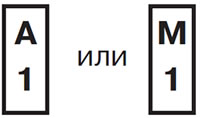
- All modes, except R, are indicated simultaneously with the gear number, for example:
The pedal assembly of a car with an AMT transmission is controlled exclusively by the right foot.
The transmission, in addition to the reverse gear, designated R, has two main driving modes:
- automatic A, in which, depending on the speed of the engine revolutions and other parameters, a fully automatic gear change is carried out without the participation of the driver;
- manual mode M is carried out by the driver by lightly touching the selector contacts in the positions:
- «+» - upshift,
- «-» - downshifting.
The selector control is easy, with fixed positions of the modes, except for touches on up or down gears in M mode (+ and -).
The engine can only be started in neutral position N and with the brake pedal depressed. This is a safety requirement and in any other position of the selector the engine will not start.
When the ignition key is turned, the engine start may be delayed by 2-3 seconds, this is due to the initialization of the transmission control system.
Movement is possible after the selector is moved to position A or M with the brake pedal depressed. When you press the accelerator pedal, the clutch engages and the vehicle starts moving. If the accelerator pedal is not depressed, the vehicle will not move, but can roll freely, despite the selected drive mode and the selected gear. The AMT transmission does not have a creep mode by design.
If, after starting the engine, move the selector to position M, 1st gear will be engaged. Then you can shift gears in manual mode. Upshifting in M mode in normal operating modes is carried out only by the driver in sequence 1-2-3-4-5 and vice versa.
Be careful, when starting off and driving in first gear, you can reach the maximum engine speed, this is done specifically for the purpose of driving up steep and long climbs using only first gear. When the maximum engine speed is reached in second and all other gears, the system will shift to an overdrive gear in order to prevent engine damage. Downshifting at speed reduction is carried out automatically depending on the reduction in speed. The M mode allows for combined braking of the car with a service brake and the engine by successively shifting gears to lower ones.
In all driving modes, delays are felt due to the operation of the gearbox synchronization system during the shift process. Mode A is tuned for the most comfortable driving style, and delays are slightly longer than in M mode.
Mode A and M has a sharp kick-down acceleration function, it is activated depending on the intensity of pressing the accelerator pedal, in mode M it is slower.
In motion, it is possible to move the selector lever from position A to position M and vice versa. If you want to select an independent shift mode or when driving in mode A, you must first change to a lower gear (e.g. when overtaking into the oncoming lane), you can turn on mode M, make a maneuver and then return back to mode A, while the system will turn on the gear corresponding to the speed. A similar change in driving mode from A to M can be carried out when driving on long uphill climbs.
When shifting the lever from position A to position R while driving, the system will block reverse gear. In this case, the mode symbol indicator R will flash, indicating to the driver that this changeover is not possible.
In order to exclude cases of transmission breakdown, the system in all cases will not allow switching on a gear that does not correspond to the speed.
If it is necessary to rock the car, for example, when slipping, it is possible to switch modes R - A and vice versa through N, but without delay in N and without pressing the brake pedal, provided that the speed does not exceed 3 km / h. At speeds above 3 km/h, switching from A to R or from R to A is only possible when the brake is applied. In some cases, it is necessary to wait 8 seconds to successfully engage the reverse gear. for the system to successfully work out the function of ensuring the inclusion of reverse gear.
You can turn off the ignition in any position of the selector. At the same time, in position N, the car can roll and can be towed; in other positions of the selector, the car will remain in the selected mode (R - in reverse gear, A and M - in first gear) and the clutch is closed. In any case, depending on the slope, it is necessary to ensure that the vehicle is prevented from rolling by the handbrake.
When entering steep hills at low speed (such as parking decks) It should be noted that when the engine speed drops below the minimum (650 min-1) The clutch will disengage automatically to avoid stopping the engine. On a slope, this can cause the vehicle to roll down. In this case, it is necessary to ensure movement with engine speed exceeding the minimum.
With a discharged battery, starting the engine from the wheels by towing is possible. This requires accelerating the vehicle in neutral N to a speed above 7 km/h, only then shifting the selector to position A. The transmission controller will register the speed and activate the wheel start function.
Turning on the indicator «gear» in the instrument cluster indicates a transmission failure. In this case, it is necessary to diagnose the AMT system with specialized diagnostic equipment. Switching at the same time can be uncomfortable, very slow or abrupt.
When the clutch is overheated, the indicator «gear» works in a flashing mode and additionally the clutch pulsates during starting to warn the driver. In this case, after the clutch has cooled down, the lamp will turn off when the engine is restarted. If this does not happen, it is also necessary to diagnose the AMT system with specialized diagnostic equipment.