



In terms of its design, the adjustments provided, and fuel consumption, your vehicle fully complies with environmental protection standards. However, technology is not omnipotent. Fuel consumption and exhaust gas toxicity levels depend to a large extent on you. Follow the recommendations for car maintenance, driving and operation.
Maintenance
The content of pollutants in the exhaust gases must comply with the current exhaust gas toxicity standards; responsibility for the vehicle's non-compliance with the specified standards lies with its owner. In addition, if engine, fuel system or exhaust system parts are replaced with non-original parts, your vehicle may no longer comply with current emission standards.
All checks and adjustments of your vehicle in accordance with the recommendations set out in the Service Book in the maintenance section must be carried out at the manufacturer's service station.
The service station has all the necessary equipment to perform the necessary adjustments for your car.
Engine adjustments
- - ignition system: does not require adjustment during operation.
- - spark plugs: normal and reliable operation of the engine in the full range of developed power with high efficiency and low toxicity of exhaust gases requires strict compliance with the requirements established by the technical departments of the manufacturer. When replacing spark plugs, use only those spark plugs that are suitable for your vehicle's engine. Contact the manufacturer's representative immediately.
- - idle speed: does not require adjustment during operation.
- - air filter, fuel filter: dirty filter elements reduce engine power. Such filter elements are subject to replacement.
Exhaust gas monitoring
The exhaust gas monitoring system allows you to detect malfunctions of the vehicle's exhaust gas cleaning device.
These faults may cause the release of toxic substances or mechanical damage.
 - The warning light on the instrument panel indicates possible system malfunctions:
It lights up when the ignition is turned on and goes out after three seconds.
- - If the lamp is constantly on, contact the manufacturer's service station immediately.
- - If the lamp is flashing, reduce the engine speed until the flashing stops. Contact the manufacturer's service station immediately.
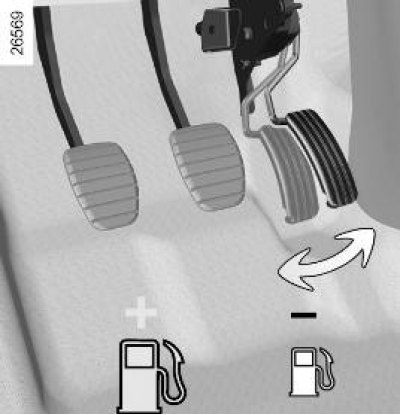
Driving
Driving carefully at low speed until the engine is fully warmed up is preferable to warming up the engine at idle while parked.
Speed is an expensive pleasure.
"Sporty" driving style is expensive - give preference to "smooth" driving style.
Brake as little as possible, try to assess the situation on the road in advance (obstacle or turn), and you will only need to take your foot off the accelerator pedal.
Don't accelerate too hard.
Do not press the accelerator pedal hard while driving in intermediate gears. Try to use the highest gear possible, but do not overload the engine.
When driving on hills, do not try to maintain the same speed; do not press the accelerator pedal more than you would when driving on a level section of the road: keep your foot on the accelerator pedal in the same position.
Double disengaging the clutch and "revving" when changing gears before stopping the engine is completely unnecessary on modern cars.
Driving in bad weather and on a road flooded with water

Do not drive on a flooded road if the water level is higher than the bottom of your wheels.
If you need to ford any section, you must drive carefully and slowly, especially if you are unfamiliar with the surface of the water bottom. If the water depth is so great that the hub is submerged, forward movement is prohibited.
When fording, both the traction force with the ground surface and the performance of the brakes are reduced.
Water entering the engine air vent tube will cause serious damage to the engine. If you dive deep while wading, water enters the transmission system through the transmission air hole, which can cause serious damage to the transmission system.
After completing the fording movement, it is necessary to drive slowly and smoothly shift gears; in this case, it is necessary to press the brake pedal several times to remove water from the brake system.
Operating tips
Electricity consumption increases fuel consumption, so always turn off unnecessary electrical appliances.
However, first of all for your safety, in poor visibility, turn on external lighting devices, follow the rule "see and be seen".
Parking
Do not park your vehicle in areas near dry leaves or grass. Even when the vehicle is stationary, there is a potential fire hazard as the exhaust pipe continues to generate heat for some time.
Before leaving the vehicle, turn off the ignition. Do not allow the engine to run when no one is inside. If you ignore this warning, your vehicle may move unexpectedly, causing injury to people or damage to property.