



The main thing to remember is that in any case, remain calm and do not take rash actions, as this can lead to extremely serious consequences!
Car malfunction
If the engine control system malfunction indicator light comes on while driving, continue driving calmly without exposing the power unit to excessive load. Choose the optimal driving speed and avoid sudden accelerations and decelerations. If there are significant changes in the damage to the car (for example, engine power has dropped), turn on the hazard warning lights and proceed with caution to the place of repair. At the earliest opportunity, visit a service station to diagnose and identify the cause of the malfunction.
If the vehicle stalls while driving, turn on the hazard warning lights, shift into neutral and bring the vehicle to a gentle stop. If possible, change lanes and stop on the side of the road. Try restarting the engine. If the engine does not start, you must first try to remove the car from the roadway so as not to interfere with other road users. If this fails, put up an emergency stop sign in accordance with the Rules of the Road (15 m from the car in the built-up area or 30 m outside the built-up area). After that, you should try to find out the cause of the malfunction (see «Possible car malfunctions and their causes») and fix it yourself. If the problem cannot be repaired locally, have the vehicle towed to the nearest service station (see «Car towing»).
Engine overheating
It is forbidden to operate the engine with an excess of the operating temperature of the coolant. If it so happened that the car engine began to heat up excessively, the coolant temperature indicator scale is completely filled (see «Information display») or the engine overheating warning lamp lights up, you cannot immediately stop the engine and, moreover, cool it with improvised means. To begin with, stop the car on the side of the road, observing all safety precautions. Turn on the air conditioner in the maximum interior heating mode (set the temperature controller to maximum, the air conditioner fan to maximum speed, the recirculation mode and the air conditioner must be turned off).
Warning! When the engine overheats, be careful when opening the hood if steam comes out from under it. Do not unscrew the cap of the expansion tank of the cooling system. The heated fluid is under pressure and you may be burned.
Let the engine idle and open the hood. If you find a break in any hose and a coolant leak, the engine must be turned off. Also check if the engine cooling fan is running. If the fan is not working, then this is most likely the cause of the overheating (see «Cooling system - checking the technical condition»). If the coolant temperature does not drop at idle, stop the engine. Wait for it to cool down a bit and check the condition of the cooling system (see «Cooling system - checking the technical condition»). Eliminate the found faults. If the problem cannot be repaired on site, have the vehicle towed to the nearest service station (see «Car towing») or drive to it, covering a short distance at a time to prevent the engine from overheating. The first option is preferable.
Brake system failure
This is one of the most terrible malfunctions, however, by remaining calm, even in this case, serious consequences can be avoided. To stop the car, use engine braking, while trying in every possible way to attract the attention of other drivers (use an audible signal, flashing headlights and other available means). Try «pump up» brakes by depressing and releasing the pedal. You can also try to stop the car with the parking brake, but at the same time hold the release button so that you can quickly lower the lever without allowing the wheels to lock.
Steering failure
Another terrible bug. In this situation, the main thing is not to slow down sharply. When braking hard, the vehicle may veer sharply to one side. Brake as smoothly as possible and turn the steering wheel to try to regain control of the car. It is likely that the steering wheel will still affect the steered wheels, but when turning at large angles.
Traffic accident
Regardless of who is responsible for the accident, stop immediately, turn on the hazard warning lights, set the emergency stop sign in accordance with the requirements of the Rules of the Road (15 m from the car in the built-up area or 30 m outside the built-up area) and call the traffic police. To call you will need to specify the name of the road, the kilometer on which the accident occurred. If there is a stationary post in sight, address it.
Warning! On busy roads (highway, motorway) the arrival of inspectors should not be expected in a car, but on the side of the road or next to the road, since other road users can run over already parked cars.
The vehicle is equipped with a telecommunications system «ERA GLONASS». In the event of an emergency, the system allows you to contact the system operator on duty.
The system controls are located in the interior dome light housing.
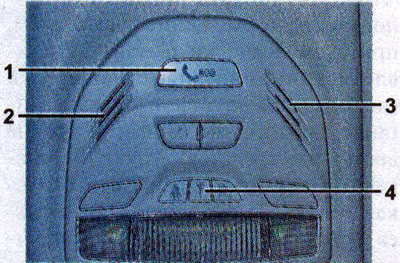
System controls «ERA GLONASS»: 1 - system operator call button «ERA GLONASS»; 2 - microphone; 3 - speaker; 4 - indicator (control lamp) system status «ERA GLONASS»
The system is equipped with an independent power source - a battery installed in the control unit. This allows the system to work autonomously for some time, in the event of a car battery failure.
By the color of the indicator you can judge the state of the system «ERA GLONASS»:
- Y - indicates the impossibility of establishing communication with the system operator. If, at the same time, it flashes, then there is a malfunction in the system;
- Y - Unable to determine the location of the vehicle. If, at the same time, it starts flashing, the built-in battery is defective.
- Y - all possible operating modes of the system are available. The indicator will flash immediately after power on and in the system self-diagnostic mode.
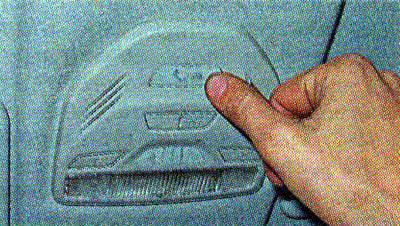
To contact the operator, briefly press the SOS button. When an operator is called, the symbols on the button will glow red. To cancel the call, press the SOS button again.
In addition, the system can work in automatic mode in this case, in case of a traffic accident, when the airbags were deployed, the system sends information to the operator, time and coordinates of the scene of the accident, the VIN of the car, the mode of movement of the car before the accident.