



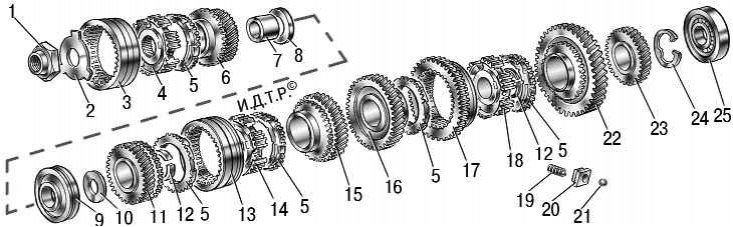
Figure 6.8. Secondary shaft parts: 1 – nut; 2 – thrust plate; 3 – sliding clutch of the 5th gear synchronizer; 4 – sliding clutch hub; 5 – synchronizer locking ring; 6 – V gear; 7 – gear sleeve; 8 – thrust washer; 9 – ball bearing; 10 – thrust washer; 11 – 4th gear pinion; 12 – synchronizer hub retaining ring; 13 – sliding clutch of synchronizer III and IV gears; 14 – sliding clutch hub; 15 – third gear pinion; 16 – 2nd gear pinion; 17 – sliding clutch of synchronizer of 1st and 2nd gears with reverse gear ring gear; 18 – hub of the sliding clutch of the synchronizer of the 1st and 2nd gears; 19 – synchronizer spring; 20 – rusk; 21 – retainer; 22 – 1st gear pinion; 23 – main gear drive pinion; 24 – retaining ring; 25 – cylindrical roller bearing
The secondary shaft parts are shown in the figure 6.8.
You will need: two large flat-blade screwdrivers, a hammer, a soft metal punch, and a set of flat feeler gauges.
1. Remove the secondary shaft from the gearbox (see "Disassembling the gearbox and inspecting its parts").
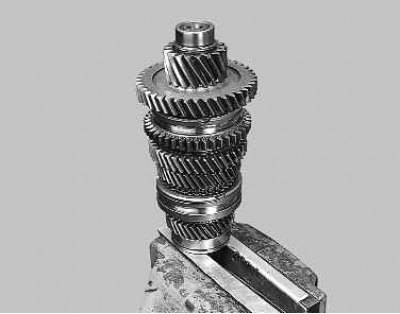
2. Clamp the shaft in a vice with soft metal jaws using light force.
Attention! The secondary shaft must be clamped in a vice with soft pads on the jaws by the inner ring of the front bearing. Tighten the vice so that the shaft can be tilted by hand, otherwise the bearing race surface may be damaged.
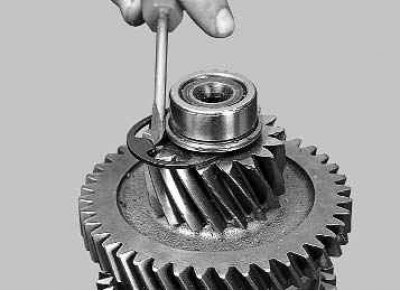
3. Remove the retaining ring from the front end of the shaft, located under the inner ring of the front bearing.
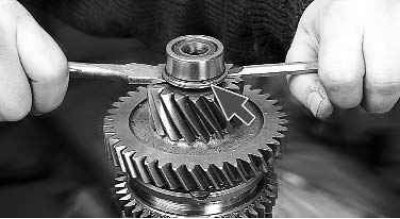
4. Using two screwdrivers, press the inner race of the front bearing off the shaft. The flange of the ring is directed towards the drive gear of the main transmission.
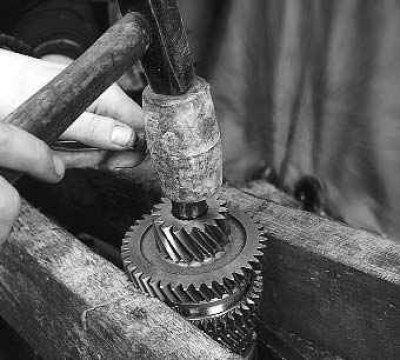
5. Having released the vice, rest the 1st gear on two supports. Using a hammer blow through a wooden block, press the 1st gear pinion off the shaft from the main gear pinion.
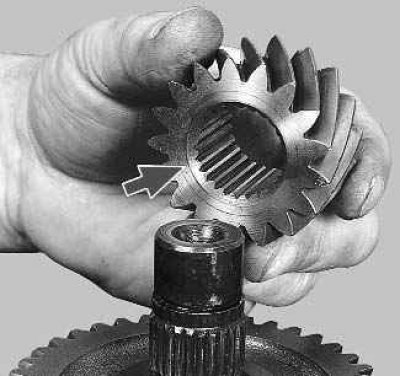
6. Remove the main gear drive pinion from the shaft. Note that the chamfer on the inner diameter of the gear is directed towards the 1st gear gear.
7. Remove the 1st gear pinion from the shaft. The cone on the pinion is directed towards the synchronizer.
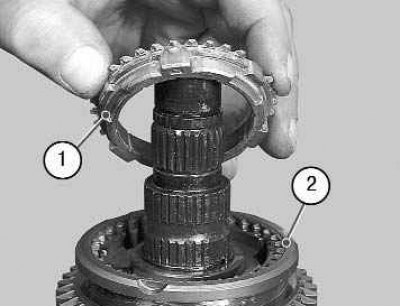
8. Mark the locking ring 1 relative to the coupling 2. During operation, the teeth of the ring become accustomed to the teeth of the coupling, therefore, during assembly, the ring must be installed in the same position. Remove the 1st gear synchronizer locking ring.
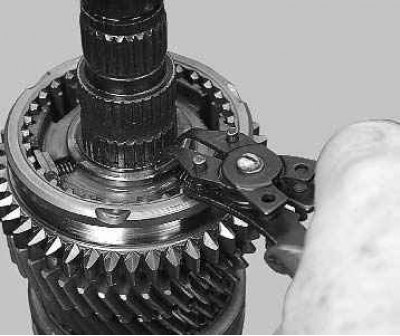
9. Clamp the shaft in a vice again and remove the synchronizer hub retaining ring.
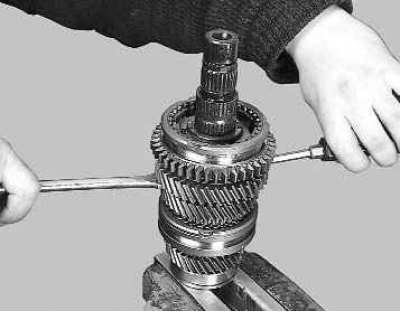
10. Using two large screwdrivers, apply force to the 2nd gear pinion and press the 1st and 2nd gear synchronizer off the shaft splines.
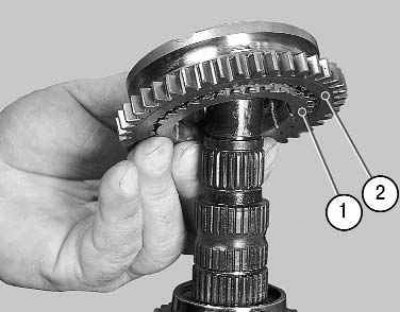
11. Remove the synchronizer with the 1st gear locking ring and mark ring 1 relative to the synchronizer clutch 2.
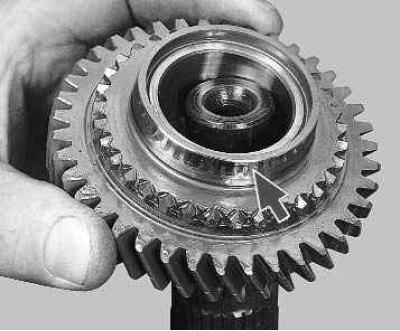
12. Remove the 2nd gear from the shaft. Note that the cone on the gear is facing the synchronizer.
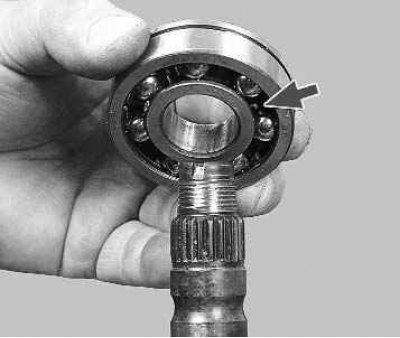
13. Turn the shaft over and use two large screwdrivers to press the rear bearing off the shaft. In this case, the open side of the bearing faces the fourth gear pinion.
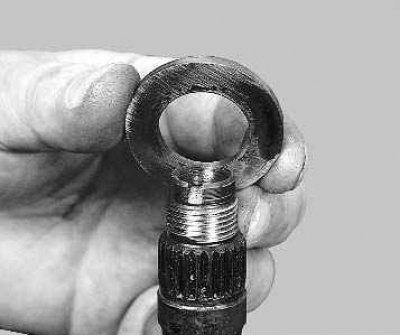
14. Remove the thrust washer.
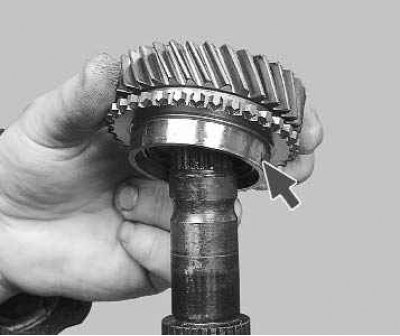
15. Remove the 4th gear pinion. Note that the cone on the pinion is directed towards the synchronizer.
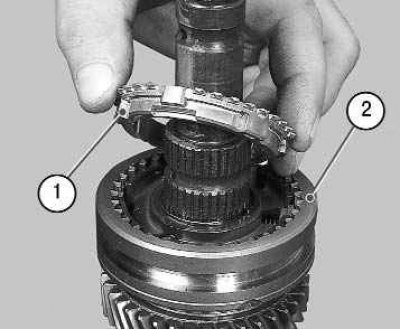
16. Mark the locking ring 1 relative to the synchronizer sleeve 2. Remove the IV gear synchronizer locking ring.
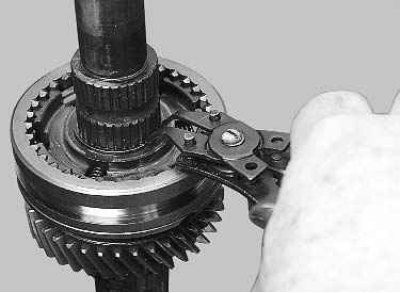
17. Remove the synchronizer hub retaining ring.
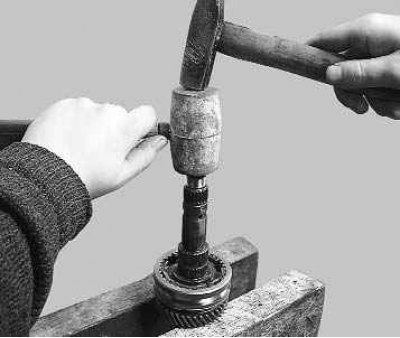
18. Having released the vice, rest the third gear pinion on two supports and using hammer blows through a soft pad, press the synchronizer of third and fourth gears off the shaft splines.
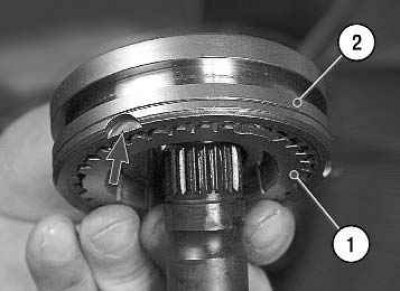
19. Remove the synchronizer with the 3rd gear locking ring and mark ring 1 relative to the synchronizer clutch 2. Please note that the groove on the coupling is directed towards the third gear pinion.
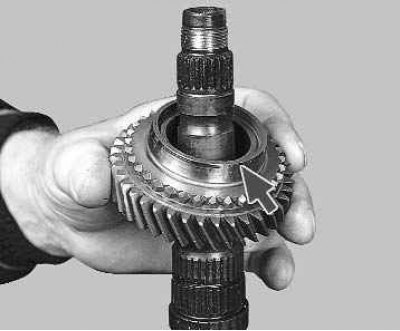
20. Remove the 3rd gear pinion. Note that the cone on the pinion is directed towards the synchronizer.
21. Thoroughly clean, rinse and dry the secondary shaft parts.
22. Check the condition of the shaft. If there is pitting (cavities) on the bearing journals or signs of wear, the shaft must be replaced.
23. Check the condition of the gears. If there are chips or chipping of teeth, scoring in internal holes or signs of wear on the working surfaces of the teeth, replace the gears. If there is significant crushing or chipping on the ends of the spline teeth, the gears must also be replaced.
24. Check the ease of rotation of the bearing. If the raceways or balls are damaged and if play is detected in the bearing (the radial clearance in the bearing should not exceed 0.04 mm) replace the bearing.
25. Check the condition of the synchronizer locking rings. If there are nicks and chips on the gear rims or significant wear on the cones, replace the blocking rings.
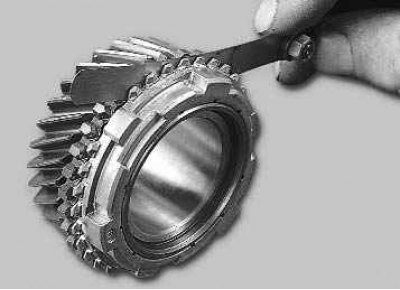
26. Check the clearance between the gears and the corresponding locking rings. To do this, tightly install the locking ring on the cone of the corresponding gear, i.e. "grind" it to the cone by turning it several times, and measure the gap with a flat feeler gauge. The minimum allowable gap is 0.6 mm. If it is less, the locking ring must be replaced.
Note: When replacing the locking ring, also check the clearance between the new ring and the gear. To do this, put the ring on the gear cone and rock it; play is unacceptable.
27. If scoring or deformation is detected on the thrust rings, or if the retaining rings lose elasticity, replace them.

28. Before assembly, clean the secondary shaft oil passages.
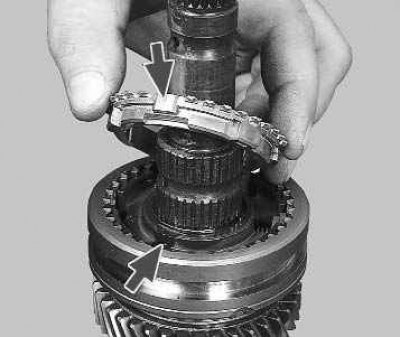
29. Assemble the secondary shaft in the reverse order of removal. In this case, install the old blocking rings in accordance with the previously made marks. Install the new rings so that the small protrusions on the ring (missing teeth) coincided with the grooves of the synchronizer hub where the locks are installed.
30. Press the rear shaft bearing in using a suitable mandrel, applying force only to the inner ring of the bearing.
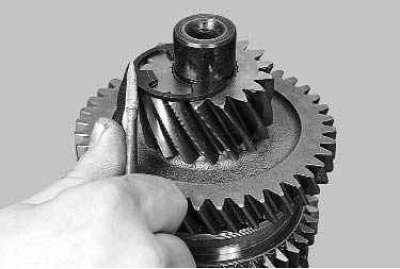
31. Before installing the front bearing inner race, first install the retaining ring and only then press the bearing inner race using a suitable mandrel until it rests against the retaining ring.
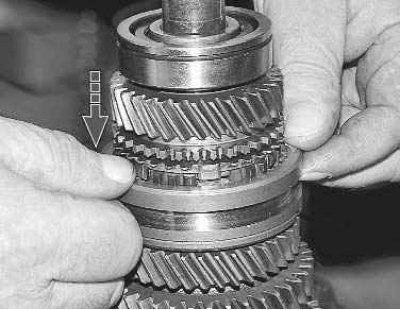
32. After assembly, check the operation of the synchronizers. To do this, manually move the synchronizer clutches to the position of engaging the corresponding gears.