



Primary shaft 29 (figure 6.4) is made in the form of a block of drive gears, which are in constant engagement with the driven gears of all forward gears. Secondary shaft 25 is hollow, with a removable drive gear 3 of the main transmission. On the secondary shaft there are driven gears 16, 18, 19, 21, 23 and synchronizers 17, 20, 24 of the forward gears. Front bearings 4, 31 shafts are roller bearings, rear bearings 22, 28 are ball bearings. Under the front bearing of the secondary shaft there is an oil collector 5, which directs the flow of oil into the secondary shaft and further under the driven gears.
The differential is symmetrical with 8 gears and two 10 bevel-shaped satellites. The preload in the differential bearings is adjusted by selecting the thickness of ring 13. The driven gear 12 of the main gear is attached to the flange of the differential box.
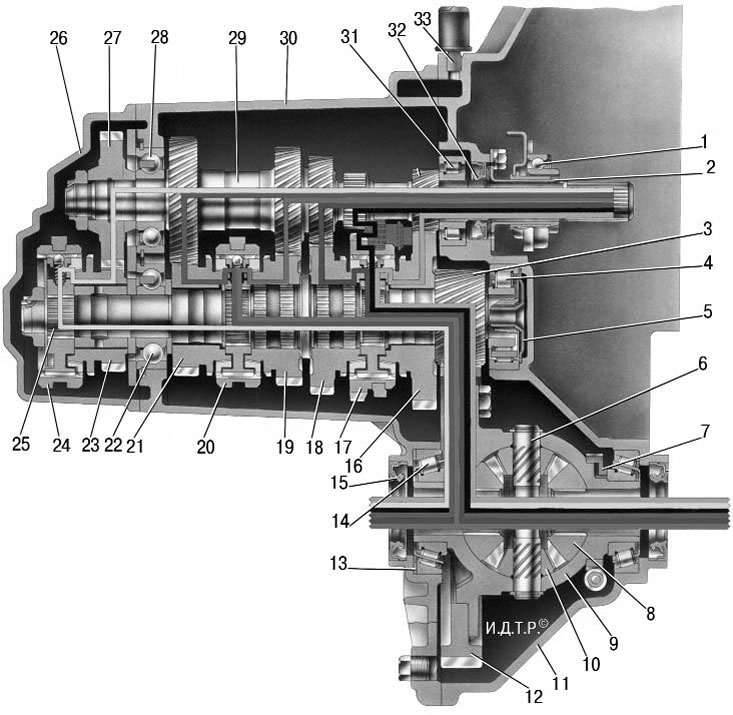
Figure 6.4. Gearbox: 1 – clutch release bearing; 2 – guide sleeve of the clutch release bearing; 3 – main gear drive pinion; 4 – secondary shaft roller bearing; 5 – oil sump; 6 – satellite axis; 7 – speedometer drive pinion; 8 – axle shaft gear; 9 – differential box; 10 – satellite; 11 – clutch housing; 12 – driven gear of the main transmission; 13 – adjusting ring; 14 – differential tapered roller bearing; 15 – axle shaft seal; 16 – driven gear of the 1st gear of the secondary shaft; 17 – synchronizer of 1st and 2nd gears; 18 – driven gear of the 2nd gear of the secondary shaft; 19 – driven gear of the 3rd gear of the secondary shaft; 20 – synchronizer of III and IV gears; 21 – driven gear of the IV gear of the secondary shaft; 22 – secondary shaft ball bearing; 23 – driven gear of the V gear of the secondary shaft; 24 – V gear synchronizer; 25 – secondary shaft; 26 – rear cover of the gearbox housing; 27 – V-gear drive gear; 28 – primary shaft ball bearing; 29 – primary shaft; 30 – gearbox housing; 31 – primary shaft roller bearing; 32 – primary shaft seal; 33 – breather
Gear shift drive consists of a lever 15 (figure 6.5) gear shift, ball joint 17, rod 14, gear selection rod 5, gear selection and shift mechanisms.
In order to prevent spontaneous disengagement of gears due to axial movement of the power unit on its supports when the vehicle is moving, a reactive thrust 18 is introduced into the gearbox control drive, one end of which is connected to the power unit, and a collar 16 of the ball joint of the gear shift lever 15 is attached to the other end.
At the inner end of rod 5, lever 1 is fixed, which acts on the three-arm lever 2 of the gear selection mechanism. This mechanism is made as a separate unit and is attached to the plane of the clutch housing.
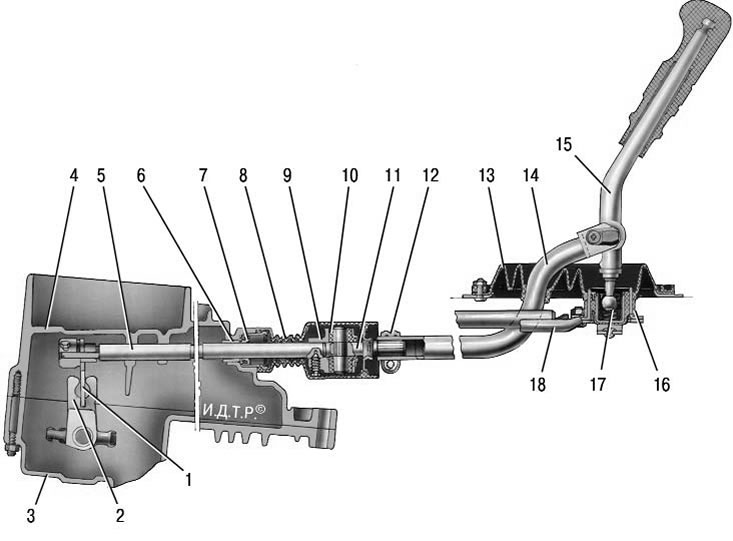
Figure 6.5. Gear shift drive: 1 – gear selection rod lever; 2 – gear selection lever; 3 – gearbox housing; 4 – clutch housing; 5 – gear selection rod; 6 – rod bushing; 7 – rod seal; 8 – protective cover; 9 – hinge body; 10 – hinge bushing; 11 – hinge tip; 12 – clamp; 13 – protective cover of the traction; 14 – gearbox control drive rod; 15 – gear shift lever; 16 – ball joint cage; 17 – gear shift lever ball joint; 18 – jet thrust
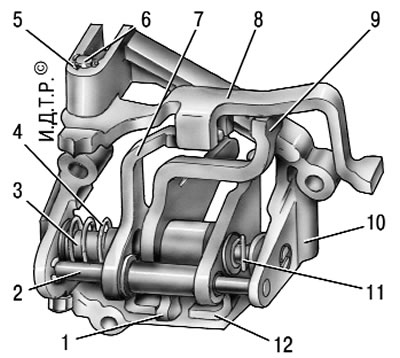
Figure 6.6. Gear selection mechanism: 1 – gear selection lever (forward running); 2 – guide axis of the locking brackets; 3 – gear selector lever axis; 4, 11 – springs; 5 – retaining ring; 6 – reverse fork axle; 7, 12 – locking brackets; 8 – reverse gear fork; 9 – gear selection lever (reverse); 10 – gear selection mechanism housing
In building 10 (figure 6.6) two axles are attached to the gear selection mechanism. A three-arm gear selector lever and two locking brackets 7 and 12 are installed on axis 3. The other axis 2 passes through the holes of the locking brackets, fixing them from turning. The arm of the gear selection lever 1 is used to engage forward gears, the arm of the lever 9 is used to engage reverse gear, and the third arm is acted upon by the gear selection rod lever. On axis 6, a fork 8 for engaging reverse gear is installed.
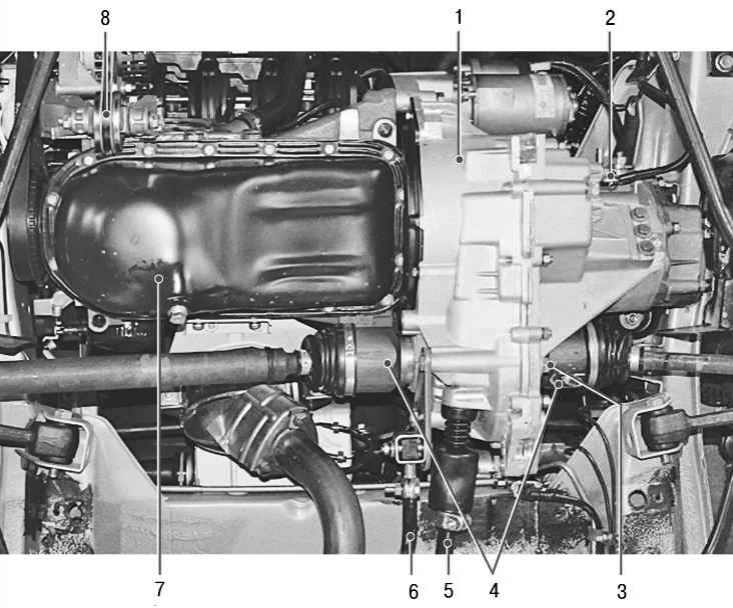
Figure 6.7. Location of the gearbox on the vehicle (bottom view): 1 – gearbox; 2 – Reverse light switch; 3 – plug of the hole for draining oil from the gearbox; 4 – internal constant velocity joints; 5 – gear shift drive rod; 6 – gear shift drive reaction rod; 7 – engine; 8 – right support of the power unit
The location of the gearbox on the car is shown in the figure 6.7.
Oil is poured into the gearbox, the level of which should be between the control marks of the oil level indicator.
Note: When filling the box, try to pour a little more oil into it (approximately 100 ml), than recommended by the manufacturer. This measure will ensure better operating conditions for the bearing of the 5th gear pinion, located high in the crankcase and lubricated only by splashing.