



Note: Check the condition of the working surfaces of the brake disc without removing it from the vehicle.
You will need: a wheel bolt wrench, a screwdriver, and a caliper.
1. Remove the wheel.
2. Clean the brake disc.
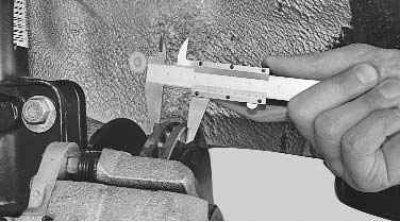
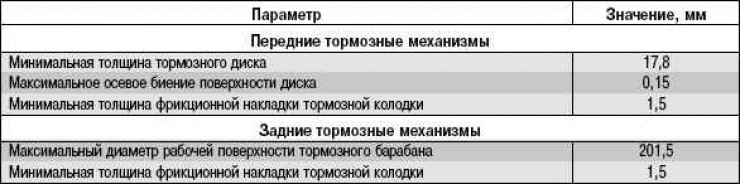
3. Measure the thickness of the disc with a caliper. The minimum permissible disc thickness is 17.8 mm (Table 4.2). If the disc thickness is less, replace it (see "Removing and installing the front wheel brake disc").
Table 4.2. Maximum permissible dimensions of brake pads, discs and drums
Note: We recommend replacing the brake discs on both sides at the same time.
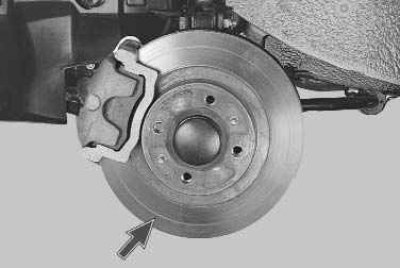
4. Inspect the disc. If there are scratches, the disc can be removed and ground, but it must be ensured that its final thickness is not less than the permissible value.
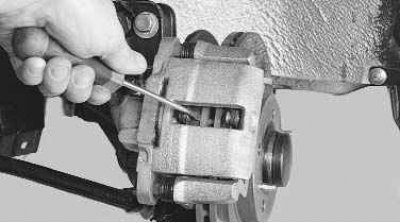
5. Use a screwdriver to check the ease of movement of the pads in the caliper. Make sure they do not pinch the brake disc.
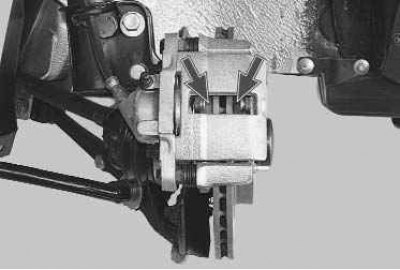
6. Check the condition of the brake pads through the hole in the brake caliper housing. If the thickness of the friction linings is less than the permissible value (see table 4.2), replace the brake pads (see "Replacing the brake pads of the front wheel brake mechanism").
Original text on the website: LadaMan.ru
Note: If the lining wear is uneven or the linings of one brake mechanism wear unevenly, replace the entire caliper assembly or the wheel cylinders (see "Removing and installing the front brake master cylinder").
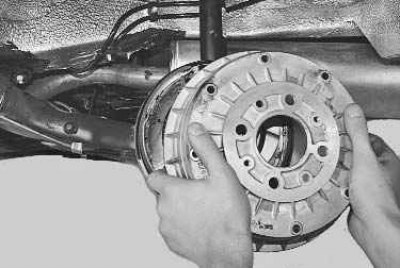
7. To check the degree of wear of the rear brake pads, remove the wheel and brake drum (see "Removing and installing the rear wheel brake drum").
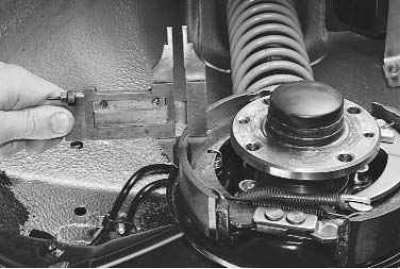
8. Measure the thickness of the friction linings with a caliper or ruler.
Recommendations
Replace the pads in the following cases:
- the thickness of the pads is less than 1.5 mm;
- the surface of the linings is oily;
- the pads are not firmly connected to the base.
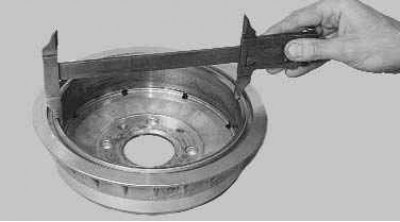
9. Measure the diameter of the working surface of the brake drum. If it is more than acceptable (see table 4.2), replace the drum (see "Removing and installing the rear wheel brake drum").