



Note. Carry out all checks and work from below the vehicle mounted on a lift or inspection ditch (with hanging front wheels).
Check the condition of rubber-metal joints, rubber pads, suspension ball joints and condition (draft) upper supports of telescopic suspension struts.
Attention! Especially carefully check for cracks on the suspension parts or traces of rubbing against road obstacles or the body, deformation of the levers, stretch marks, stabilizer bar and its struts, parts of the front end of the body at the attachment points of the suspension units and parts.
Rubber-metal hinges and rubber pads must be replaced in case of ruptures and one-sided buckling of rubber, as well as when cutting their end surfaces.
On rubber suspension parts are not allowed:
- signs of rubber aging;
- mechanical damage.
On rubber-metal hinges (silent blocks) not allowed:
- signs of aging, cracks, one-sided bulging of the rubber mass;
- separation of the rubber mass from the reinforcement.
Replace defective parts.
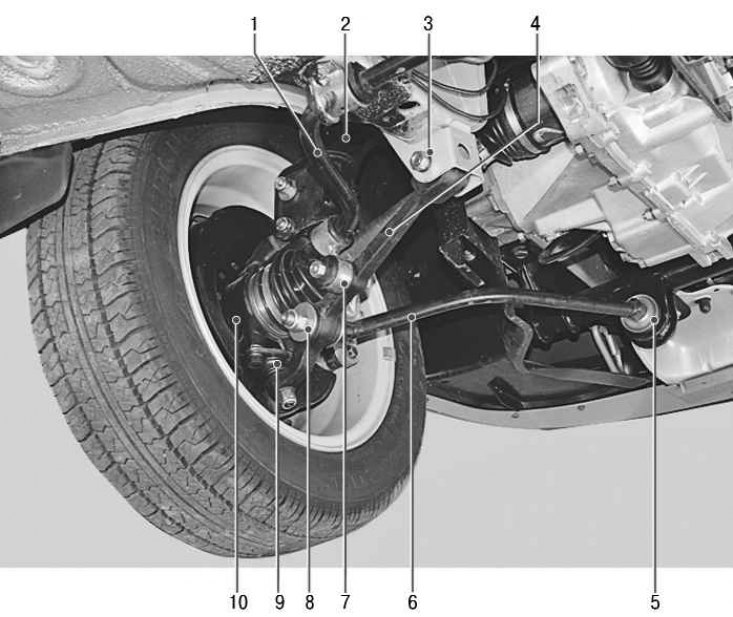
Pic. 4.2. Front suspension details: 1 – a bar of the stabilizer of cross stability; 2 - telescopic stand; 3 – lower arm hinge; 4 - the lower arm of the front suspension; 5 - front extension hinge; 6 - stretching the lower arm; 7 – a rack of the stabilizer of cross stability; 8 - rear extension hinge; 9 - ball bearing of the lever; 10 - steering knuckle
The location of the checked elements of the front suspension is shown in fig. 4.2.
Note. When shaking the posted front wheel, it is difficult to distinguish play in the hub bearings and in the ball bearings. Ask an assistant to press the brake pedal and, if in this case you feel play, the ball joints are faulty.
Inspect the following key locations on the underside of the vehicle.
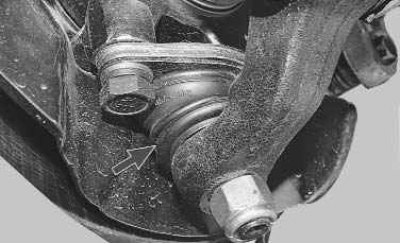
1. Protective covers of ball bearings.
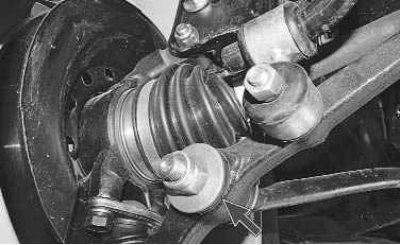
2. Rubber-metal hinges of the extension of the lower arms rear..
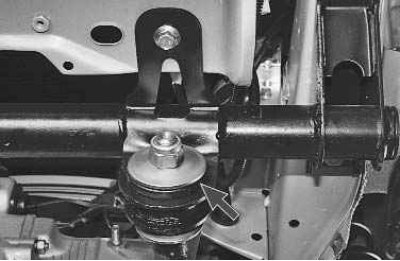
3.... and front.
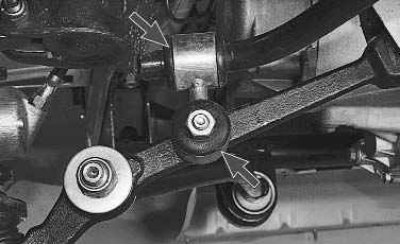
4. Rubber-metal hinges of the anti-roll bars.
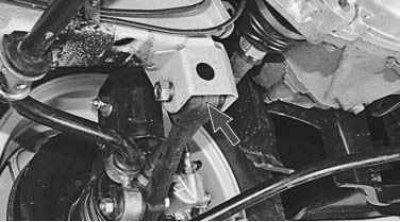
5. Rubber-metal hinges of the lower arms.
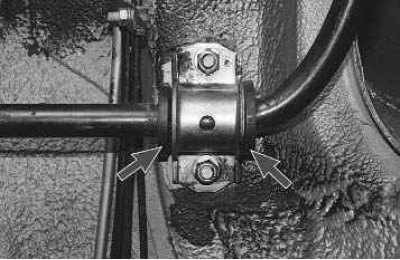
6. Rubber arrays of pillows of the stabilizer bar on the side member of the body.
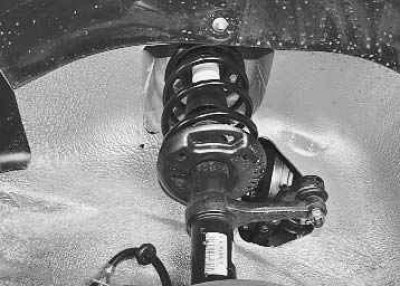
7. Telescopic racks. Shock absorber leaks and «sweating» not allowed.
Note. To check the ball joints, substitute a support under the lower arm.
Attention! When working on a lift, be careful not to drop the car when lowering it onto a support.
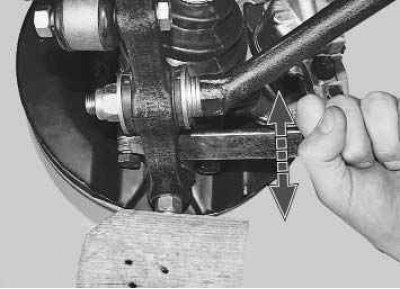
8. To check the ball joints, insert a mounting blade between the lower arm and the steering knuckle and move its free end up and down. If movement of the fist relative to the lever is felt, there is a gap in the support and it must be replaced.
9. Repeat the test for the hinges on the opposite side. Remove the support from under the car.