



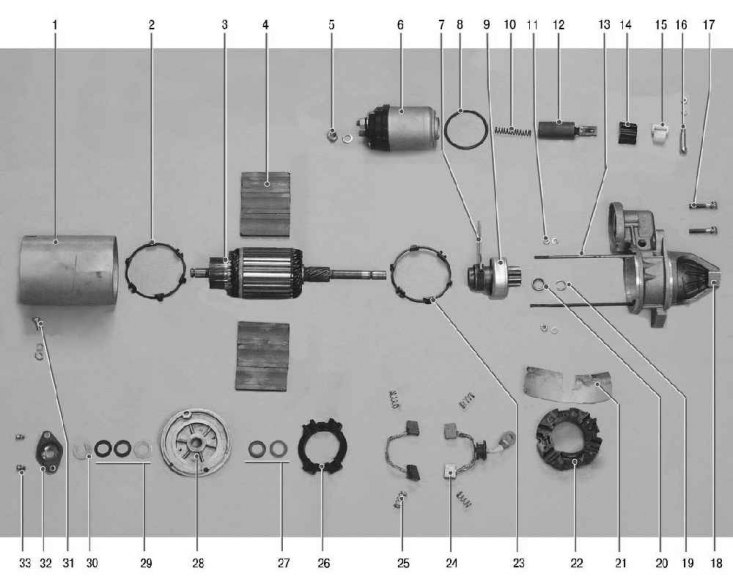
Figure 10.4. Starter parts 2111.3708010-01: 1 – body; 2 – thrust ring from the collector side; 3 - anchor; 4 – permanent magnet; 5 – positive polarity brush busbar mounting nut; 6 – traction relay; 7 – drive lever; 8 – sealing ring; 9 – freewheel clutch; 10 – return spring; 11 – tie rod nut; 12 – relay anchor; 13 – tie rod; 14 – seal; 15 – lever support; 16 – lever axis; 17 – traction relay mounting screws; 18 – front cover; 19 – retaining ring; 20 – limiting ring; 21 – insulator; 22 – internal brush holder; 23 – thrust ring on the drive side; 24 – "positive" brush; 25 – pressure spring; 26 – external brush holder; 27 – internal spacer washers; 28 – back cover with bushing; 29 – external spacer washers; 30 – lock washer; 31 – bolt for fastening the negative polarity brush bar; 32 – anchor shaft cover; 33 – anchor shaft cover mounting bolt
Figure 10.4 shows the starter parts. Before disassembling the starter, make sure it is faulty by performing the following simple checks.
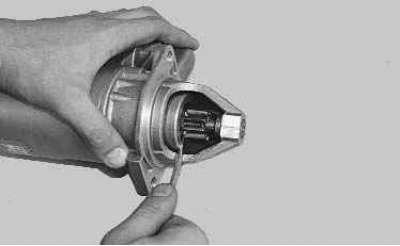
1. Using a screwdriver, check the ease of movement of the drive coupling along the shaft.
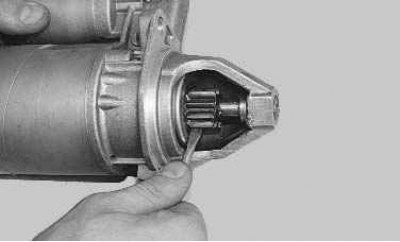
2. Turn the drive gear. It should rotate easily relative to the coupling hub in the direction of rotation of the anchor and should not rotate in the opposite direction.
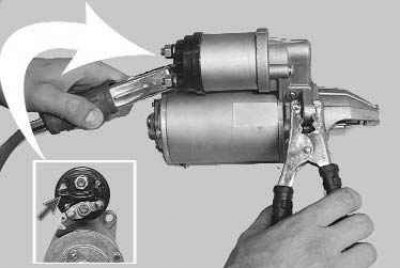
3. Connect the negative terminal of the battery removed from the vehicle to the starter housing using jumper wires. Connect one end of the second wire to the positive terminal of the battery, and the other to the terminal of the control wire of the traction relay. If the traction relay is working properly, a click will be heard and the drive clutch will extend. Otherwise, the traction relay must be replaced.
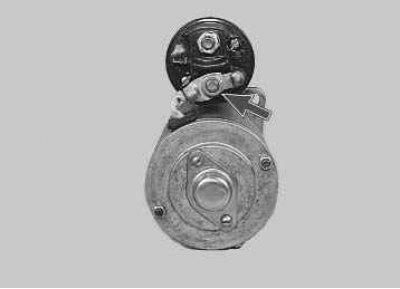
4. Disconnect the wire from the control terminal of the traction relay and connect it to the lower contact bolt of the traction relay. The starter armature should start to rotate at a frequency of more than 5000 min⁻¹. Otherwise, repair the starter.
You will need: wrenches "8", "10", "13", a flat-blade screwdriver, pliers with narrow jaws, a hammer, a tester, a caliper.
1. Remove the starter from the vehicle (see "Removing and installing the starter").
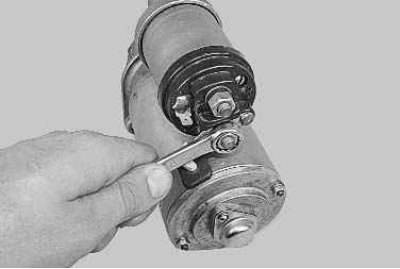
2. Unscrew the nut securing the tire to the contact bolt.
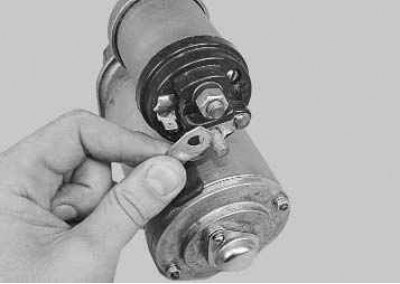
3. Disconnect the busbar from the contact bolt of the traction relay.
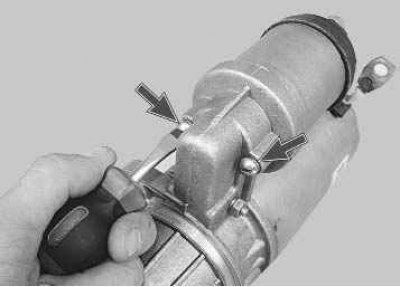
4. Remove the two screws securing the traction relay...
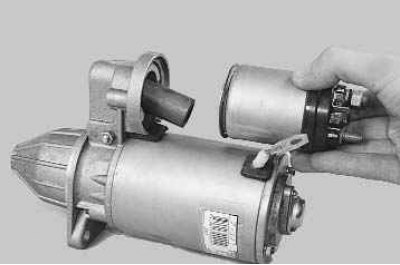
5. ...and remove the relay.
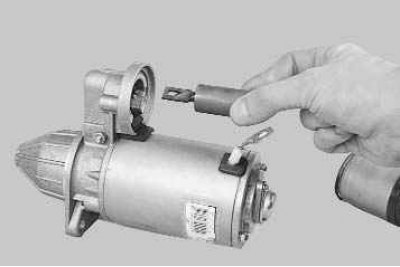
6. Remove the traction relay anchor by lifting it up so that the anchor loop comes off the lever.
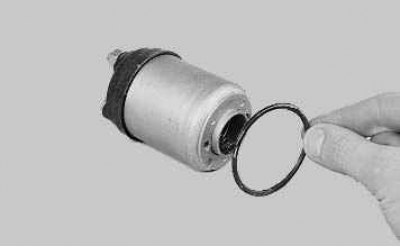
7. Remove the sealing ring from the traction relay housing...
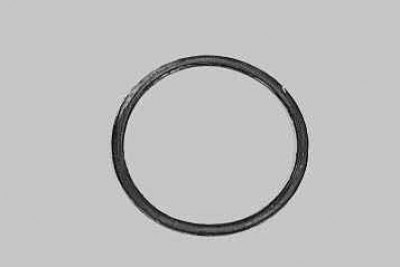
Note: If the ring is too compressed, cracked or has lost elasticity, replace it with a new one.
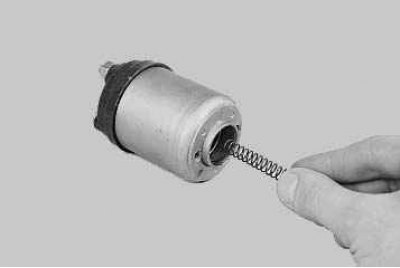
8. ...and remove the return spring.
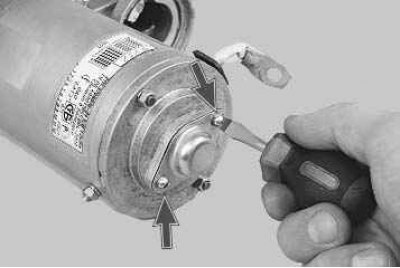
9. Remove two screws...
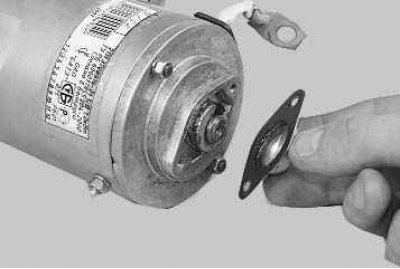
10. ...and remove the armature shaft cover...
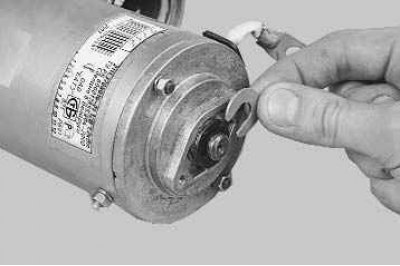
11. ...lock washer...
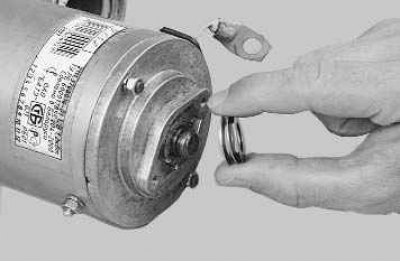
12. ...and spacer washers.
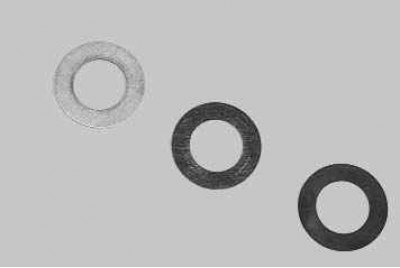
Note: Remember the order in which you install the spacers, as they are of different thicknesses. When assembling the starter, install the washers in the same sequence.
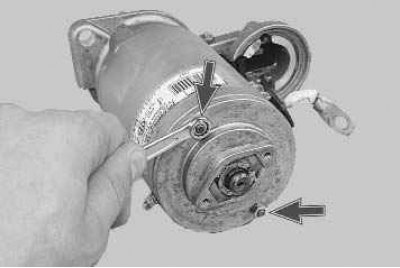
13. Unscrew the two nuts of the tie rods...
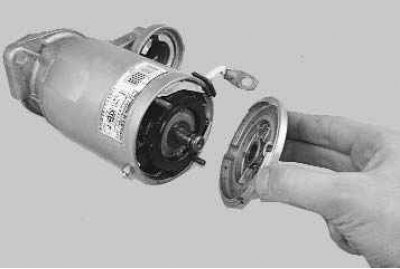
14. ...and remove the cover from the starter armature shaft from the collector side.
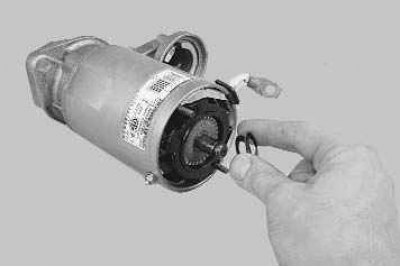
15. Remove the two spacer washers...
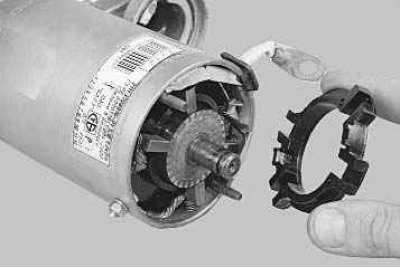
16. ...and external brush holder.
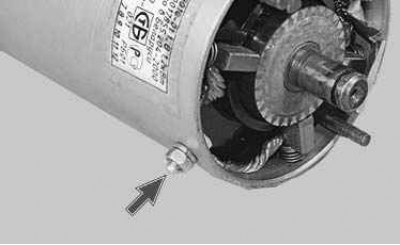
17. Unscrew the nut securing the negative polarity brushes...
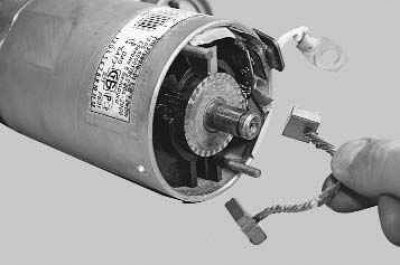
18. ...and carefully, so as not to damage the brushes, remove them together with the pressure springs. Replace springs that are too compressed or bent.
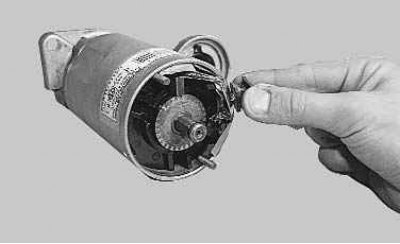
19. Remove the positive polarity brushes in the same way.
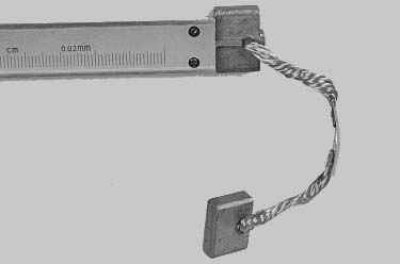
Note: Measure the height of the brushes from the edge of the work surface to the copper braid of the wires.
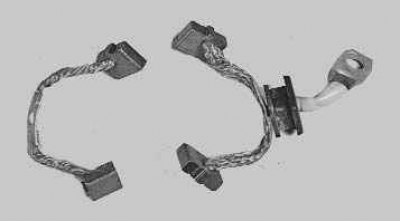
If their height is less than 4 mm, replace the brushes as a set (4 pcs).
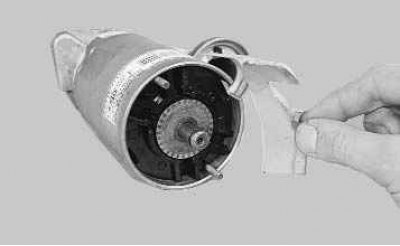
20. Remove the paper insulator of the positive polarity brushes...
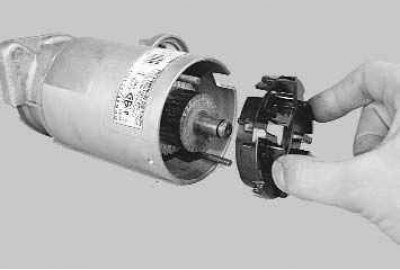
21. ...and the internal brush holder.
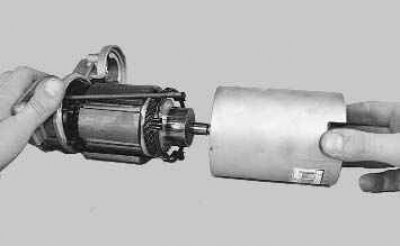
22. Remove the rotor with magnets and front cover from the starter housing.
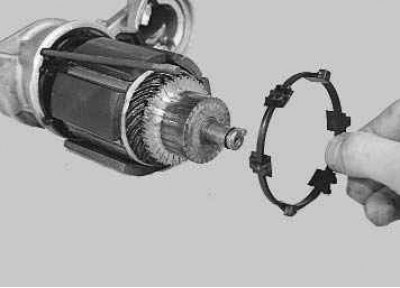
23. Remove the magnet retaining ring from the collector side.
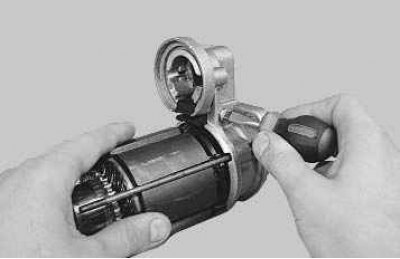
24. Unscrew the lever axle, having first unscrewed the lock nut on the other side...
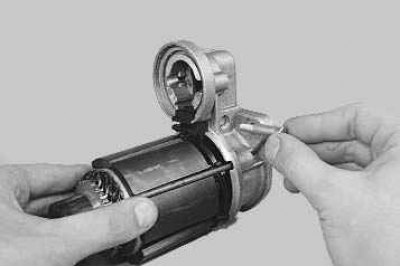
25. ...and remove the axle.
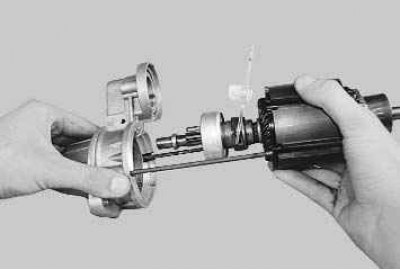
26. Remove the cover from the drive side.
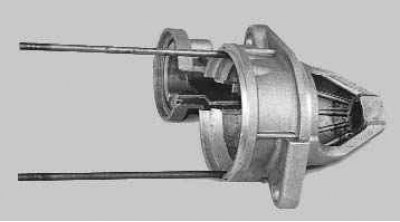
27. Inspect the starter covers; if cracks are found, replace them. If the bushings located in the covers, in which the anchor shaft rotates, are worn, have burrs, cavities and other defects, replace the bushings or covers with defective bushings...
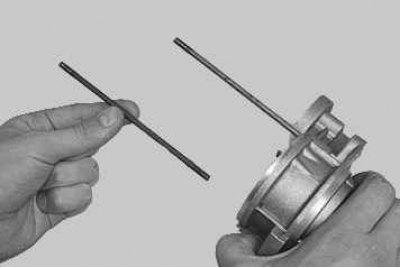
28. ...after first unscrewing the tie rods from the cover on the drive side.
Data obtained from the website (ladaman.ru)
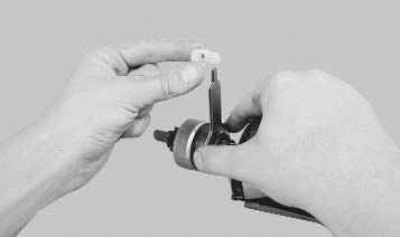
29. Remove the lever support.
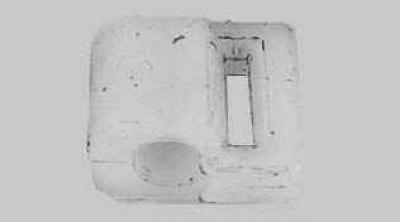
30. Replace a cracked or significantly worn support with a new one.
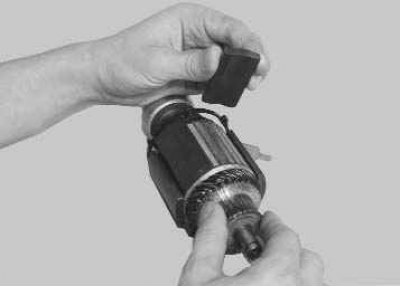
31. Remove the six magnets from the anchor, having previously marked or remembered their relative positions.
Note: Incorrect installation of magnets may result in reduced starter power or reverse starter rotation.
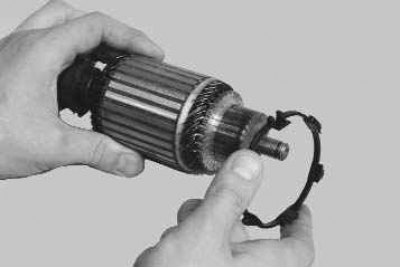
32. Remove the magnet retaining ring from the drive side.
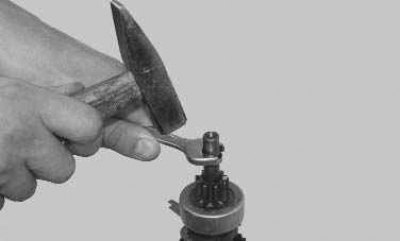
33. Having installed the drive shaft on a wooden block, with clear blows of a hammer, move the limiting ring along the armature shaft, as shown in the photo.
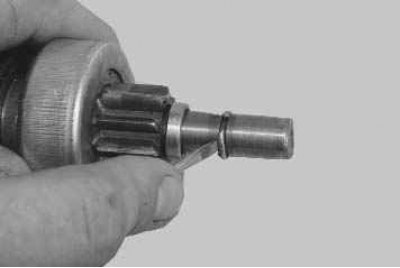
34. Using a screwdriver, pry...
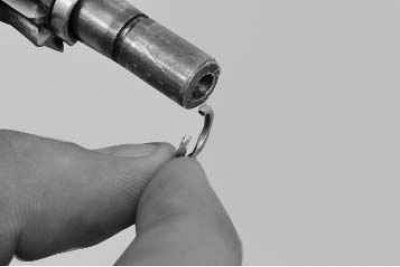
35. ... remove the retaining ring...
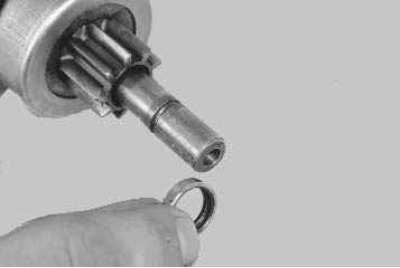
36. ...then the limiting ring...
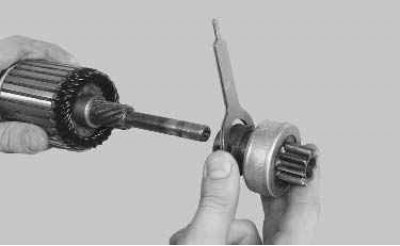
37. ...and remove the overrunning clutch assembly with the lever from the armature shaft.
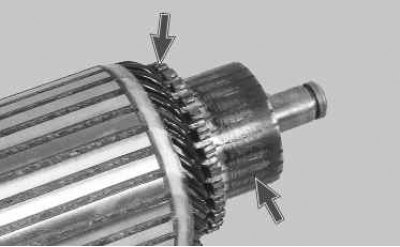
38. Inspect the anchor. If the manifold is dirty or has scratches, nicks or other defects, sand the manifold with fine-grain sandpaper. If the collector is significantly rough or mica protrudes between its plates, turn the collector on a lathe and then polish it with fine-grained glass paper. The commutator runout relative to the shaft journals should not exceed 0.05 mm. Remove any yellow coating from the bearing found on the armature shaft with fine-grained sandpaper, as it may cause the gear to jam on the shaft. Check the reliability of the soldering of the armature winding leads to the collector plates. Inspect the winding at the ends of the anchor. The winding diameter must be smaller than the anchor iron package. Otherwise, replace the anchor.
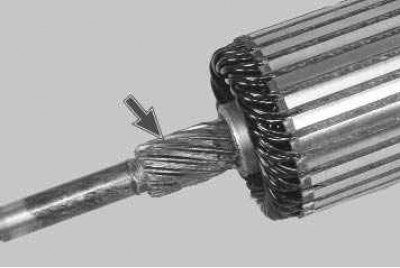
39. Inspect the condition of the splined connection of the anchor shaft for damage in the form of nicks and roughness. If possible, remove minor damage with fine-grained sandpaper.
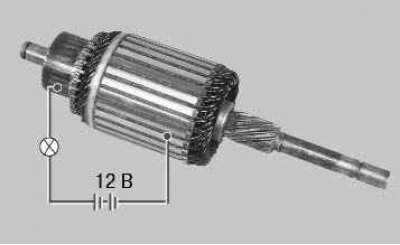
40. Check the condition of the armature winding using a test lamp powered by 12 V. Apply voltage to the collector plate and the armature core - the lamp should not light. If the lamp lights up, it means that there is a short circuit of the anchor winding or the collector plate to ground. In this case, replace the anchor.
41. Check whether the starter traction relay anchor moves easily and whether the contact bolts are closed by the contact plate (using a tester).
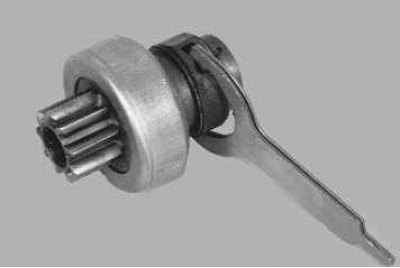
42. Check the drive. The drive gear teeth must not have significant wear. The gear should rotate easily relative to the clutch hub in the direction of rotation of the anchor and should not rotate in the opposite direction. If the gear teeth are worn or damaged, or the gear turns in both directions, replace the drive. There should be no cracks on the starter drive lever.
43. Assemble the starter in the reverse order of disassembly, taking into account the following features:
- lubricate the splined surface of the armature shaft with General Electric CG321 silicon grease or equivalent;
Attention! During operation, the drive coupling does not need to be lubricated. However, it is necessary to clean it from dirt. Do not use any cleaning agents to clean the drive that may wash out the lubricant contained in its coupling.
- lubricate the bearings (bushings) in the starter covers with engine oil;
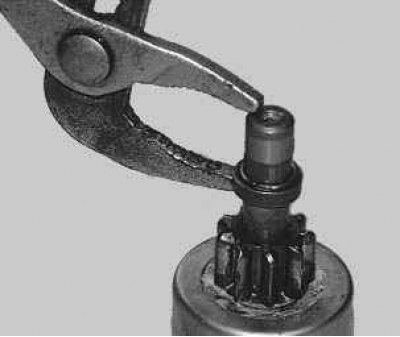
- use pliers to install the stop ring;
- before installing the traction relay, apply a thin layer of silicone sealant to its surface that contacts the starter cover on the drive side.
44. After assembling the starter, turn on the traction relay (see item 3) and measure the gap between the end of the gear and the thrust ring; it should be 3–5 mm.
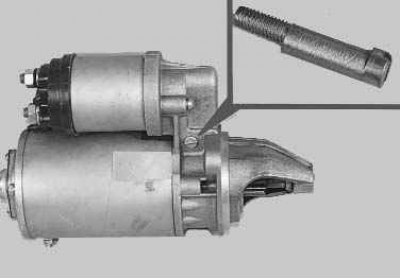
45. If the gap is not within the specified range of values, adjust it by turning the lever axis, the body of which is made in the form of an eccentric. To do this, loosen the lock nut, turn the axle and tighten the lock nut. After final assembly, it is recommended to check the starter at a service station on a mod. 532M.