



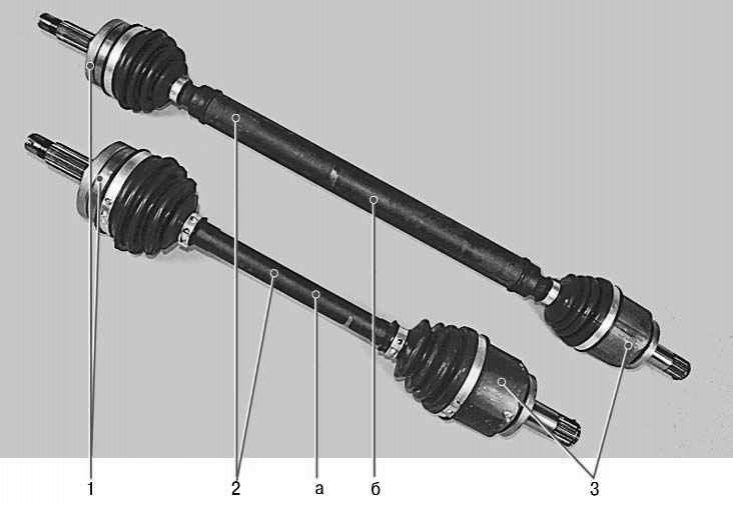
Figure 6.12. Front wheel drives: a – left front wheel drive; b – right front wheel drive; 1 – external hinges; 2 – front wheel drive shafts; 3 – internal hinges
The front wheel drives consist of outer 1 (figure 6.12) and 3 internal constant velocity joints (CV joints) connected by shafts 2. The external joint allows only angular movements of the connected shafts. In addition to the angular joint, the internal joint also provides axial displacement of the shafts when turning the front wheels and operating the suspension. The drive shaft of the left wheel is made of a rod, and the right one is made of a pipe. In addition, the drive shafts differ in length: the right one is longer than the left one.
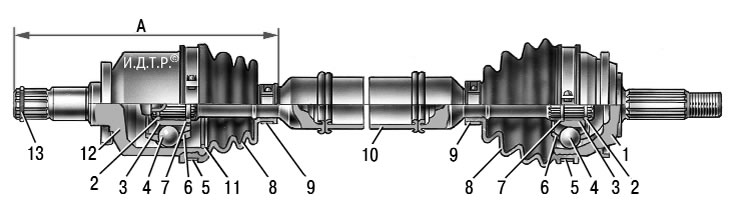
Figure 6.13. Front wheel drive: 1 – outer hinge housing; 2 – retaining ring; 3 – clip; 4 – ball; 5 – outer clamp; 6 – separator; 7 – thrust ring; 8 – protective cover; 9 – inner clamp; 10 – wheel drive shaft; 11 – inner hinge lock; 12 – inner hinge housing; 13 – inner joint housing retaining ring; A – control size
The outer hinge consists of a housing 1 (figure 6.13), separator 6, inner race 3 and six balls. The joint body and the cage have grooves for placing the balls. The grooves in the longitudinal plane are made along the radius, which provides an angle of rotation of the outer hinge of up to 42°. The splined tip of the hinge housing is installed in the hub of the front wheel and is secured to it with a nut.
The sleeve 3 of the joint is installed on the splines of the shaft 10 between the thrust ring 7 and the retaining ring 2.
The internal hinge differs from the external one in that the body and collar tracks are straight rather than radial, which allows the hinge parts to move in the longitudinal direction. This is necessary to compensate for movements caused by vibrations of the front suspension and power unit.
Balls of the same sorting group are installed in the outer and inner hinges; if necessary, all six hinge balls are replaced; the balls must be of the same sorting group. The selective method is used when assembling the inner hinge. Replacing any one part is not allowed - the inner joint must be replaced as an assembly.
The hinge parts are lubricated with SHRUS-4 grease, which is placed in the hinge housings during assembly. Sealing of the hinges is ensured by protective covers secured with clamps.
Note: The drive joints are very durable, their estimated service life is almost equal to the service life of the car. However, during operation they are changed or repaired quite often. This type of work is expensive and labor-intensive. To save a lot of money, regularly check the condition of the hinge covers and replace them immediately if they show any damage. If water or dust gets into the joint through a damaged cover, it will fail after several hundred kilometers. The sealed joint wears out extremely slowly.
Original publication on the website: ladaman