



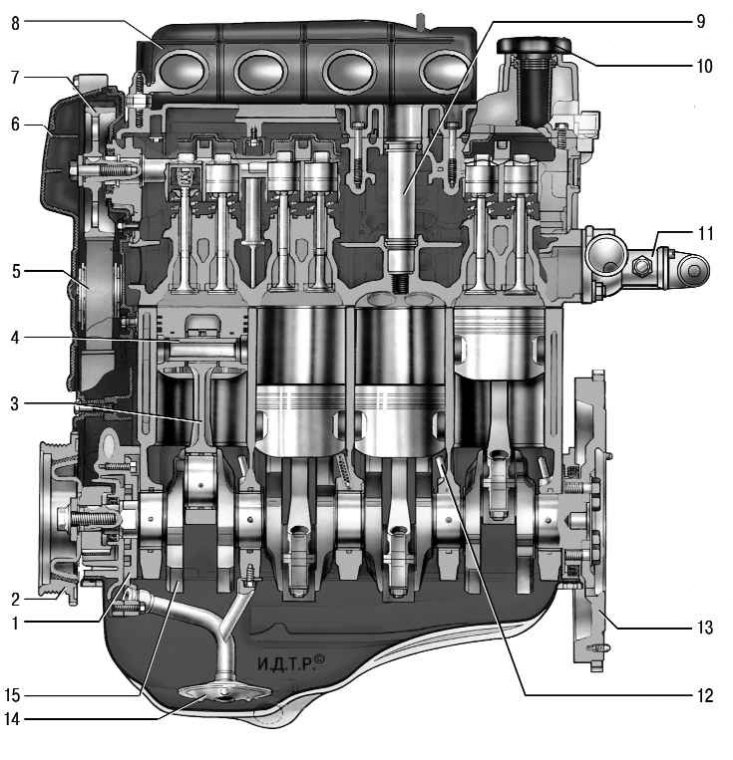
Figure 5.1. Longitudinal section of the VAZ-21126 engine: 1 – oil pump; 2 – generator drive pulley; 3 – connecting rod; 4 – piston pin; 5 – timing belt of the gas distribution mechanism; 6 - gas distribution mechanism cover; 7 – camshaft pulley; 8 – intake manifold; 9 – spark plug well; 10 – oil filler cap; 11 – thermostat; 12 – flywheel; 13 – piston bottom cooling nozzle; 14 – oil receiver; 15 – crankshaft
The VAZ-21126 engine is installed on the VAZ-2170 Lada Priora (figure 5.1, 5.2), created on the basis of the VAZ-2112 engine. Increase in the working volume of the engine mod. 21126 up to 1.6 l compared to the working volume of mod. 2112 is achieved by increasing the piston stroke with the same cylinder diameter.
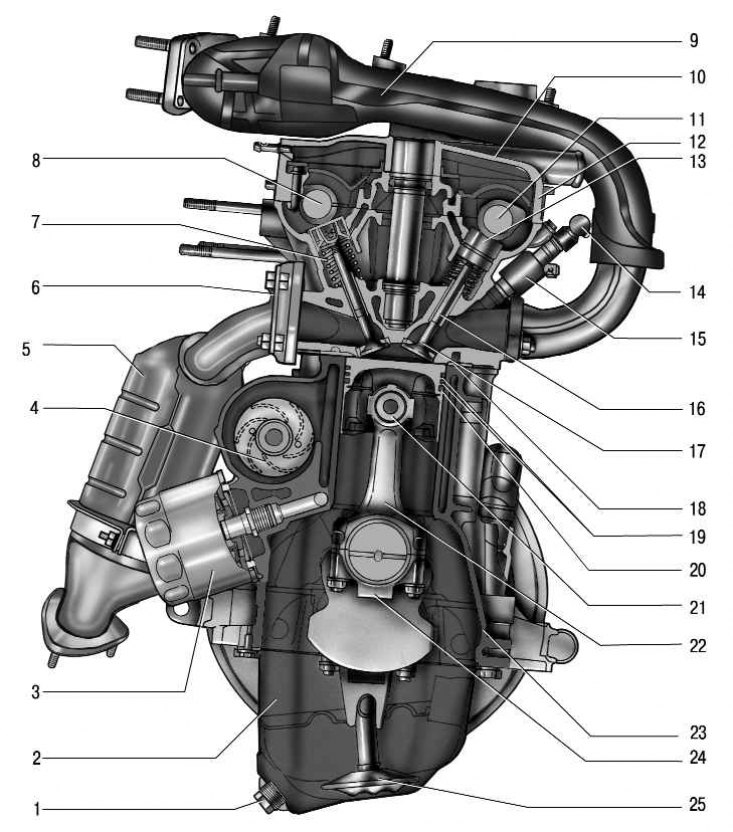
Figure 5.2. Cross-section of the VAZ-21126 engine: 1 – drain plug; 2 – oil pan; 3 – oil filter; 4 – water pump; 5 – cat collector; 6 – exhaust valve; 7 – valve spring; 8 – exhaust camshaft; 9 – intake manifold; 10 – cylinder head cover; 11 – intake camshaft; 12 – hydraulic valve tappet; 13 – camshaft bearing housing; 14 – fuel rail; 15 – nozzle; 16 – valve guide bushing; 17 – inlet valve; 18 – cylinder head gasket; 19 – compression rings; 20 – oil scraper ring; 21 – piston pin; 22 – connecting rod; 23 – cylinder block; 24 – connecting rod cover; 25 – oil receiver
Cylinder block cast from special high-strength cast iron, which gives the engine structure rigidity and strength.
The coolant passages that form the cooling jacket are made along the entire height of the block, which improves piston cooling and reduces block deformation from uneven overheating. The cooling jacket is open at the top towards the cylinder head. At the bottom of the cylinder block there are five crankshaft main bearing supports, the covers of which are attached with bolts. The supports contain thin-walled steel-aluminum liners that act as crankshaft bearings. The middle support has grooves into which thrust half rings are inserted, holding the crankshaft from axial movements.
Compared to the engine block mod. 2112 cylinder block mod. 21126 is 2.3 mm higher, the height from the axis of the main bearing beds to the upper surface of the block is 197.1 mm.
Crankshaft cast from special high-strength cast iron. The main and connecting rod journals of the shaft are ground. To lubricate the connecting rod bearings, oil channels are drilled in the crankshaft and closed with plugs. Eight counterweights located on the crankshaft serve to reduce vibration. Crankshaft radius of engine mod. 21126 is 2.3 mm larger than engine mod. 2112, due to which the piston stroke increased from 71 to 75.6 mm. To distinguish the shafts, the marking "11183" is cast on one of the counterweights of the crankshaft of the VAZ-21126 engine.
An oil pump, a toothed pulley for the camshaft drive belt and a generator drive pulley with a built-in torsional vibration damper are mounted on the front end of the crankshaft. At the rear end of the crankshaft is a flywheel, cast from cast iron. A steel toothed rim is pressed onto the flywheel.
Connecting rods steel, forged, with covers on the lower heads. The connecting rod caps are made by tearing them off from a solid connecting rod. This achieves higher precision in installing the cover on the connecting rod. Thin-walled liners are installed in the lower head of the connecting rod, and a steel-bronze bushing is pressed into the upper head.
Pistons cast from aluminum alloy. Each of them has three rings installed: two upper compression rings and a lower oil scraper ring. The piston bottom is flat, with four recesses for the valves, and on the pistons of the engine mod. 21126 recesses are larger than those of the 2112 engine. The pistons are cooled with oil, for which purpose special nozzles are installed in the main bearing supports. They are tubes containing spring-loaded balls. When the engine is running, the balls open holes in the tubes and a stream of oil hits the piston from below.
In the engine mod. 21126 uses a reduced weight piston-piston rings-piston pin-connecting rod kit (piston weight reduced from 350 to 235 g, piston pin weight from 113 to 65 g, connecting rod weight from 707 to 485 g, total kit weight by 32%).
Oil pan steel, stamped, bolted to the cylinder block from below.
Cylinder head, installed on top of the cylinder block, is cast from aluminum alloy. The lower part of the head contains cast channels through which the liquid circulates to cool the combustion chambers. Two camshafts are installed in the upper part of the head: one for the intake valves, the other for the exhaust valves. Cylinder head of engine mod. 21126 differs from the head mod. 2112 with an increased area of flanges for the intake manifold and spark plug well cups made in one piece with the cylinder head.
Camshafts are installed in supports made in the upper part of the cylinder head and in one common bearing housing, secured with bolts to the cylinder head. The camshafts are cast from cast iron. The camshaft pulleys of the 21126 engine differ from the pulleys of the 2112 engine by the valve timing marks being offset by 2°.
To reduce wear, the working surfaces of the cams and the surfaces under the oil seal are heat-treated - bleached. The camshaft cams operate the valves through the tappets. Engine 21126 is equipped with hydraulic valve lifters, which automatically compensate for clearances in the valve drive. This engine does not require valve clearance adjustment during operation. The engine has four valves per cylinder: two intake and two exhaust.
The valve guides and seats are pressed into the cylinder head. The guide bushings are also equipped with retaining rings to prevent them from falling out. The guide bushings are fitted with oil scraper caps to reduce oil ingress into the cylinders.
Each valve has one spring installed. The camshafts are driven by a rubber toothed belt from the crankshaft.
Cylinder head cover made of aluminum. The joint between the cover and the cylinder head is sealed with a gasket. The cylinder head cover of the 21126 engine differs from the 2112 cover by the absence of a platform for mounting the ignition module and the presence of holes for mounting individual ignition coils next to the spark plug wells.
Lubrication system engine combined: spray and pressure. Main and connecting rod bearings and camshaft supports are lubricated under pressure. The system consists of an oil sump, a gear oil pump with an oil receiver, a full-flow oil filter, an oil pressure sensor and oil channels.
Cooling system the engine consists of a cooling jacket, a radiator with an electric fan, a centrifugal water pump, a thermostat, an expansion tank and hoses.
The fuel system includes an electric fuel pump installed in the fuel tank, a throttle assembly, a fine fuel filter, a fuel pressure regulator, injectors, and fuel hoses. Differences between the elements of the engine power supply system mod. 21126 from engine mod. 2112:
- the non-return tubular fuel rail is made of stainless steel instead of aluminum alloy;
- reduced size fuel injectors are not interchangeable with previous ones;
- the redesigned fuel pressure regulator is installed in the fuel pump module rather than on the fuel rail;
- the throttle assembly does not have a hole connecting the air supply hose to the intake module bypassing the throttle valve. The throttle body flange configuration has been changed.
The fuel system functionally includes a fuel vapor recovery system with a carbon adsorber (see "Replacing the fuel vapor recovery system components"), preventing the release of fuel vapors into the atmosphere.
Ignition system consists of individual ignition coils mounted on the cylinder head cover and spark plugs. The ignition coils are controlled by the engine electronic control unit (ECU). Installation of individual ignition coils instead of the engine ignition module mod. 2112 made it possible to do away with high-voltage ignition wires and improve the technical characteristics and reliability of the system.
[Original text on the website LadaMan.ru]
Crankcase ventilation system
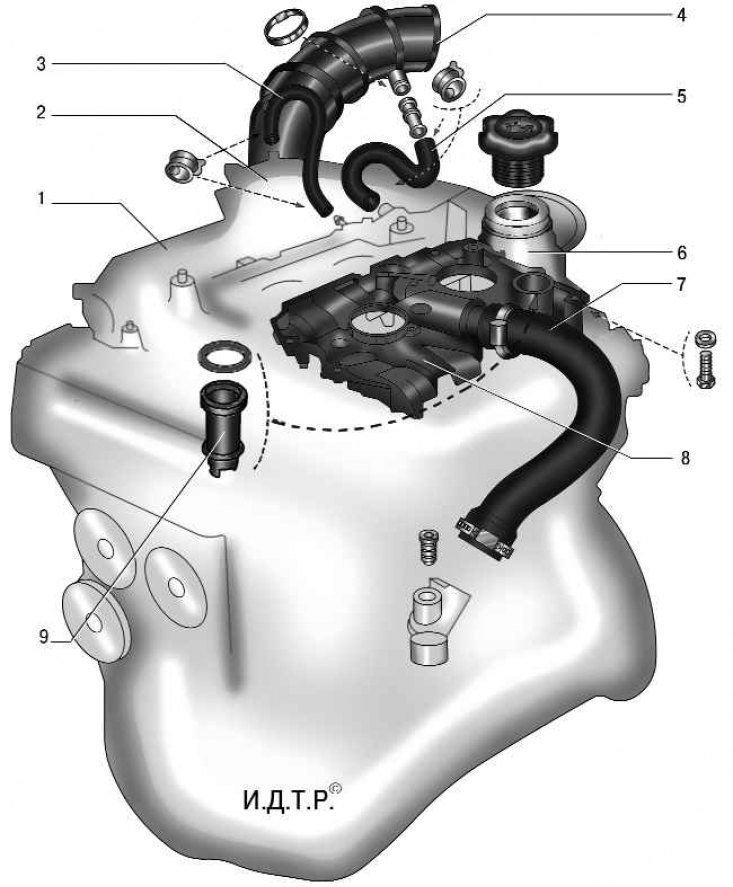
Figure 5.3. Engine crankcase ventilation system: 1 – intake manifold; 2 – throttle assembly; 3 – small circuit ventilation system hose; 4 – air supply hose; 5 – large circuit ventilation system hose; 6 – cylinder head cover; 7 – exhaust hose; 8 – separator; 9 – separator oil deflector
closed engine, with crankcase gases discharged through separator 8 (figure 5.3) oil separator installed in the cover 6 of the cylinder head, into the intake pipe. The crankcase gases are then directed into the engine cylinders, where they are burned. When the engine is idling, crankcase gases enter through hose 3 of the small circuit through a calibrated hole (jet) in the throttle body. In this mode, a high vacuum is created in the intake manifold and crankcase gases are effectively sucked into the throttle body space. The jet limits the volume of gases sucked out so that the engine operation at idle speed is not disrupted. When the engine is running under load, when the throttle valve is partially or fully open, the main volume of gases passes through hose 5 of the large circuit into the air supply sleeve 4 in front of the throttle assembly and then into the intake manifold and combustion chambers.