



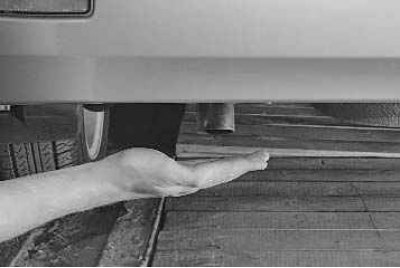
1. Start the engine and let it idle. Go to the exhaust pipe and listen to the exhaust sound. You can put your hand near the end of the exhaust pipe - this way you can feel the interruptions better. The sound should be even, "soft", of one tone. Pops from the exhaust pipe at regular intervals indicate that one cylinder is not working due to a faulty spark plug, no spark on it, a failed injector, a strong air leak in one cylinder or a significant decrease in compression in it. Popping sounds at irregular intervals are caused by dirty injector nozzles, severe wear or dirty spark plugs. If the pops occur at irregular intervals, you can try to replace the entire set of spark plugs yourself, regardless of mileage and appearance, but it is better to do this after contacting a car service for diagnostics and repair of the engine management system.
2. If the popping sounds are regular, stop the engine and open the hood. Check the condition of the ignition system wiring harness and the fastening of the wiring blocks on the ignition coils. If there is any damage to the wires, replace the entire ignition wiring harness.
3. Remove the spark plugs (see "Replacing and servicing spark plugs").
4. Carefully examine the spark plugs and compare their appearance with the photographs provided in the subsection "Diagnostics of engine condition by the appearance of spark plugs".
5. If all spark plugs look good...
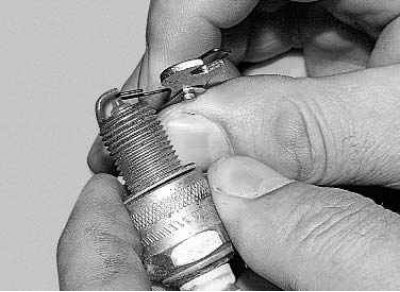
6. ...check the gap between the spark plug electrodes (only with a round feeler gauge). It should be 1.00–1.13 mm.
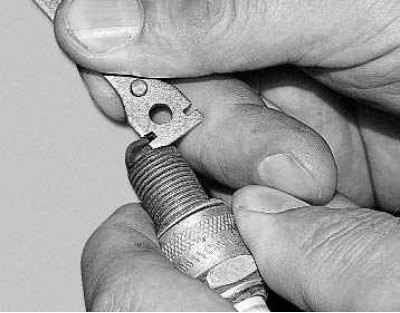
7. If the gap differs from the specified one, adjust it by bending the side electrode.
8. Install the spark plugs and coils in place and connect the wiring harness connectors to them.
9. Disconnect the wiring harness connector from the 1st cylinder coil. Start the engine. If the engine misfires do not increase, replace the spark plug in cylinder 1 with a known good one. Put on the high-tension wire and start the engine. If the misfires become more severe, repeat the procedure sequentially with all cylinders to identify the faulty spark plug.
If the engine misfires are not eliminated as a result of the measures taken, check the compression in each cylinder (see "Checking the compression in the cylinders"). Normal compression is more than 1.0 MPa (10 kgf/cm²), a difference in compression values in the cylinders of more than 0.2 MPa (2 kgf/cm²) indicates the need for engine repair.