



1. The starter does not turn on. The reason is a violation of contact connections, a break or short circuit in the starter circuits, or a malfunction of the traction relay.
2. When the starter is turned on, multiple clicks are heard. The reason is a faulty holding winding of the traction relay, the battery is very discharged, and the contact connections in the starter circuit are loose.
3. The starter engages, but its anchor either does not rotate or rotates slowly. The reason is a discharged battery, broken contact connections, burnt contacts of the traction relay, contaminated collector or worn brushes, interturn or short circuit in the windings.
4. The starter is engaged, its anchor rotates, but the flywheel remains stationary. The reason is a loose starter mount to the clutch housing, damage to the flywheel or drive gear teeth, slipping of the drive freewheel clutch, breakage of the lever, drive ring or starter drive buffer spring.
5. The starter does not turn off after the engine starts. The reason is a malfunction of the starter freewheel clutch, sintering of the traction relay contacts. In case of such a malfunction, stop the engine immediately!
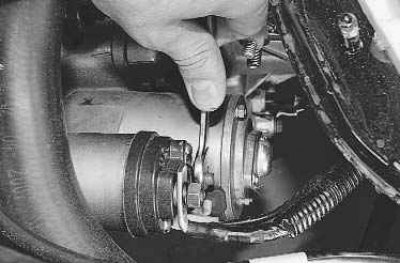
The above faults require qualified intervention at a car service center or upon arrival at the garage (see section. "Electrical equipment"). You can only check the battery discharge level in advance using the indicator built into it, and if there is none, use a car tester in voltmeter mode, connecting it to the battery terminals, as well as the tightening of the starter circuit contact connections.