



Note: If the cable is difficult to move in the sheath after being removed from the vehicle, lubricate it by pouring transmission or engine oil into the sheath until it starts to flow out from the opposite end of the sheath. During the pouring process, periodically move the cable in the sheath.
Note: Install the cable with an assistant: the lever rod is short, so it is necessary to pull the cable tightly to install the equalizer.
Replace the cable if the following faults occur:
- the cable ends are loose;
- the rope threads began to break;
- the cable moves with difficulty in the sheath even after it has been lubricated.
You will need: a 10 mm wrench, two 13 mm wrenches, and a large screwdriver.
1. Lower the parking brake lever all the way down.
2. Remove the brake drum of the corresponding wheel.
3. Remove the muffler from the suspension mounts and the resonator from the rear mount. Lower the exhaust system down (see "Replacing the exhaust system suspension cushions").
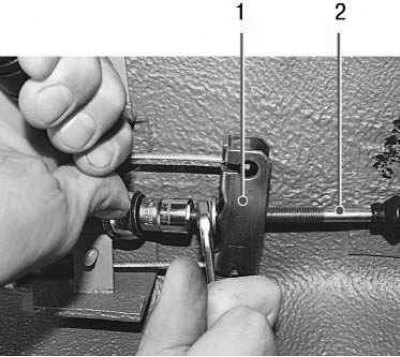
4. Using a 13 mm spanner, loosen the lock nut and adjusting nut of the parking brake and remove equalizer 1 from rod 2.
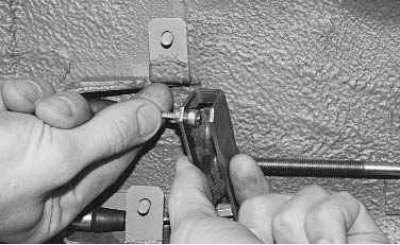
5. Remove the cable end from the equalizer.
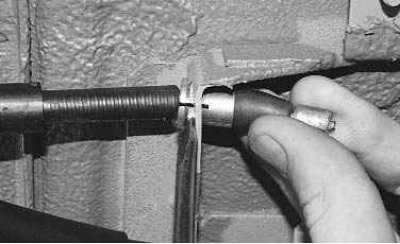
6. Remove the cable sheath end from the bracket on the body.
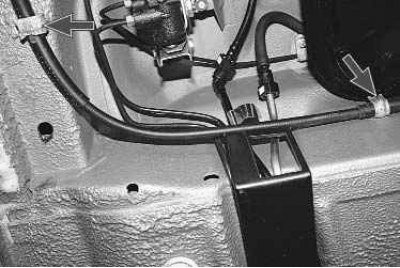
7. Bend back the two fastening brackets of each cable.
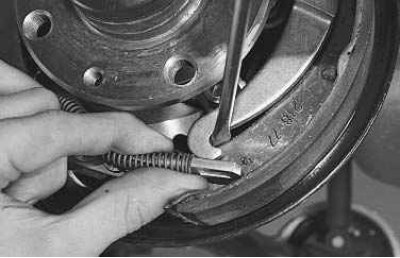
8. Insert a screwdriver between the shoe and the parking brake lever, move the lever to the forward position and disconnect the cable end from the lever.
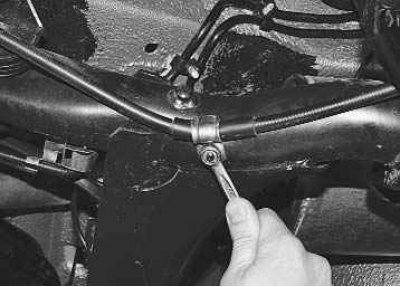
9. Loosen the nut securing the cable holder to the rear axle beam and remove the cable from the holder.
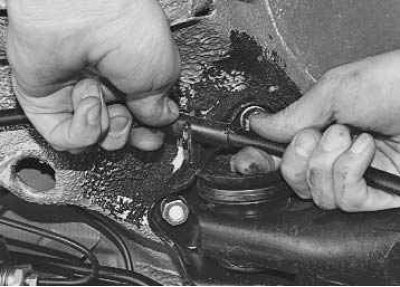
10. Remove the cable from the bracket on the body.
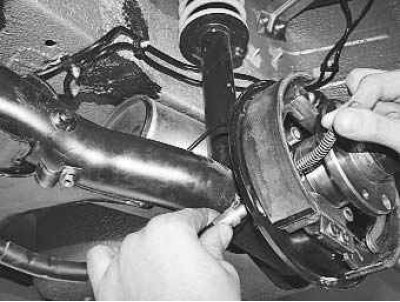
11. Remove the cable from the brake shield.
12. Install the cable in the reverse order of removal. Please note that the cables are installed in the bracket crosswise. After installation, adjust the parking brake (see "Checking and adjusting the parking brake drive").
Note: Some drivers, in an effort to reduce wear on the parking brake cable, try to use it less often. Such "savings" lead to the opposite result: the cable, rarely moving in the sheath, gradually loses mobility and eventually jams and breaks. Use the parking brake whenever necessary.