To complete the work you will need a bore gauge and a piston ring mandrel.
Disassembly
1. Remove the piston rings from the piston ("Piston rings and connecting rod bearings - replacement").
2. Using an awl or a screwdriver with a thin blade, pry up and remove the piston pin retaining ring from the groove.
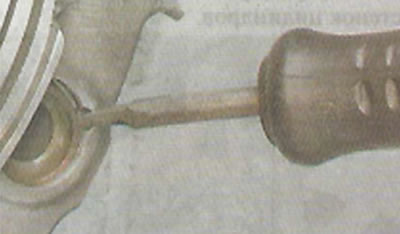
Recommendation. If the grooves of the retaining rings are dented, nicked, and the rings are not securely fixed in them, the piston should be replaced.
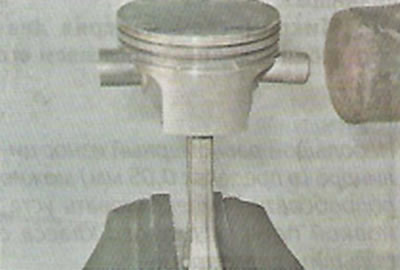
3. Using a soft metal rod with a diameter of 16-18 mm, push out the piston pin and remove the piston from the connecting rod.
Examination
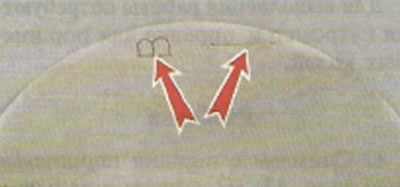
In new engines, the clearance between the piston and the cylinder is 0.025-0.045 mm and is determined by installing pistons of the same class as the cylinders. The piston and cylinder class are designated by Latin letters which are stamped on the lower mating surface of the cylinder block...
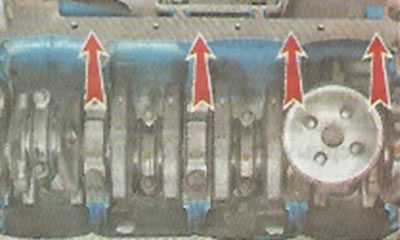
...and on the piston bottom. The arrow on the piston points towards the front end of the crankshaft.
Note: For information on how to use the bore gauge, see the enclosed instructions or special literature.
1. Using a bore gauge, check the wear of the cylinder walls.
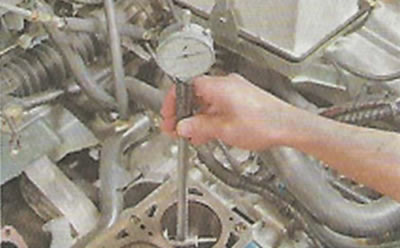
We take measurements in four zones (3, 10, 60 and 112 mm from the top edge of the cylinder) in the longitudinal and transverse directions of the engine. The upper belt does not wear out the cylinder. Based on the difference in bore gauge readings in different zones, we determine the degree of wear of each cylinder.
2. Using a micrometer to measure the diameter of the piston skirt, we determine its wear.
Recommendation. Slight uniform wear of the cylinder (within 0.05 mm) you can try to compensate by installing a piston of a different class with a larger diameter.
If the maximum wear is 0.15 mm or more, the cylinders must be bored and pistons of a repair size must be installed.
Selection of pistons and pins
In new engines, the clearance between the piston and the cylinder is 0.025-0.045 mm and is set by installing pistons of the same class as the cylinder class.
1. Using a bore gauge, check the wear of the cylinder walls (see above).
Cylinder diameters are divided into five size classes (see table 8.1.5). The class of each cylinder is stamped on the lower mating surface of the cylinder block.
Table 8.1.5. Cylinder classes by diameter
| Designation | Diameter, mm |
| A | 82,00-82,01 |
| IN | 82,01-82,02 |
| WITH | 82,02-82,03 |
| D | 82,03-82,04 |
| E | 82,04-82,05 |
Recommendation. Slight uniform wear of the cylinder (within 0.05 mm) it is possible to compensate by installing a piston of a different class with a larger diameter.
If the maximum wear is 0.15 mm or more, the cylinders must be bored and pistons of a repair size must be installed.
It is possible to bore cylinders by 0.4 mm and 0.8 mm to suit the dimensions of repair pistons.
2. The designations on the piston bottom indicate where:
- 2 - all holes for the piston pin;
- C — piston class;
- ← — arrow for piston orientation in the cylinder (should be directed towards the timing drive);
- G - piston mass group.
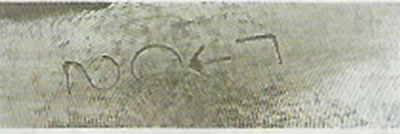
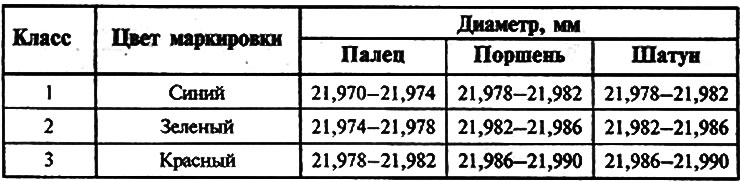
According to the diameter of the hole for the piston pin, pistons are divided into ori classes (1, 2, 3) - by 0.004 mm.
According to the outer diameter, pistons are divided into five classes (A, B, C, D. E) — through 0.01 mm (measured in a plane perpendicular to the piston pin, at a distance of 55 mm from the piston bottom).
According to size, pistons are divided into nominal and two repair sizes. Pistons are not marked with nominal size. Pistons of the first repair size are manufactured with a diameter increased by 0.4 mm and are marked with the symbol "d". Pistons of the second repair size have a diameter increased by 0.8 mm and are marked with the symbol "□".
All pistons in an engine must be of the same weight group. Pistons of the nominal group are designated by the symbol "G". Pistons with increased and decreased mass by 5 g are designated "+"* and "—" respectively.
The finger class is marked with paint on its end.
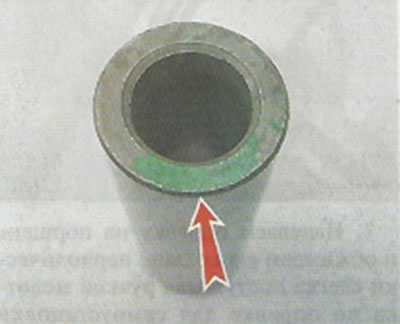
According to the outer diameter, the fingers are divided into ori classes (blue, green and red), through 0.004 mm.
To facilitate the selection of the pin for the piston hole, the required pin class is indicated on its inner side with paint.
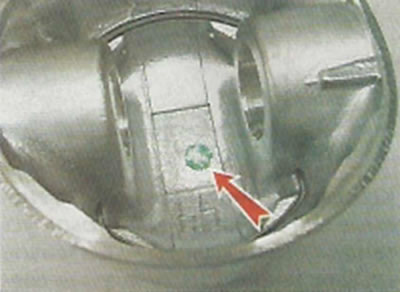
The required pin class is indicated on the connecting rod cap 2. Connecting rods are divided into classes according to the weight of the heads. Mammoth marking on the connecting rod cover 1...
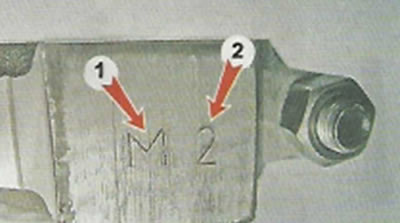
...or paint.
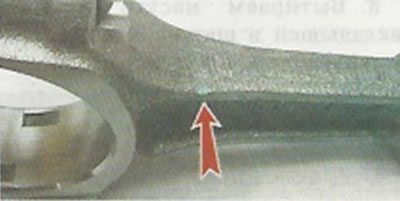
Warning! The engine must be equipped with connecting rods of the same weight class (see table 8.1.6).
Table 8.1.6. Connecting rod classes by weight
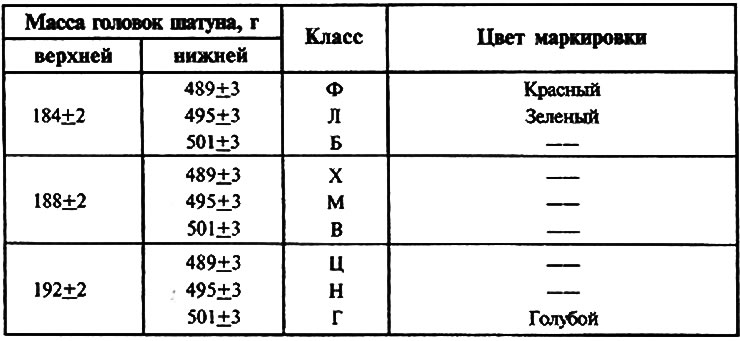
Table 8.1.7. Piston pin classes by outside diameter and pin hole diameter
[The material was taken from a website Ladaman.ru]