



Therefore, regularly, especially before long trips, you should check the oil level in the crankcase.
The oil level is checked on a cold idle engine with the vehicle on a level surface. The level must be between the MIN and MAX marks on the oil level indicator 1 (pic. 45) or between the top and bottom edges of the grooved surface of the pointer 1 (pic. 45a) depending on engine model. Adding oil if necessary (see annex 1) is made through the neck, closed with a stopper 2.
On a 16-valve engine, the handle of the oil level indicator 1 is brought out flush with the top cover of the engine. The oil level should be from the upper to the lower edge of the notch on the pointer.
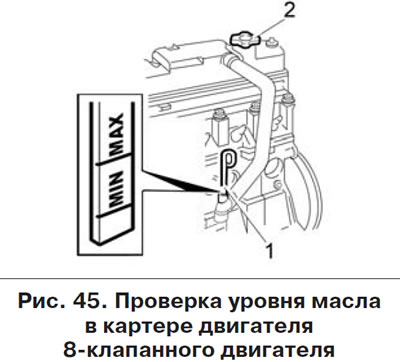 | 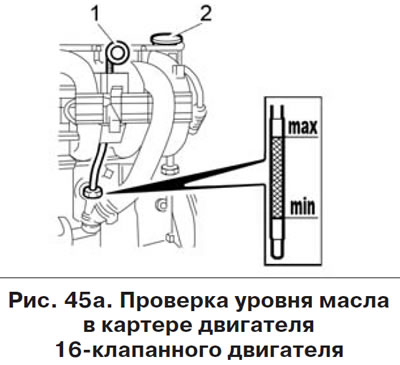 |
After topping up, the oil level should be checked no earlier than three minutes later, so that the topped-up portion of oil has time to drain into the crankcase. For correct measurement, it is necessary to insert the oil level indicator 1 into its mounting hole until it stops.
Attention! It is not allowed to exceed the oil level in the engine crankcase above the MAX mark of the oil level indicator 1.
Otherwise, the oil will enter the combustion chamber through the crankcase ventilation system and be released into the atmosphere together with the exhaust gases, and the products of oil combustion can damage the converter.
During intensive operation in winter in conditions of negative temperatures, combined with the predominance of urban traffic, it is recommended to change the engine oil twice as often as indicated in the service book.