



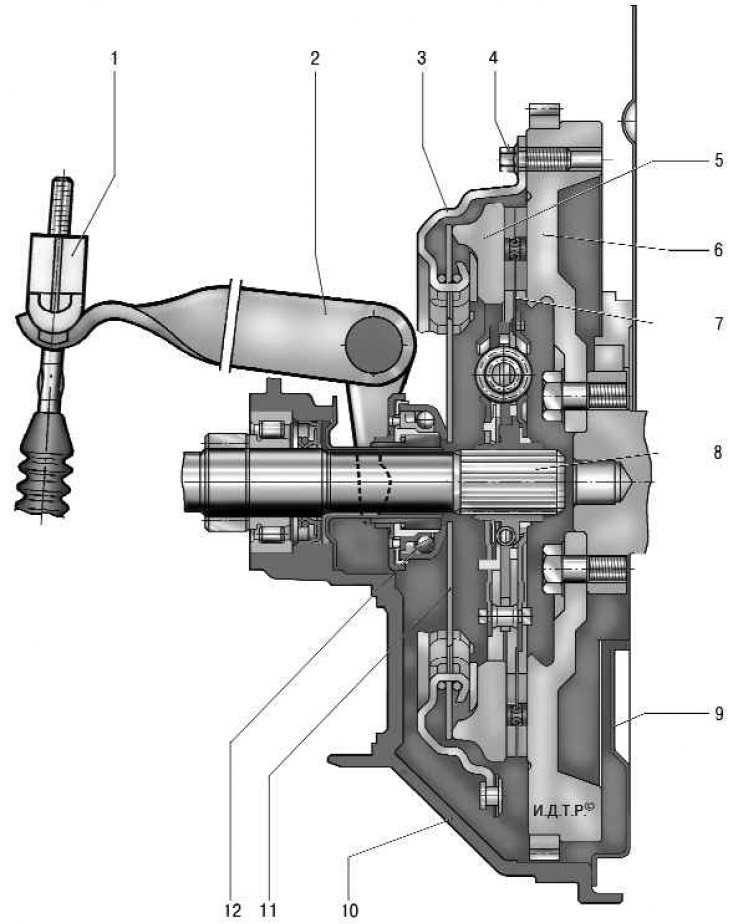
Figure 6.1. Clutch: 1 – cable tip leash; 2 – clutch release fork lever; 3 – clutch housing; 4 – bolt securing the clutch to the flywheel; 5 – pressure plate; 6 – flywheel; 7 – driven disk; 8 – primary shaft of the gearbox; 9 – Front clutch housing cover; 10 – clutch housing; 11 – pressure spring; 12 – clutch release bearing
Clutch single-disc, dry, permanently closed, with central pressure spring 11 (figure 6.1, 6.3) and a torsional vibration damper on the driven disk 7. The clutch housing 3 is attached to the flywheel 6 with six bolts 4, and is connected to the pressure plate 5 with three pairs of elastic plates.
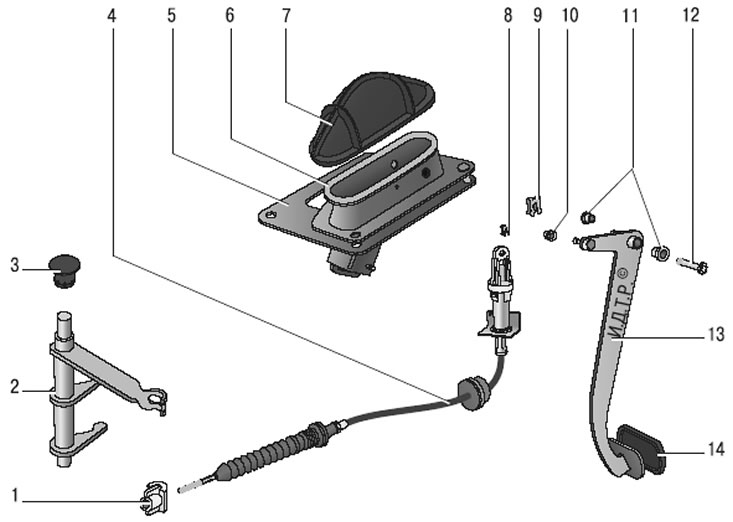
Figure 6.2. Clutch release drive: 1 – cable leash; 2 – clutch release fork; 3 – fork axle bushing; 4 – cable; 5 – seal; 6 – clutch pedal bracket; 7 – case; 8 – locking bracket; 9 – bracket; 10 – bushing; 11 – Clutch pedal axle bushing; 12 – clutch pedal axle; 13 – clutch pedal; 14 – Clutch pedal cover
Clutch release drive cable, gap-free (there are no gaps in the drive). Cable 4 (figure 6.2) the clutch release drive is equipped with a ratchet mechanism designed to compensate for the length during operation when the driven disk linings wear out (no drive adjustment is required during operation).
Clutch pedal 13 is installed in bracket 6, secured to the front shield, on the axle through two plastic bushings. The upper part of the pedal is connected to the body of the clutch driven disc wear compensation mechanism. The upper end of the cable sheath is secured to the clutch pedal bracket using a plate stop, and the lower end of the cable is secured to a bracket mounted on the gearbox housing.
Plastic leash 1 (see figure 6.1) the lower end of the cable is connected to lever 2 of the clutch release fork. Clutch release bearing 12 is of a closed type and does not require lubrication during operation. The main parameter that determines the operation of the clutch release drive is the travel of the clutch pedal until it hits the floor mat of the vehicle body. The pedal travel is not adjusted during operation; it is provided by a structurally sound mechanism for compensating for wear of the clutch driven disk linings and the correct initial installation of the drive cable (see "Replacing the clutch release cable").
Note: To ensure long and trouble-free clutch service, do not keep your foot on the clutch pedal all the time. This bad habit is often acquired during driving lessons at driving schools due to the fear of not having time to disengage the clutch when the car stops. In addition to the rapid fatigue of the foot, which is always above the pedal, the clutch is at least slightly pressed, and the driven disk slips and wears out. In addition, although the release bearing is designed to operate in constant rotation mode, when the pedal is pressed even slightly, it experiences increased load and its service life is also reduced.
Note: For the same reason, we do not recommend keeping the clutch in the disengaged position for a long time (for example, in traffic jams). If you don't have to move off right away, it's better to put the gearbox in neutral and release the pedal.
(Data taken from the specified website: LADAman)
Note: Clutch slippage can be easily determined using a tachometer. If, while driving, when you press the accelerator pedal sharply, the revs increase sharply, and then drop slightly and the car begins to accelerate, the clutch requires repair.