



Note: The hood is quite heavy and bulky, so we recommend removing it with an assistant.
If the hood is not to be replaced, it is recommended to mark the position of the washers relative to the hood hinges to facilitate its subsequent installation. In this case, there is no need to remove the sound insulation, rubber buffers and safety hook.
You will need: 10 and 13 mm wrenches, a flat-blade screwdriver, and side cutters.
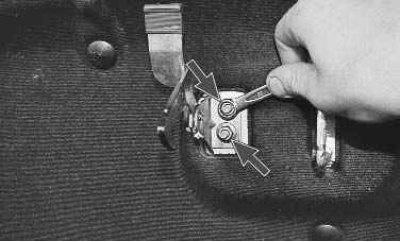
1. Open the hood and remove the safety hook from it by unscrewing the two nuts securing it with a 10 mm wrench.
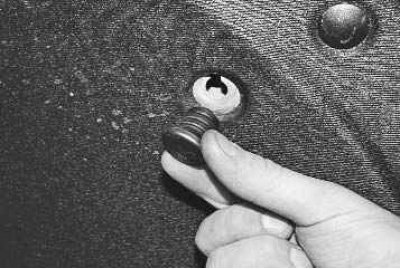
2. Unscrew the two rubber buffers.
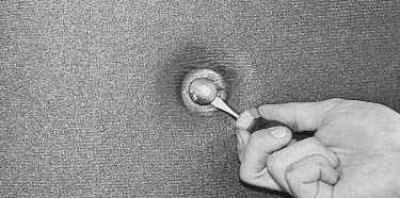
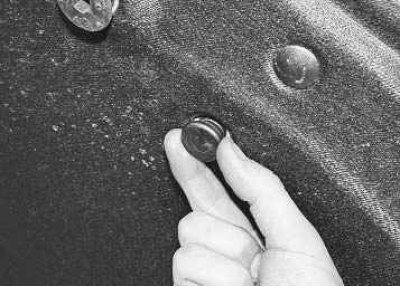
3. Using a screwdriver, remove the nineteen plastic pins securing the hood sound insulation and remove the sound insulation.
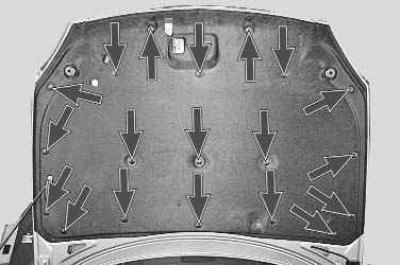
Note: This is how the noise insulation mounting pins are located.
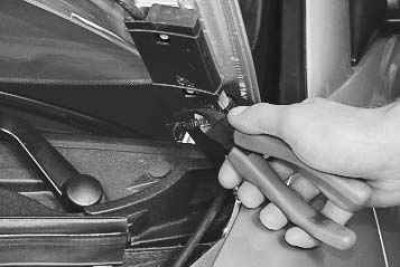
4. Cut the windshield washer hose holder clamp…
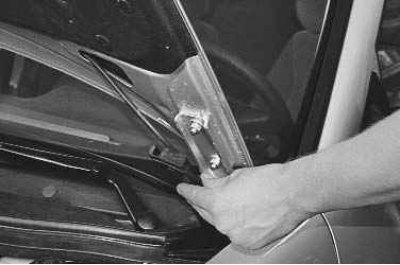
5. …and remove the holder.
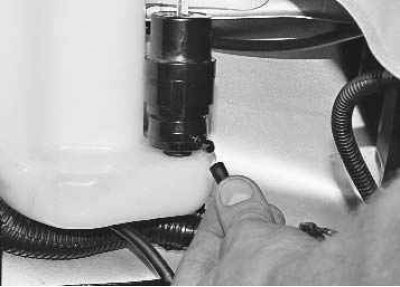
6. Disconnect the windshield washer hose from the washer pump.
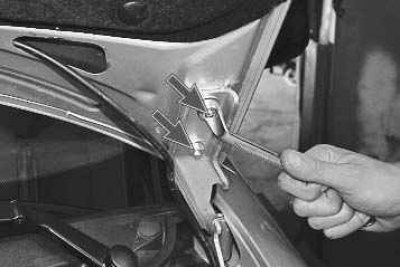
7. Unscrew two nuts securing the hood on both hinges. In this case, the assistant must hold the hood. Please note that there are spring washers installed under the nuts.
8. With the help of an assistant, remove the pins on the hood from the holes in the hinges and remove the hood.
9. Install the new hood onto the hinges. The hood position is adjusted using enlarged holes in the hinges. Therefore, before finally tightening the mounting nuts, close the hood and move it so that the front edge of the hood is flush with the radiator grille. Carefully open the hood and tighten its mounting nuts completely. Install the sound insulation, rubber buffers and safety hook on the hood in the reverse order of removal.
10. The height of the hood is adjusted by turning the rubber buffers in or out. When adjusted correctly, the gaps between the hood and front fenders are equal and uniform on both sides.
11. Check the ease of opening and reliability of the hood lock, if necessary, adjust the position of the lock (see "Adjusting the position of the hood lock").