



Note: Also see the detailed description of work on replacing CV joints, boots and the experience of car owners. here.
Outer CV joint
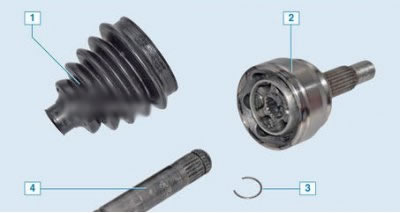
1 – anther; 2 – outer CV joint assembly; 3 – retaining ring; 4 – shaft
For lubrication of outer CV joints, use MOBIL CVJ 825 BLACK STAR grease (comes with a repair kit). The domestic analogue is SHRUS-4 grease.
Approximate dimensions of the outer CV joint boot: small inner diameter - 23 mm, large inner diameter - 79 mm, height (length) - 106 mm.
Replacing the outer CV joint
Remove the front wheel drive (see left-hand drive or right hand drive). We clean it from dirt and clamp the drive shaft in a vice.
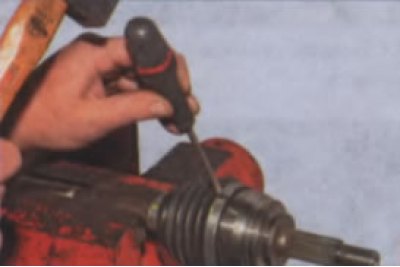
Having placed the blade of a slotted screwdriver at the junction of the lock of the large clamp, we strike the handle of the screwdriver with a hammer.
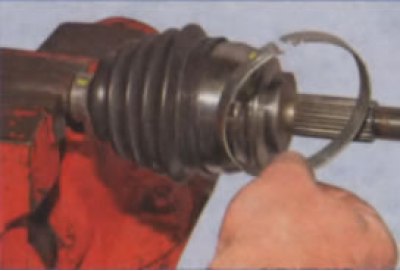
Having opened the clamp lock, we remove the clamp.
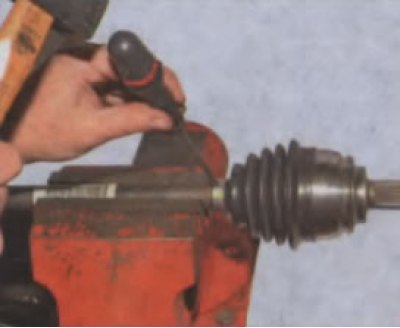
Having placed the blade of a slotted screwdriver at the junction of the small clamp lock, we strike the handle of the screwdriver with a hammer.
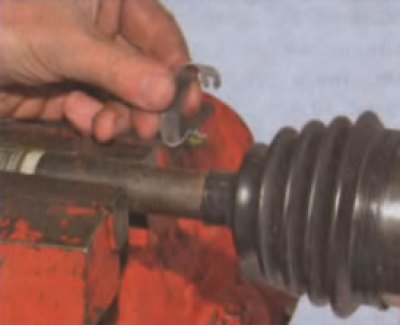
Having opened the clamp lock, we remove the clamp.
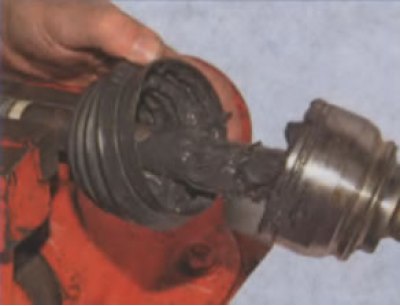
We remove the boot from the outer CV joint housing and move the boot along the shaft towards the inner CV joint.
The outer CV joint cage is fixed on the shaft with a retaining ring and it is quite difficult to press it off the shaft.
Therefore, if you only need to replace the boot of the outer CV joint of the left drive, we recommend removing the inner joint from the shaft (see "Removing the inner CV joint"), after which...
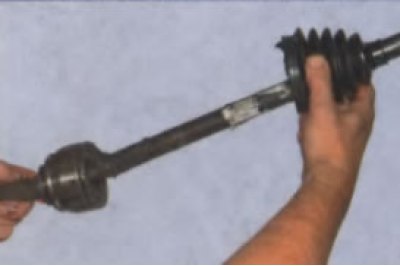
...we pull the boot off the shaft from the side of the inner CV joint.
It is not possible to replace the boot on the right wheel drive in the same way, since a rubber damper is put on the right drive shaft and when removed, its tight fit is disrupted. In this case, the boot can only be replaced after the outer joint has been removed from the shaft.
To remove the outer CV joint...
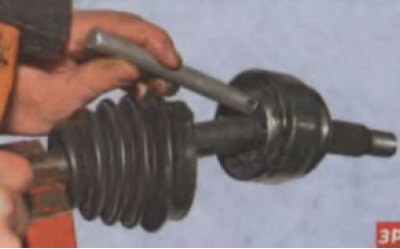
...using a soft metal punch, we knock the outer CV joint off the splines of the drive shaft, striking the end of the sleeve and moving the punch around the circumference of the sleeve.
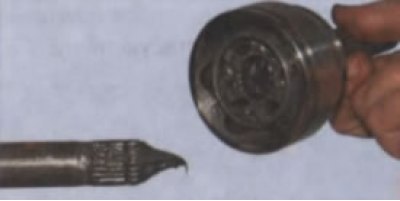
We remove the outer CV joint from the shaft.
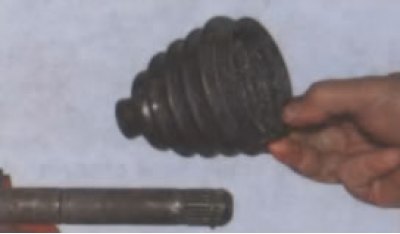
We remove the boot from the shaft.
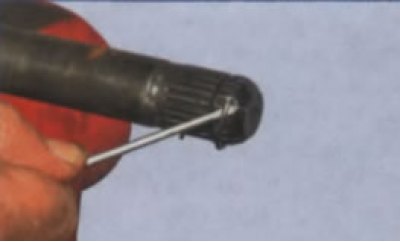
Using a screwdriver, pry off the retaining ring...
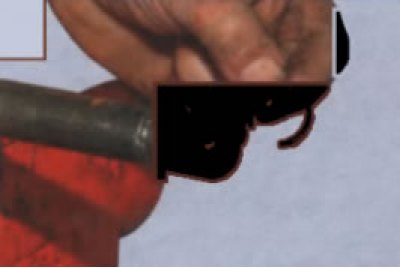
...we take it out of the groove on the shaft.
If the CV joint is removed only to replace the boot (when it is known that it was damaged recently and the CV joint has retained its functionality), then, without disassembling the joint, we remove the old grease from the joint and wash it in kerosene. We blow out the joint with compressed air. We inspect the balls, separator, cage and internal cavity of the housing. Scores, dents, cracks, traces of corrosion on the hinge elements are not allowed - such a hinge is replaced. We clean the shaft from old grease and apply a thin layer of new grease to it. We put a new boot on the shaft. We install a new retaining ring into the shaft groove. We insert and evenly distribute the required volume of new grease into the cavities of the CV joint housing and its boot.
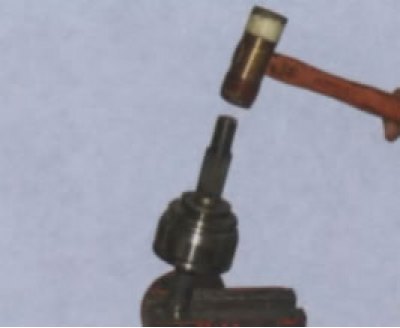
We put the CV joint on the shaft and, striking the splined tail of the joint with a hammer with a soft metal striker, press the CV joint onto the shaft.
We check the fixation of the CV joint cage with a retaining ring. We check the mobility of the CV joint - it should move without jamming. We pull the boot onto the CV joint housing so that the boot belts under the clamps are located in the corresponding places on the shaft and the joint housing. We secure the boot with new clamps. The design of factory clamps for CV joint installation does not allow them to be installed in a garage, since this requires special equipment.
In this case, for example, you can use universal clamps with locks for fastening CV joint boots, which are available on the market.
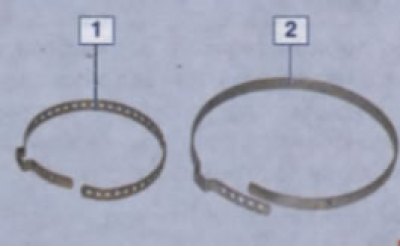
Universal clamps for CV joint boot: 1 - clamp for fastening boot on drive shaft: 2 - clamp for fastening boot on joint housing
Having installed the clamp into the groove of the boot and fastened the lock...
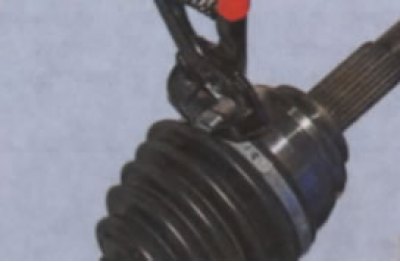
...we use pliers with blunt edges to squeeze the clamp lock.
We check the reliability of the clamp fastening by trying to move it by the lock along the groove of the boot. When properly tightened, the clamp should not move. We install the front wheel drive in the reverse order.
Replacing the inner CV joint
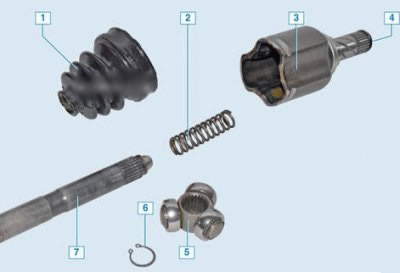
1 – anther; 2 – spring; 3 – inner CV joint housing; 4 – housing retaining ring; 5 – three-spined (tripod); 6 – three-spike retaining ring; 7 – shaft
For lubrication of inner CV joints of the car with JR5 gearbox and right inner CV joint of the car with JH3 gearbox use MOBIL CVJ 825 BLACK STAR grease. Domestic analogue is SHRUS-4 grease.
For the left inner CV joint of vehicles with a JH3 gearbox, grease 7711420011 is used.
Remove the front wheel drive (see left-hand drive or right hand drive).
Main material on the website [www.ladaman.ru]
We clean the drive from dirt and place it on the workbench.
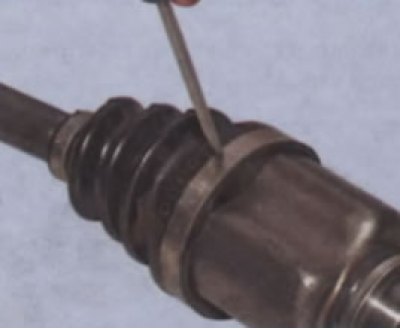
Having placed the blade of a slotted screwdriver at the junction of the lock of the large clamp, we strike the handle of the screwdriver with a hammer.
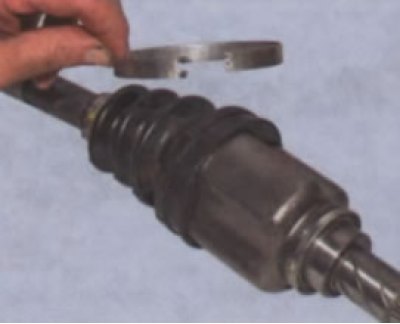
Having opened the clamp lock, we remove the clamp.
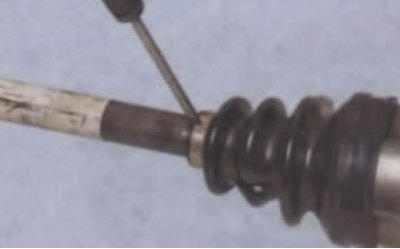
Having placed the blade of a slotted screwdriver at the junction of the small clamp lock, we strike the handle of the screwdriver with a hammer.
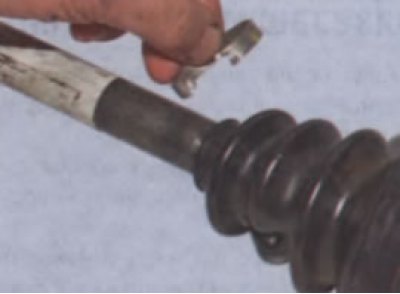
Having opened the clamp lock, we remove the clamp.
We pull the boot off the inner CV joint housing...
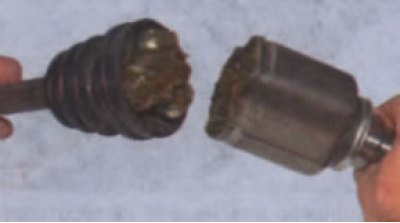
...and remove the hinge housing.
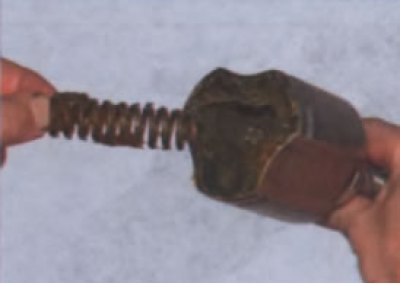
We remove the spring from the hinge housing.
Having clamped the drive shaft in a vice...
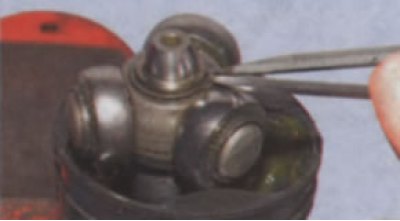
... using two slotted screwdrivers or special pliers for removing retaining rings...
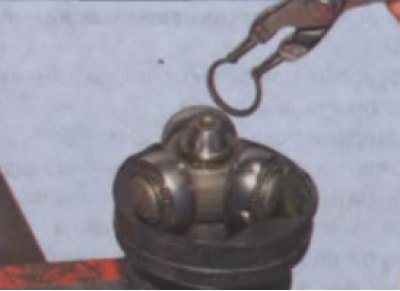
... we remove the retaining ring from the groove on the shaft.
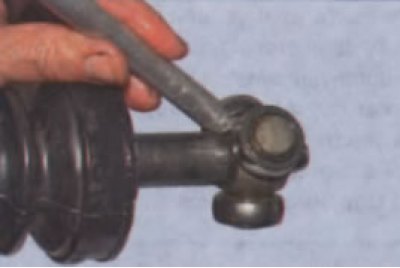
Using a soft metal drift, we knock the three-spike off the shaft splines by striking the end of the three-spike hub and moving the drift around the circumference of the hub.
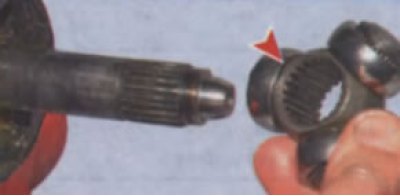
We remove the three-spike from the shaft.
During subsequent assembly of the joint, the three-pin joint should be installed on the shaft so that the groove on the three-pin joint (shown by arrow) was directed towards the anther.
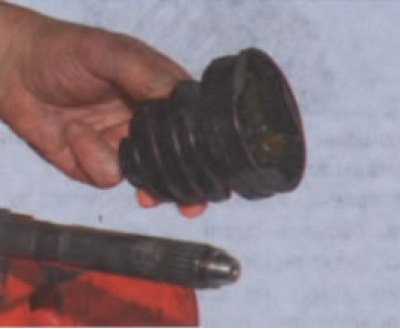
We remove the boot from the shaft.
If the spring is broken or has lost its elasticity, replace it with a new one.
We remove the old grease from the CV joint housing and wash it in kerosene. Wipe with a rag and blow with compressed air. We inspect the rollers, the needle bearings of the three-stud joint and the internal cavity of the CV joint housing. The rollers of the three-stud joint should rotate on the needle bearings freely, without jamming. Before installing a new boot, apply a small amount of grease to the end of the shaft. Having put the boot on the shaft, we place its belt under the small clamp in the shaft groove. We press the three-spike onto the shaft and secure it with a retaining ring. We put half of the recommended volume of required lubricant and distribute it evenly in the cavity of the CV joint housing, and the other half in the cavity of the boot. We install a new retaining ring into the groove of the body tail. We put the housing on the three-spike and pull the boot, placing its belt under the large clamp in the housing's installation groove. We secure the boot with new clamps.
We install the front wheel drive in the reverse order.