



In front disk brakes, rear - drums.
| Engine, transmission | 1.6 l 16 cl (106 hp) 5MT | 1.6 l 16 cl (110 hp) 5MT | 1.8 l 16 cl. (122 hp) 5MT | 1.8 l 16 cl. (122 hp) 5AMT |
| Body | ||||
| Wheel arrangement / driving wheels | 4x2 / front | |||
| Engine location | anterior transverse | |||
| Body type / number of doors | crossover / 5 | |||
| Number of seats | 5 | |||
| Length/width/height mm | 4155 / 1764 / 1570 | |||
| Base, mm | 2592 | |||
| Track front/rear, mm | 1404...1492 / 1524...1532 | |||
| Road project, mm | 195 | |||
| Volume of luggage compartment in passenger/cargo variants, l | 361 / 1207 | |||
| Engine | ||||
| Engine code | 21129 | H4M | 21179 | 21179 |
| Engine type | petrol | |||
| Power supply system | electronically controlled fuel injection | |||
| Number of cylinders | 4, in-line | |||
| Working volume, cm³ | 1596 | 1598 | 1771 | 1771 |
| Maximum power, kW (hp) / rpm. | 78 (106) / 5800 | 81 (110) / 5500 | 90 (122) / 5050 | 90 (122) / 5050 |
| Maximum torque, Nm/rpm. | 148 / 4200 | 150 / 4000 | 170 / 3700 | 170 / 3700 |
| Fuel | gasoline, min 92 | |||
| Dynamic characteristics | ||||
| Maximum speed, km/h | 176 | 181 | 179 | 185 |
| Acceleration time to 100 km/h, s | 11.4 | 11.1 | 10.3 | 10.9 |
| Fuel consumption | ||||
| Urban cycle, l/100 km | 9.3 | 8.9 | 9.3 | 8.6 |
| Extra-urban cycle, l/100 km | 5.9 | 5.6 | 5.8 | 5.8 |
| Combined cycle, l/100 km | 7.2 | 6.8 | 7.1 | 6.8 |
| Weight | ||||
| Curb weight, kg | 1190...1250 | |||
| Technically permissible maximum weight, kg | 1650 | |||
| Maximum trailer weight without brake system / with brake system, kg | 600 / 800 | |||
| Fuel tank capacity, l | 50 | |||
| Transmission | ||||
| Transmission type | 5MT | 5MT | 5MT | 5AMT |
| Final drive ratio | 4.5 | 4.4 | 4.2 | 3.9 |
| Suspension | ||||
| Front | Independent, MacPherson type, spring, with hydraulic or gas-filled telescopic shock absorbers, with anti-roll bar | |||
| Back | Semi-independent, lever, spring, with hydraulic or gas-filled telescopic shock absorbers | |||
| Steering | ||||
| Steering gear | rack and pinion | |||
| Tires | ||||
| Dimension | 195/65 R15 (91, H); 205/55 R16 (91, H/V); 205/50 R17 (93, W) | |||
Dimensions
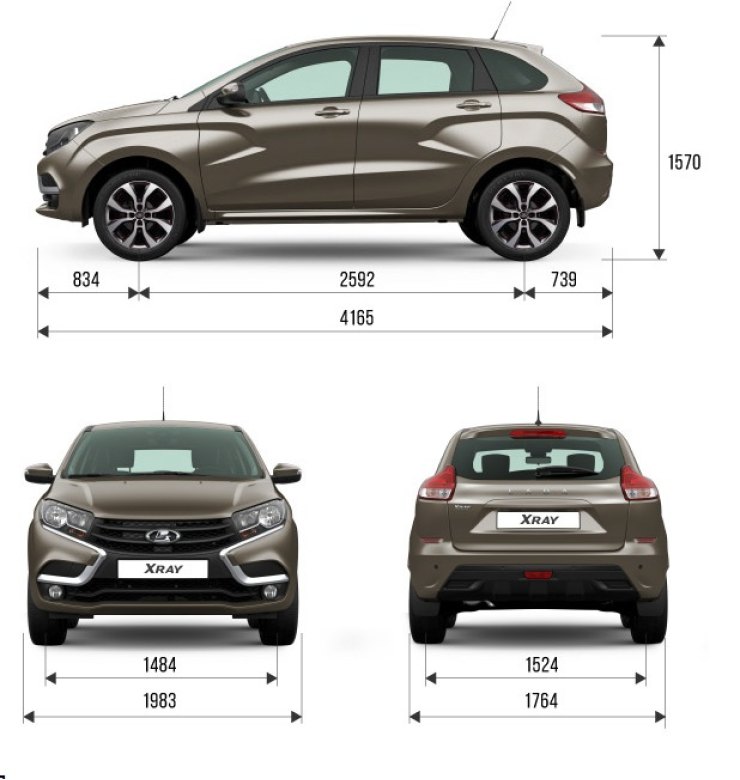
Overall length Lada Xray is 4165 mm wide (along the rear wheel arches) – 1764 mm, height with unladen weight* and without roof rails – 1570 mm. Wheelbase length – 2592 mm.
For comparison: Renault Sandero Stepway has the following characteristics: 4080 x 1757 x 1618 mm; 2589 mm.
Article copied from the resource (ladaman.ru)
Ground clearance the platform-sharing vehicles have the same width – 195 mm.
The weight distribution between the front and rear axles is 51 and 49%
Front track of Lada Xray – 1592 mm for 15" disks; 1484 mm for 16" wheels. The rear track size is 1532 and 1524 mm, respectively.
Front overhang – 830 mm, rear – 743 mm. Approach/departure angle with unladen weight – 21/34 degrees.
Luggage compartment volume in the passenger version - 361 liters; with rear seats folded – 1207 liters; with the rear and front passenger seats folded – 1514 liters.
Engines
For Lada Xray 2016 is provided three power units:
- hR16 engine with a volume of 1.6 liters and a power of 110 hp. (alliance development) and a five-speed manual transmission (alliance development) - since June 2016 discontinued;
- engine 21129 with a volume of 1.6 liters and a power of 106 hp. (development of Lada) and manual transmission (alliance development);
- engine 21179 with a volume of 1.8 liters and a power of 122 hp. (development of Lada) and a robotic gearbox (development of Lada). In the fall of 2016, this engine became available with "mechanics" (see test drive)
The least powerful version of XRay is overclocked from zero to one hundred kilometers per hour in 11.9 seconds (mechanics), the modification with a 114-horsepower engine - in 10.3 seconds (mechanics), and the top version with a 1.8-liter engine in combination with a "robot" - in 10.9 seconds.
The base engine for the X-ray will be a VAZ engine 16-valve unit with a volume of 1.6 liters. The engine power will be 106 hp., and it will be aggregated with the French manual gearbox JR5, assembled at AVTOVAZ. It was decided to abandon the VAZ "mechanics" because of its noise. Maximum speed - 170 km/h. Consumption 7.5 liters. Price 589 thousand rubles.
The second engine for the 2017 LADA XRAY is a combination of the Nissan H4 engine, also localized at VAZ, and the same JR5 "mechanics". Obviously, we are talking about 1.6-liter petrol engine with 110 hp. It is also installed on the Nissan Sentra, although it produces 114 hp. 4 "horses" disappeared due to "adaptation". Consumption in a mixed style will be 6.9 liters. Price from 639 thousand rubles. - discontinued
The third engine for LADA XRAY is a VAZ unit 1.8 l, producing 122 hp. and working in tandem with VAZ automated manual transmission (AMT). With this engine, the X-Ray will accelerate to 100 km/h in 10.9 seconds, and its maximum speed will be 183 km/h. Fuel consumption is 7.1 liters. Price from 669 thousand rubles.
VAZ-21179 (1774 cm³) — the first serial domestic engine with variable valve timing
Suspension the VAZ newcomer borrowed its design from the Renault Sandero (the new Lada is built on the basis of the hatchback), but it has different springs and shock absorbers, as a result of which the XRAY "completely lost its legendary Logan roll".
An important point on the Lada X Ray is non-disconnectable traction control system TCS (or traction control as many call it). This system prevents wheel slippage and loss of traction, but sometimes it still gets in the way, for example, in the snow you can simply get stuck, since the wheels will slip and the system will lock them.