



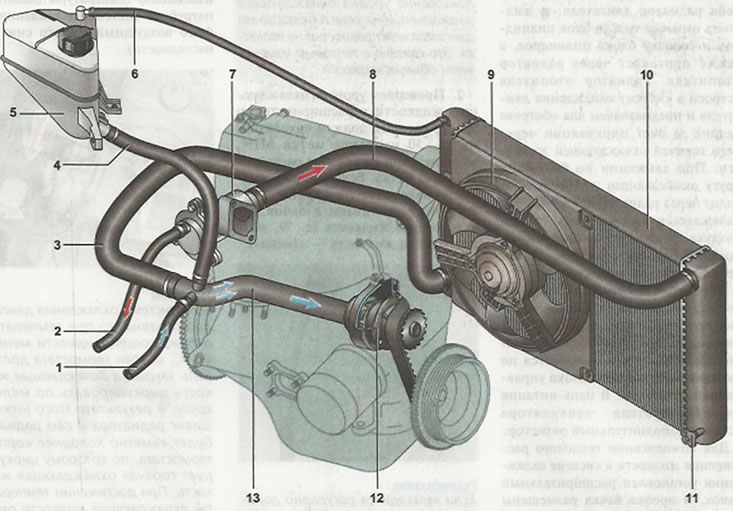
Cooling system: 1 - coolant drain hose from the heater radiator; 2 - coolant supply hose to the heater radiator; 3 - hose for draining liquid from the engine radiator; 4 - expansion tank hose; 5 - expansion tank; 6 - engine radiator steam bleed hose; 7 - thermostat; 8 - hose for supplying liquid to the engine radiator; 9 - radiator electric fan; 10 - engine radiator; 11 - radiator drain plug; 12 - Coolant pump; 13 - coolant pump supply pipe.
The engine cooling system is liquid, closed type with forced circulation of coolant and an expansion tank.
The engine cooling system uses special fluids based on a mixture of water and ethylene glycol. They have a low freezing point and a high boiling point. In addition, thanks to the complex of added additives, the coolant prevents corrosion of the channel walls, does not foam, and extends the service life of the coolant pump seal.
The circulation of liquid in the system is provided by a centrifugal pump installed in the cylinder block. The pump drive is drained by a toothed timing belt.
The cooling system consists of two so-called circulation circles. The small circle does not include the engine radiator, and the fluid washes only the cylinder block and cylinder head, and also flows through the heater radiator. The heater radiator is built into the engine cooling system and is designed to heat the interior by circulating hot coolant through it. When moving in a large circle, the coolant passes through the engine radiator, where it is cooled by the oncoming air flow. The thermostat controls the direction of fluid flow in the engine cooling system.
If the air flow is not intense enough, the radiator is cooled by an electric fan. It is installed behind the engine radiator and is switched on by a signal from the electronic engine control unit. An additional resistor is built into the fan motor power supply circuit.
To compensate for thermal expansion of the liquid, an expansion tank is installed in the cooling system. The tank cap contains inlet and outlet safety valves, which allows maintaining optimal pressure in the system when the liquid overheats, and also compensates for the vacuum when it cools down.