



Front and rear towing eyes
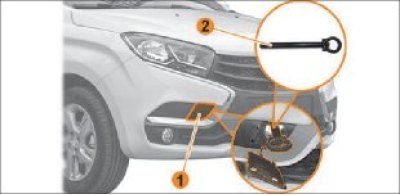
Figure 9.6. Front towing eye: 1 – Cover. 2 – Eye.
Design and location of front/rear towing eye: under cover 1 (Figure 9.6, 9.7) there is a threaded sleeve into which the towing eye is screwed. Towing eye 2 is located in the luggage compartment (see Figure 9.4.1.).
The towing eyes are only permitted to be used when towing on paved roads.
Pulling out a stuck vehicle using the eyes is prohibited.
Keep people away from vehicles during towing, especially if the vehicle becomes stuck (a broken cable may cause injury).
Avoid high-speed wheel spin when stuck, which can cause tire blowouts and injury, as well as overheating and damage to the transmission.
The lugs are screwed in clockwise and unscrewed counterclockwise (right hand thread).
Do not screw in any bolts or eyes from other vehicles instead of the standard towing eye, as this may cause damage to the threads, subsequent sudden separation of the eye with the cable and an accident.
The towing eye must be tightened until it stops and with force (using a wheel wrench), otherwise she might get out of it.
The towing rope must not be twisted, otherwise the towing eye may come loose.
Always remove the towing eye after towing, otherwise you risk causing serious injury to pedestrians.
Before towing, turn the ignition switch to the "ON" position and the transmission lever to the "neutral" position.
If there is damage to the wheels, transmission, suspension, steering, body or other parts of the vehicle that prevent the vehicle from being safely towed, a support dolly or a tow truck should be used for towing.
To tow a vehicle over long distances, use a support dolly or a tow truck.
Before towing, it is necessary to lighten the towed vehicle as much as possible (place passengers and luggage in the tractor).
Towing must be carried out in strict compliance with local traffic regulations (including requirements for permissible weights, speed limits, operation of light signals, etc.).
When towing, use certified types of rigid hitches or flexible cables.
It is prohibited to apply lateral forces to the towing eye, which occur when the cable is deflected to the side (try to position the tractor so that the cable has a minimum deviation to the right/left or up/down).
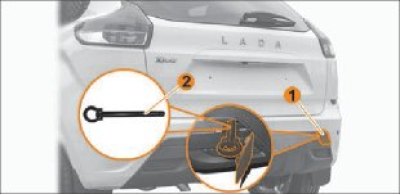
Figure 9.7. Rear towing eye: 1 – Cover. 2 – Towing eye.
Warning: When stowing the tools, make sure they are correctly positioned in the luggage compartment as they were originally. do not leave tools unsecured as they may move and injure people when braking.
The brake booster only performs its function when the engine is running. Therefore, when towing a vehicle with the engine off, you should press the brake pedal much harder when braking.
The power steering does not work when the engine is off (disabled), so the effort on the steering wheel will increase significantly.