



Purpose, composition and operating principle of the system
The system is designed to detect obstacles located behind the vehicle and warn the driver of the distance to the obstacle using an acoustic signal.
The system detects obstacles using four ultrasonic sensors operating on the echolocation principle, which are located in the rear bumper of the car.
The parking system includes the following components:
- safe Parking System Control Unit;
- parking safety system sensor;
- parking Safety System Alarm Unit;
- rear bumper;
- wiring harness for parking safety system sensors.
The system is activated automatically if the ignition switch key is in position "I" and reverse gear is engaged, and a short high-pitched sound signal is emitted to confirm that the system is activated.
If an obstacle is within the detection zone, the system informs the driver of the presence of the obstacle with an audible signal. The signal can be intermittent or continuous, depending on the distance to the obstacle. The car can move in reverse or stand still.
When the vehicle approaches an obstacle, starting from a distance of approximately 100 cm, an intermittent high-pitched alarm signal is activated, the frequency of which increases as the vehicle gets closer to the obstacle. The signal becomes continuous when the distance between the bumper and the obstacle is about 40 cm.
Once reverse gear is disengaged, the parking safety system is automatically deactivated.
Features of operation and maintenance of the safe parking system
After the system is turned on, the control unit performs a comprehensive check to detect defective sensors or other system malfunctions.
If a defective sensor or other system malfunction is detected, after the power-on signal, a continuous high-pitched beep sounds for 3 seconds, then:
- if the left one is faulty (in the direction of the car) sensor, the system signals a faulty sensor with one short high-pitched signal;
- if the center left one is faulty (in the direction of the car) sensor, the system signals a faulty sensor with two short high-pitched beeps;
- if the central right one is faulty (in the direction of the car) sensor, the system signals a faulty sensor with three short high-pitched beeps;
- if the right one is faulty (in the direction of the car) sensor, the system signals a faulty sensor with four short high-pitched beeps;
- if the control unit is faulty, five short high-pitched beeps are heard.
After signaling a malfunction, the system switches off.
It should be taken into account that due to the peculiarities of the propagation of ultrasonic waves, the system does not always detect dangerous obstacles:
- located near the car below the sensors;
- absorbing ultrasonic waves - down clothing, soft snow, etc.;
- scattering ultrasonic waves - thin objects, pointed objects, smooth walls.
Additionally, heavy precipitation and/or other conditions that distort the sensor signals may impair the ability of the sensors to detect obstacles.
When the vehicle is fully loaded, low-lying obstacles that are not dangerous to collide with may be detected.
Information taken from the website: Ladaman.ru
When operating the vehicle with a trailer, the parking system may be disabled.
To prevent malfunction, sensors must be kept free of snow, ice and dirt. When cleaning the sensors, do not use hard or sharp objects.
Lada X-Ray. Removal and installation of units and parts of the safe parking system
Safe parking system sensor
Removal
Place the vehicle on a two-post lift and apply the parking brake (electro-hydraulic lift type P-3.2 G with a lifting capacity of 3.2 t).
Turn off the ignition, lift the hood, disconnect the ground wire terminal from the battery (spanner 10).
Raise the vehicle to a height convenient for performing the work.
Disconnect the connector of sensor 1, Figure 18-1, of the parking safety system from the connector of the 2 wire harness of the rear bumper.
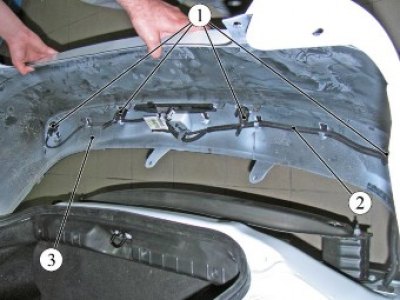
Figure 18-1 - Parking Assist System Sensors (on the removed rear bumper): 1 - parking safety system sensor; 2 - rear bumper wiring harness; 3 - rear bumper
Press the latches of the holder 2, Figure 18-2, of the parking sensor and remove the sensor 1 of the safe parking system.
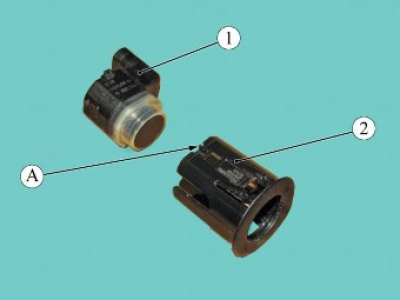
Figure 18-2 - Components of the parking safety system sensor: 1 - parking safety system sensor; 2 - parking sensor holder; A - holder orientation mark
If necessary, squeeze the holder clamps and remove the parking sensor holder from the rear bumper.
Installation
Install the parking safety system sensor in the reverse order of removal.
When installing holder 2, Figure 18-2, of the parking sensor on the rear bumper, mark "A" must be in the upper position.