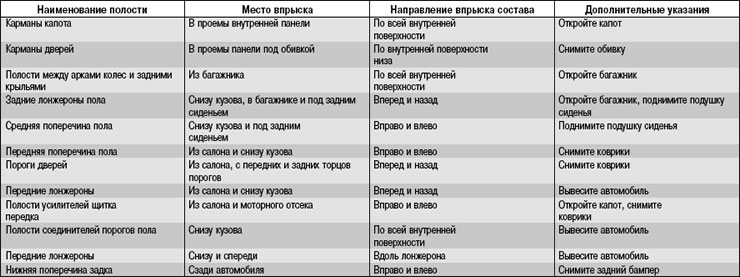
The order of operations for protection of hidden cavities from corrosion:
- place the car on a lift, remove parts and upholstery that prevent access to hidden cavities;
- flush hidden cavities with water at a temperature of 40–50°C through technological and drainage holes (table 11.2) and the bottom of the body until clean water flows out. In this case, the door glass must be raised;
- remove moisture that has entered the interior and trunk, blow out all areas where anti-corrosion compounds have been applied with compressed air;
- drive the car into the anti-corrosion compound application chamber and place it on a lift. Spray the anti-corrosion compound to the areas shown in the picture 11.5;
- lower the car from the lift, clean the front surfaces of the body from dirt with a rag soaked in white spirit.
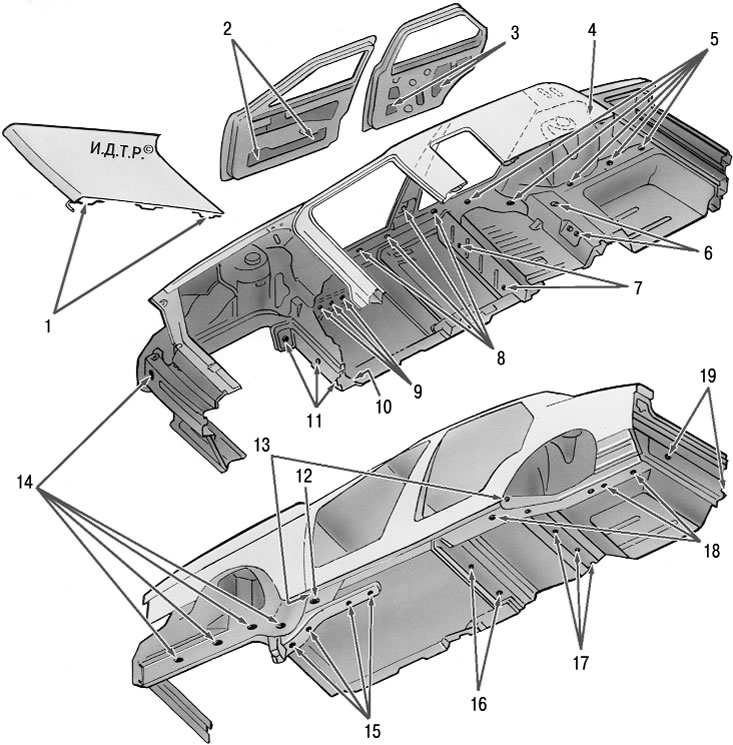
Figure 11.5. Hidden cavities of the body: 1 – hood pockets; 2 – front door pockets; 3 – rear door pockets; 4 – cavities between the rear wheel arches and the rear fenders; 5 – rear floor rails; 6 – middle floor crossbar; 7 – front floor crossbar; 8 – door thresholds; 9 – front floor rails; 10 – cavities of the front shield reinforcements; 11 – cavities of the front shield reinforcements (from the engine compartment side); 12 – cavities of floor threshold connectors; 13 – floor thresholds (from the ends); 14 – front side members; 15 – front floor rails (from below the body); 16 – Front floor cross member (from below the body); 17 – middle floor crossbar (from below the body); 18 – rear floor rails (from below the body); 19 – lower rear cross member
(Article copied from the resource: «ladaman»)
Table 11.2. Hidden cavities treated with anti-corrosion compounds