



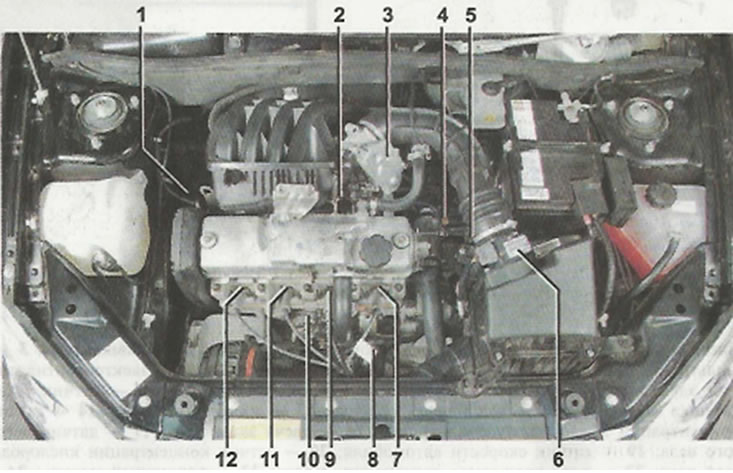
Location of engine control system components in the engine compartment: 1 - crankshaft position sensor installation location; 2 - fuel injector of the third cylinder (the injectors of other cylinders are not visible in the photo); 3 - throttle assembly; 4 - coolant temperature sensor; 5 - purge valve of the adsorber; 6 - mass air flow sensor; 7 - spark plug of the fourth cylinder; 8 - ignition coil and high-voltage wires; 9 - spark plug of the third cylinder; 10 - knock sensor; 11 - spark plug of the second cylinder; 12 - spark plug of the first cylinder.
The engine management system switches the fuel pump on and off, controls the amount of air entering the engine cylinders, injects the required amount of fuel into the intake manifold, controls spark formation on the spark plugs, adjusts the ignition timing, regulates the idle speed of the crankshaft, and controls the electric fan of the engine cooling system.
The engine management system is electronic, with distributed fuel injection. The system consists of the following elements:
- electronic control unit;
- sensors:
- 1) gas pedal position sensor;
- 2) throttle position sensor (built into the throttle assembly);
- 3) knock sensor;
- 4) coolant temperature sensor;
- 5) Mass air flow sensor:
- 6) vehicle speed sensor;
- 7) two oxygen concentration sensors;
- 8) pressure sensor (for vehicles with air conditioning);
- actuators:
- 1) main relay;
- 2) fuel pump relay;
- 3) injectors;
- 4) ignition coils;
- 5) Electric throttle actuator;
- 6) cooling system electric fan relay;
- 7) instrument panel;
- 8) purge valve of the adsorber;
- connecting wires;
- diagnostic connector block.
The engine management system also integrates an anti-theft system (immobilizer).
The main control element of the system is the electronic control unit (ECU), or, as it is often called, a controller with a built-in microprocessor. In essence, the ECU is a specialized mini-computer in which only one program is installed - engine control, and the sensors and actuators form the peripheral equipment of this computer. The block receives and analyzes signals from sensors. Based on the received data, the unit calculates control commands and issues them to the actuators. The unit has three types of memory: read-only memory (ROM), random access memory (RAM), and programmable programmable memory (EPROM).
ROM - non-volatile memory (that is, the information in the memory is retained when the power is turned off) and is a microcircuit ("chip")*. The ROM stores the calculation program and the data necessary for the calculation (engine parameters, transmission ratios and other characteristics). This information is individual for each vehicle modification.
* The design of the ECU may be changed by the manufacturer.
Warning! Unqualified reprogramming of the ROM may result in engine malfunctions, failure of engine management system components, and engine damage.
During operation, the ECU monitors the serviceability of all elements and circuits of the engine control system. Having detected a malfunction, the ECU switches the engine management system to the backup operating mode and turns on the engine malfunction indicator lamp on the instrument panel. The engine will still be able to continue working (except in case of crankshaft position sensor failure, see below), which allows you to get to the repair site under your own power. The ECU records the codes of detected faults in RAM. The operational information that the ECU microprocessor uses in calculations is also stored there. When the battery is disconnected from the vehicle's on-board computer, all information stored in RAM will be deleted.
The EPROM stores the codes of the car's anti-theft system (immobilizer). This type of memory is non-volatile. After activating the immobilizer, the ECU blocks the operation of the engine management system when attempting to start the engine without special electronic keys.
The engine management system ECU is located behind the soundproofing material under the right side of the instrument panel.
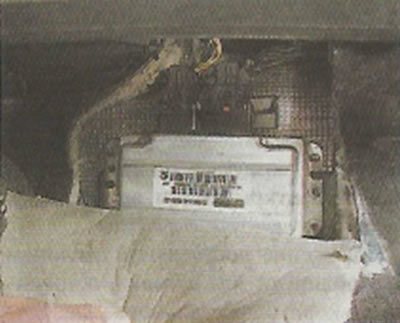
Electronic control unit (ECU)
Crankshaft position sensor (DPKV) is designed to generate signals by which the ECU synchronizes its operation with the engine's operating cycles. That is why this sensor is often called a synchronization sensor. The sensor operates on the principle of induction: when the crankshaft pulley teeth pass the sensor core, AC voltage pulses are generated in the sensor circuit.
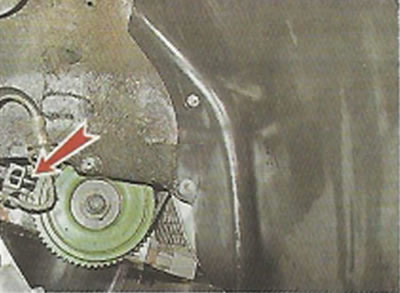
The frequency of pulses corresponds to the crankshaft rotation frequency. The teeth are located around the pulley circumference (6° apart). Two of them are spaced at an angular distance of 18°. This is done to form reference signals in the sensor circuit - a kind of reference points relative to which the ECU determines the position of the crankshaft - the top dead centers in the first/fourth and second/third cylinders. Engine operation with a faulty crankshaft position sensor is impossible. The crankshaft position sensor cannot be repaired; in case of malfunction, it is replaced as an assembly.
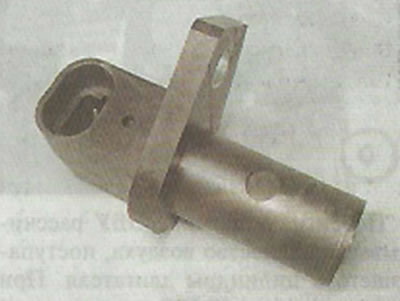
Crankshaft position sensor
Knock sensor (DD) - piezoelectric, reacts to engine vibration. Based on the sensor signals, the ECU determines the moment of detonation during engine operation and adjusts the ignition timing accordingly. If the DD fails, the electronic control unit switches the system to backup operating mode.
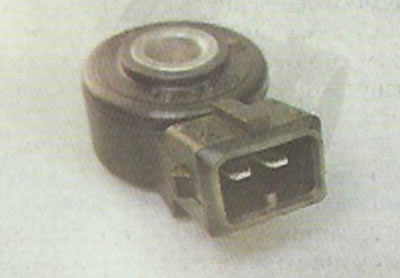
Knock sensor
The cars are equipped with a frequency-type mass air flow sensor, which has proven itself to be more reliable. This type of sensor measures frequency rather than voltage in its output signal.
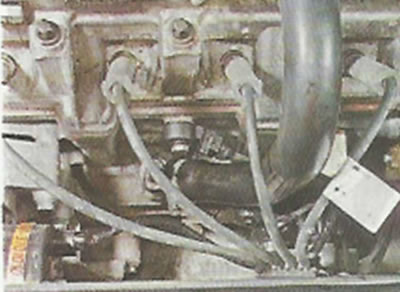
The knock sensor is installed on the front wall of the cylinder block
Mass Air Flow Sensor (MAF) is installed between the air filter and the throttle valve.
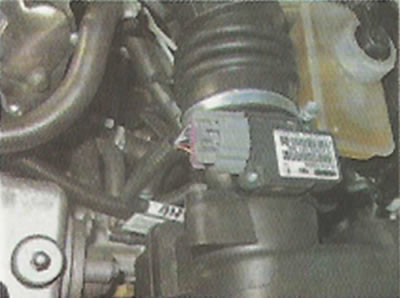
Based on the sensor signal, the ECU calculates the amount of air entering the engine cylinders. If the MAF sensor fails, the electronic control unit switches the system to backup mode.
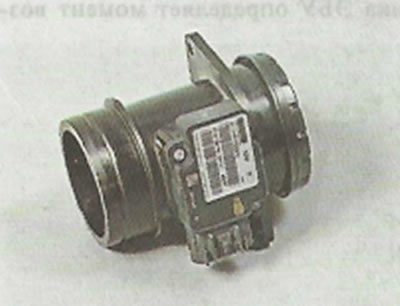
Mass Air Flow Sensor
To enable the engines to meet more stringent emission standards, the throttle actuator is equipped with a gear motor. The gas pedal is electronic and has no mechanical connection with the throttle valve. The engine control is fully electronic. In essence, the driver, by pressing the gas pedal, only indicates what acceleration he would like to give the car, and the engine management system implements this. The same thing happens when the driver releases pressure on the gas pedal, holds it pressed in one position, or completely removes his foot from the gas pedal. At AvtoVAZ, such a system is called "E-gas" (E-GAS). Engines with such a system can comply with environmental standards EURO IV-V.
The amount of air entering the engine cylinders is regulated by the throttle assembly, which is installed between the intake manifold receiver and the air filter.
The throttle valve is turned by an electric motor through a gearbox. Both are built into the throttle body.
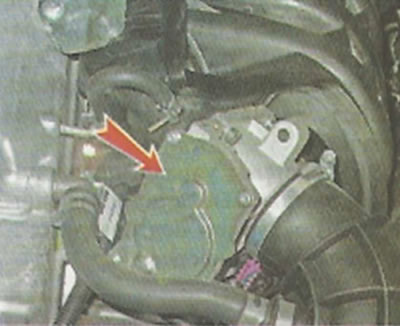
Throttle assembly
When starting and warming up the engine, as well as in idle mode, the air supply to the cylinders is regulated by opening the throttle valve.
The position of the throttle valve is monitored by two sensors built into the throttle body.
The throttle valve opening angle is set by the electronic control unit (ECU) depending on the calculated amount of air that should enter the engine cylinders. The engine operating mode is taken into account (starting, warming up, idling, etc), ambient air and engine temperature, gas pedal position.
Control commands are sent to the throttle assembly on the electric motor. At the same time, the ECU monitors the opening angle of the valve and, if necessary, will send the appropriate commands to adjust its position. As a result of the fact that the ECU simultaneously regulates the amount of injected fuel and incoming air, the optimal composition of the combustible mixture is maintained in any engine operating mode.
The electric throttle body is sensitive to deposits that can accumulate on its inner surface. The resulting layer of deposits can interfere with the smooth movement of the throttle valve, causing it to jam (especially at small opening angles). As a result, the engine will run unstably and even stall at idle, start poorly, and may experience dips in transient conditions. To avoid this, as a preventive measure, deposits should be removed with special cleaning compounds during the next maintenance of the vehicle. A large layer of deposits can completely block the movement of the valve. If flushing fails to restore the functionality of the throttle assembly, it must be replaced.
Malfunction or incorrect operation of the throttle assembly may be caused by a contact fault in its electrical circuit (oxidized terminals in the wiring harness connector block). In this case, it will be possible to restore operation by treating the terminals with a special compound for cleaning and protecting electrical contacts. There may be other reasons for the malfunction:
- there is no supply voltage to the throttle assembly;
- no signals from both throttle position sensors;
- The ECU cannot recognize signals from the throttle position sensors.
In these cases, the engine management system switches to emergency operation mode. At the same time, the car retains the ability to move independently over a short distance at a slow speed, which, in extreme cases, will allow it to be moved to a safe place (pull over, left, crossroads, etc).
The fact that the throttle assembly is operating in emergency mode may be indicated by a lit engine management system malfunction indicator lamp and an increased crankshaft speed at idle (about 1500 min⁻¹, despite the fact that the engine has warmed up to operating temperature). The engine will not respond to pressing the gas pedal.
Each throttle position sensor is a potentiometer. During operation, there is a gradual wear of the conductive paths and moving contacts. Over time, wear can reach such a level that the sensor will no longer function properly. The presence of two sensors increases the reliability of the entire unit.
If only one sensor fails, the control lamp will light, but the engine management system will switch to backup mode. In this case, the engine will adequately respond to pressing the gas pedal, but with worse operating parameters.
The reserve mode allows you to drive your car to the repair site under your own power.
Electronic gas pedal consists of a plastic lever, which is made integral with the pedal, and two sensors built into the bracket. All components form a single structure, sometimes referred to as the gas pedal module.
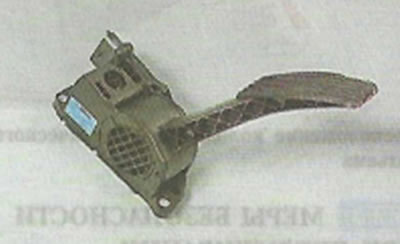
Electronic gas pedal
Each gas pedal position sensor (built into the gas pedal bracket) is a potentiometer whose movable contact is rigidly connected to the rotary axis of the pedal lever. The electronic control unit (ECU) continuously monitors the pedal position using sensor signals. The change in position is monitored by changing resistance at the terminals of both sensors. In accordance with these parameters, the ECU will send control commands to the throttle body motor-reducer and to the fuel injectors. As a result of wear of moving contacts or conductive tracks, sensors may fail or the signals coming from them will be incorrect. If the signals are disrupted, the engine will operate unstably, and "failures" are possible during transient conditions. When idling, the engine crankshaft speed may change spontaneously.
In case of failure of one of the sensors (or its chains), the engine management system malfunction indicator lamp will come on. If the signal from the sensor is not restored within the control time, the ECU will switch the system to backup mode. In this mode, when you sharply press the gas pedal all the way down, the revs will increase slowly. The vehicle can be driven to the repair site under its own power. Some increase in fuel consumption and changes in some other technical parameters of the engine are possible.
If both sensors fail, the ECU will switch the engine management system to emergency operation mode. The engine will only run at a speed slightly above idle (1500 min⁻¹). At the same time, the car retains the ability to move independently, albeit at a slow speed. This will allow you to leave the intersection, pull over to the side of the road, or move your vehicle to a safe location a short distance away if necessary.
In order to switch to certain operating modes, the engine management system requires monitoring the position of the brake pedal. The brake pedal position sensor is a brake light switch, which has two pairs of contacts.
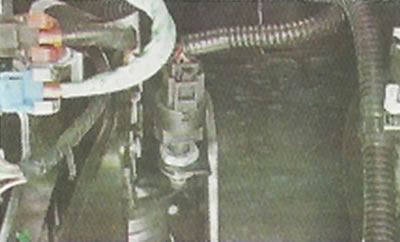
The switch is connected to the ECU by an additional wire. You will also need a sensor to monitor when the clutch is engaged and disengaged. It is installed in the clutch pedal bracket.
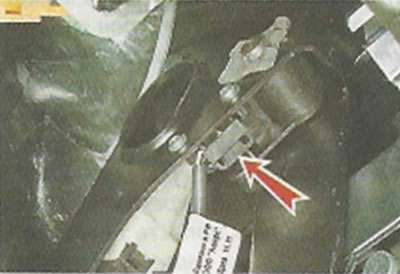
Clutch Pedal Position Sensor works on the same principle as the brake light switch.
Oxygen concentration sensor provides an output signal that the ECU uses to determine the oxygen concentration in the exhaust gases. Based on the data received, the ECU adjusts the amount of fuel injected into the engine cylinders. thereby maintaining the optimal proportion of air-fuel mixture (this is necessary for the efficient operation of the catalytic converter). The oxygen concentration sensor's sensitive element is located in the exhaust gas flow (before the catalytic converter). The sensor can only operate when its sensitive element is heated to a temperature of at least 300°C. To reduce the warm-up time, a heating element is built into the sensor.
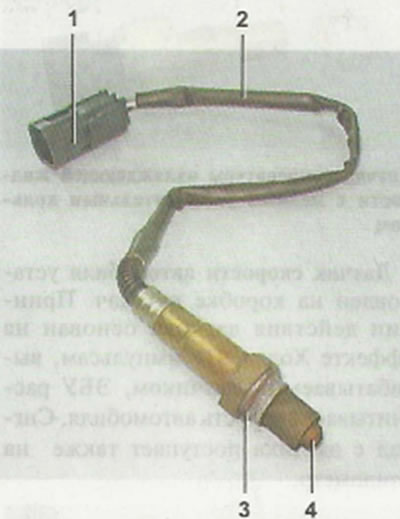
Oxygen concentration sensor: 1 - connection block; 2 - wiring harness; 3 - sealing ring; 4 - a sensitive element with holes for supplying working gases.
To ensure that the engine complies with the EURO IV emission standards, a second oxygen concentration sensor is installed in the exhaust system after the catalytic converter.
Warning! The presence of lead and silicon compounds in the exhaust gases may cause the oxygen concentration sensor to fail. Therefore, the use of leaded petrol is not permitted. When repairing an engine, do not use a sealant with a high silicone content (silicon compounds), vapors of which can enter the cylinders through the crankcase ventilation system and then into the exhaust tract. You should use a sealant that is labeled as safe for use with the oxygen sensor.
Coolant temperature sensor (DTOZH) is a semiconductor device, thermistor, the electrical resistance of which changes with changes in the ambient temperature. The coolant temperature sensor is installed in the thermostat housing. Based on the sensor resistance, the ECU evaluates the engine's thermal conditions. The obtained data are used to calculate most of the control commands for the engine control system elements, as well as to turn on the electric fan of the engine cooling system. If the coolant temperature sensor fails, the electronic control unit switches the system to backup mode.
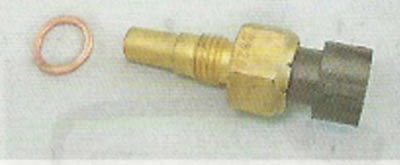
Coolant Temperature Sensor with Copper O-Ring
Vehicle speed sensor installed on the gearbox. The operating principle of the sensor is based on the Hall effect. According to the pulses generated by the sensor. The ECU calculates the speed of the vehicle. The signal from the sensor also goes to the speedometer.
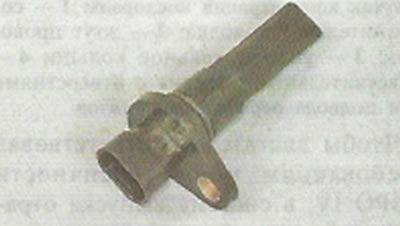
Vehicle speed sensor
The engine ignition system uses one ignition coil. It consists of two dual-terminal ignition coils, made in a single housing. Spark formation occurs in two cylinders simultaneously (1-4 or 2-3). The ignition coil is connected to the spark plugs by four high-voltage wires with non-removable tips.
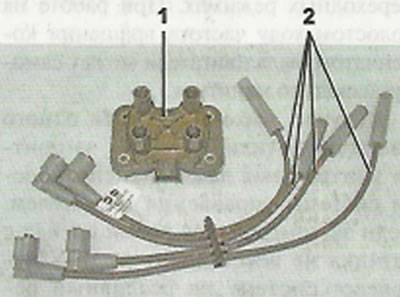
Elements of the ignition system: 1 - ignition coil; 2 - set of high-voltage wires.
The engines use A17DVRM spark plugs, where:
- A - thread M14x1.25;
- 17 — heat rating;
- D — threaded part length 19 mm, with a flat seating surface;
- B — the protrusion of the thermal cone of the insulator beyond the end of the threaded part of the housing;
- R - built-in resistor;
- M - bimetallic central electrode.
Article copied from a web page ladaman
The engine can be equipped with similar spark plugs from other manufacturers:
- WR7DCX (BOSCH);
- LR15YC-1 (BRISK).
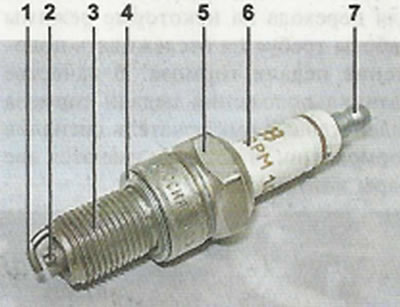
Spark plug: 1 - side electrode; 2 - central electrode (in the thermal cone of the insulator); 3 - threaded part of the body; 4 - sealing ring; 5 - hexagonal part of the body for the key; 6 - insulator (it has spark plug markings on it); 7 - contact tip (removable, threaded).
Nozzle — is an electromagnetic needle valve, on the outlet pipe of which there is a sprayer with four calibrated holes. The injector opens on signal from the ECU, and fuel under pressure is injected directly into the inlet valve. The amount of fuel entering the cylinder is regulated by the opening time of the injector. The engine is equipped with one injector per cylinder.
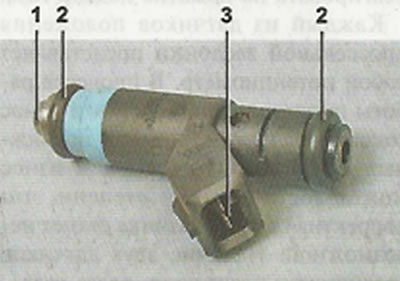
Engine injector: 1 - sprayer; 2 - sealing rubber ring; 3 - terminals for connecting the wiring harness.
Evaporative Canister Purge Valve installed on the air filter housing (more details "Power supply system").
Diagnostic connector block designed to connect an external diagnostic device to the engine management system. The block is installed to the right of the center console.
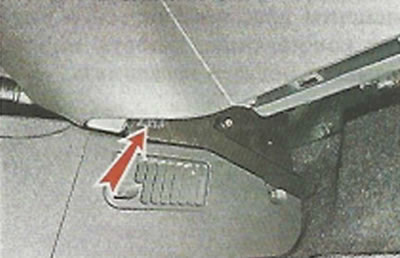
Location of the diagnostic connector block