



Your vehicle uses the standard adult seat belts to secure child restraints.
Safe placement of children in a car is only possible with the use of child restraint systems that meet the requirements of the European standard ECE R44 (find the relevant information on the product or packaging).
Depending on the type of child restraints used in your vehicle, you must select the correct installation locations, using the table below, "Child restraint installation diagram".
Installation of child restraints must be carried out in accordance with the manufacturer's instructions. Before installing a rear-facing child restraint system (back to front) on the front passenger seat, be sure to turn off the front passenger airbag (see Figure 2.15). Before installing a child restraint system on the rear middle passenger seat, position the rear middle passenger seat belt so that the lower tongue is inserted into the black buckle 4 (see Figure 2.10), then follow the recommendations of the child restraint system manufacturer.
Warning!
- it is prohibited to install a rear-facing child restraint system on the front passenger seat with an active front airbag.
- do not leave children unattended in the vehicle.
- do not modify the design of child restraints.
Installing child seats with ISOFIX mountings
Your vehicle is equipped with an ISOFIX anchorage system located on the sides of the rear seat, which allows the installation of child restraint systems (seats) with ISOFIX anchorages that comply with the requirements of the European standard ECE R44 (for children weighing no more than 18 kg). When choosing a child seat with ISOFIX fastening, you must follow the information provided in the table "Diagram for installing child seats with ISOFIX fastening".
The ISOFIX mounting system consists of two lower ISOFIX brackets and a bracket for the ISOFIX upper tether strap.
The lower ISOFIX brackets, to which the corresponding ISOFIX child seat anchorages are attached, are located at the base of the rear seat backrests. Their locations are marked on the backs with special "ISOFIX" pictograms. Before connecting the ISOFIX child seat anchors, it is necessary to clear the area where the lower ISOFIX brackets are located by placing the rear seat belt locks along the junction line of the cushion and back of the rear seat.
Make sure that the rear seat belt buckles do not interfere with the installation of an ISOFIX child seat. Attach the ISOFIX child seat anchors in accordance with the instructions provided by the seat manufacturer.
The ISOFIX upper tether anchorages are located at the bottom of the rear seat backrest on the luggage compartment side and are marked with special labels (Figure 2.17). After securing the ISOFIX top tether, adjust its tension according to the instructions of the manufacturer of the seat.
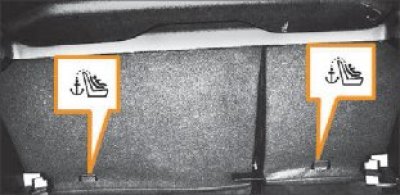
Figure 2.17. ISOFIX top tether brackets
Warning! A child seat with ISOFIX mounting can only be installed in your vehicle if it complies with the requirements of the European standard ECE R44 (find the corresponding inscription on the product or packaging).
Make sure that the ISOFIX child seat anchors do not damage the rear seat belt webbing during installation.
The installation of a child seat with ISOFIX mounting must be carried out in accordance with the instructions of the manufacturer of the seat.
Child restraint installation diagram
Weight group of child restraint devices | Type of child restraint | Front passenger seat | Rear passenger seats | ||
airbag ACTIVE | airbag DISABLED | lateral | average | ||
"0" ≤ 10 kg (approximately 0-6 months) | Cross cradle | X | X | U (1) | X |
"0+" ≤ 13 kg (approximately 6-18 months) | A seat that can be installed against the direction of travel | X | U | U | U |
"I" 9-18 kg (approximately 9 months – 3.5 years) | A seat that can be installed against the direction of travel | X | U | U | U |
Seat that can be installed in the direction of travel | UF | U | U | U | |
"II" 15-25 kg (approximately 3.5-6 years) | Seat that can be installed in the direction of travel | UF | U | U | U |
"III" 22-36 kg (approximately 6-12 years) | Seat that can be installed in the direction of travel | UF | U | U | U |
U – the seat is suitable for the "universal" category of child restraints officially approved for this weight category.
UF – the seat is suitable for the "universal" category of forward-facing child restraints that are officially approved for this weight category.
X – the seat is not suitable for installing child restraints for children of this weight category.
(1) – the child restraint system is installed across the vehicle and takes up two passenger seats; the child should be positioned with his head on the side opposite the door.
Installation diagram for child seats with ISOFIX fastening
Child's weight category | ISOFIX size class (1) | Position of ISOFIX mounting systems on the vehicle | |
right side rear seat | left side rear seat | ||
Category "0" ≤ 10 kg (approximately 0-6 months) | F (Cross cradle) | X | X |
G (Cross cradle) | X | X | |
E (Seat facing away from the direction of travel) | X | X | |
Category "0+" ≤ 13 kg (approximately 6-18 months) | E (Seat facing away from the direction of travel) | IL(2) (3) | X |
D (Seat facing away from the direction of travel) | X | X | |
C (Seat facing away from the direction of travel) | X | X | |
Category "1" 9–18 kg (approximately 9 months – 3.5 years) | D (Seat facing away from the direction of travel) | X | X |
C (Seat facing away from the direction of travel) | X | X | |
B (Forward facing seat) | IUF | IUF | |
B1 (Forward facing seat) | IUF | IUF | |
A (Forward facing seat) | IUF | IUF | |
IUF – the seat is suitable for installing a "universal" ISOFIX child restraint system of this size class.
IL – the seat is suitable for installing a "semi-universal" ISOFIX child restraint system of this size class.
x – location not suitable for installing an ISOFIX child restraint system.
1 – The ISOFIX size class is defined by capital letters from A to G, which are indicated on ISOFIX child restraint systems.
2 – To accommodate a child restraint system of this size class, the front passenger seat must be moved forward.
3 – At the date of publication, the recommended child restraint system for this ISOFIX size class is the seat "Maxi Cosi Cabriofix" with ISOFIX base "Familyfix".