



Attention. When carrying out any type of work on the car related to the depressurization of the air conditioning system, completely unload the refrigerant, followed by loading the system in the required volume (see below).
Unloading (removal) refrigerant
Attention. Works on unloading the refrigerant should be carried out in accordance with the operating instructions for the service equipment.
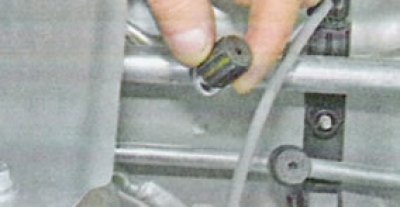
Unscrew the cap on any of the 2 fittings (must work with gloves)
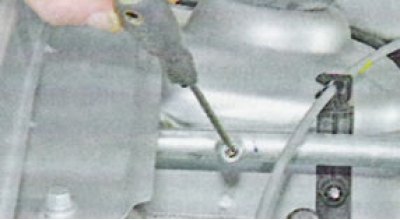
Press a suitable thin tool on the valve spool and bleed the refrigerant from the system.
This work must be done outdoors. When releasing the refrigerant, do not rush, then it will have time to evaporate. Keep in mind that some oil may splatter, stock up on wiping material.
Vacuum system
Before loading the refrigerant, it is necessary to evacuate the air conditioning system in accordance with the operating instructions for the service equipment.
Refrigerant charge
Attention. Works on charging refrigerant should be carried out in accordance with the operating instructions for service equipment.
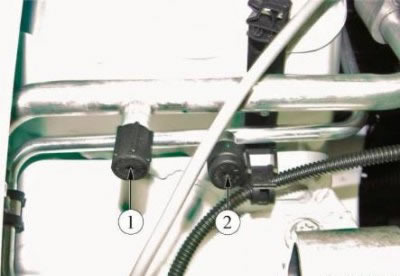
Figure 4-1 - Charging the air conditioning system with refrigerant: 1 - fitting of the high pressure circuit; 2 - fitting of the low pressure circuit
Attention. Charge refrigerant with the engine stopped through the high pressure circuit, Figure 4-1. If the system is not fully loaded with refrigerant, additional charging should be carried out with the engine running and the air conditioning system turned on through the low pressure gaseous refrigerant circuit.
The mass of refrigerant charged into the system (R134a, aka freon HFC-134a) is 475±35 g.
Special SP10 oil has been added to the refrigerant to lubricate the compressor. It is strictly forbidden to use other types of refrigerants and oils in the system.
Checking for refrigerant leaks
Attention. Carry out work on detecting refrigerant leaks in accordance with the operating instructions for the leak detector.