



Features of the device
The exhaust gases are discharged from the engine through the exhaust manifold and the exhaust system, which includes the catalytic converter 1, Figures 12-1 and 12-2, the additional muffler 2 and the main muffler 3. The exhaust system is made as a single welded structure, which is suspended from the car body using rubber cushions. It is possible to replace individual units of the exhaust system using cutting of pipelines and subsequent assembly using repair clamp couplings. For this purpose, the exhaust system is provided with two zones A and B for cutting. On the catalytic converter side, the exhaust system is secured to the exhaust manifold with a flange using mounting studs and nuts.
General view of the exhaust system from below a car with a 1.6 liter engine
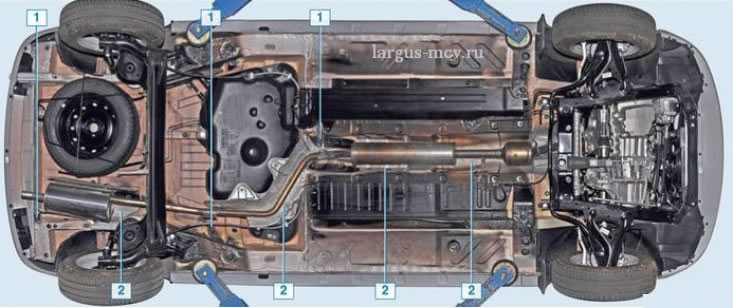
1 – rubber cushion of the exhaust system suspension; 2 – heat shield
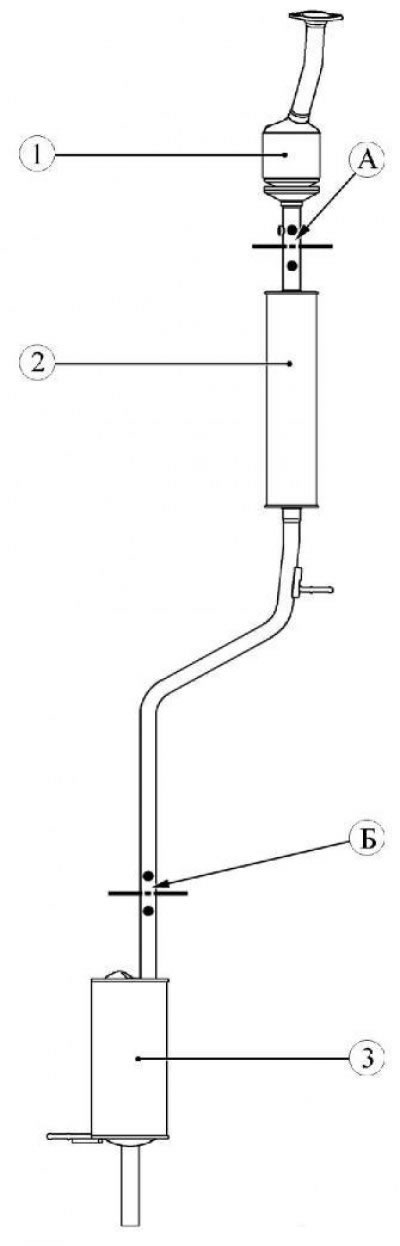
Figure 12-1 - Exhaust system of a vehicle with a K4M engine: 1 - catalytic converter; 2 - additional muffler; 3 - main muffler; A - cutting zone; B - cutting zone
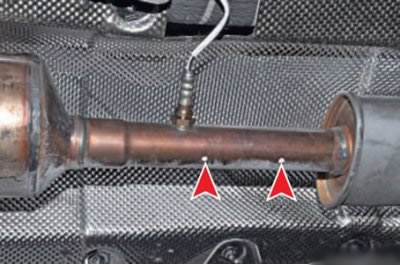
Location of marks on the pipe between the neutralizer and the additional muffler
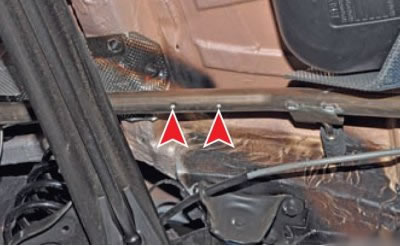
Location of marks on the pipe between the additional and main mufflers
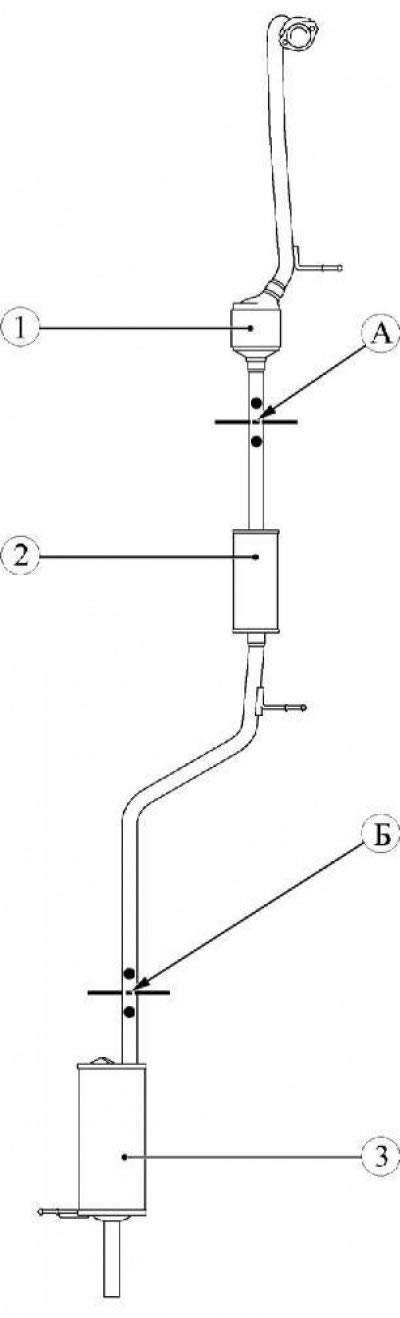
Figure 12-2 - Exhaust system of a vehicle with a K7M engine: 1 - catalytic converter; 2 - additional muffler; 3 - main muffler; A - cutting zone; B - cutting zone
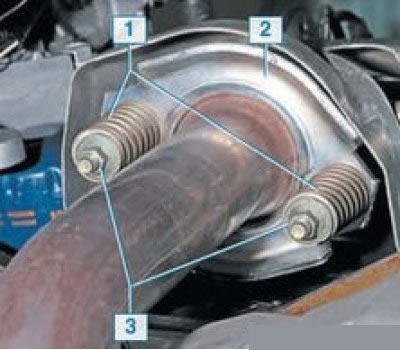
Connecting the inlet pipe to the exhaust manifold of the 1.6 (8V) engine: 1 – spring; 2 – pressure plate; 3 – nut
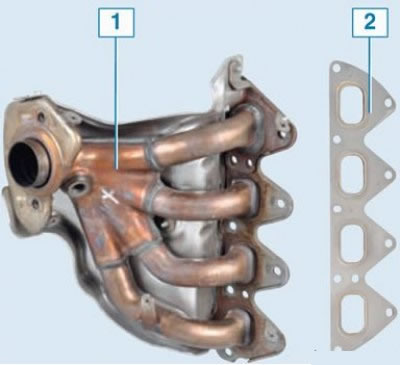
Exhaust manifold of engine 1.6 (16V): 1 – exhaust manifold; 2 – manifold gasket
The exhaust manifold serves to collect exhaust gases from all engine cylinders into one exhaust channel.
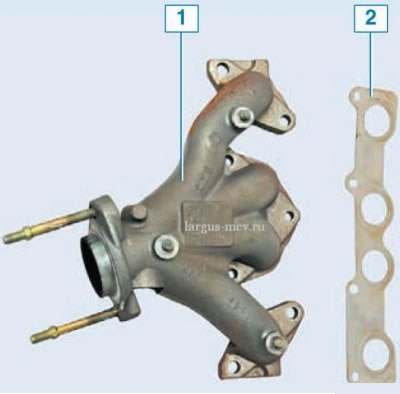
Exhaust manifold of engine 1.6 (8V): 1 – exhaust manifold; 2 – manifold gasket
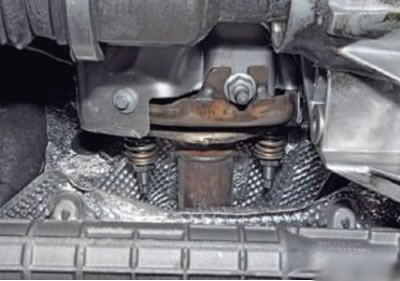
Connecting the inlet pipe to the exhaust manifold of the 1.6 (16V) engine
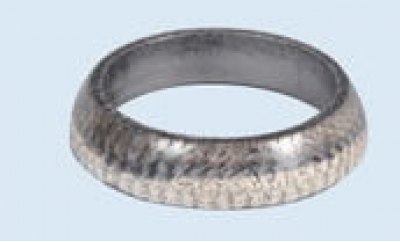
Sealing ring with spherical surface
Removal the exhaust system from the car
Place the vehicle on a two-post lift, apply the parking brake, turn off the ignition and disconnect the ground wire from the battery.
For cars with K7M engine
Remove the engine crankcase guard.
Remove connector 1, Figure 12-3, of the oxygen sensor control from the holder by sliding it.
Disconnect the wiring harness connector from the oxygen sensor control connector.
Disconnect clamp 2.
Unscrew the control oxygen sensor 3 (device Mot. 1495 or replaceable insert 22 from the kit type 811382 f. "USAG").
Operations for all vehicle configurations
Disconnect the wiring harness connector from connector 1, Figure 12-4, of the diagnostic oxygen sensor.
Disconnect the oxygen sensor diagnostic connector from the mounting bracket.
Unscrew the diagnostic oxygen sensor 2 (device Mot. 1495 or replaceable insert 22 from the kit type 811382 f. "USAG").
Unscrew the two nuts 1, Figure 12-8, studs securing the catalytic converter to the exhaust manifold 3, remove the springs 2 (replacement head 10, extension and ratchet).
For cars without ABS
Disconnect the rear brake adjuster rod from the rear suspension arms (flat head screwdriver, pliers).
Operations for all vehicle configurations
Place the support part of the hydraulic transmission strut (SG-1 "GARO" type hydraulic transmission strut) under the cross beam of levers 1, Figure 12-11, of the rear suspension until it stops.
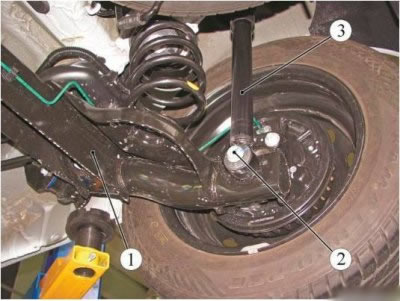
Figure 12-11 - Removing the shock absorbers from the rear suspension arms: 1 - rear suspension arms; 2 - bolt; 3 - rear suspension shock absorber
Loosen and remove bolts 2 securing shock absorbers 3 to the rear suspension arms and carefully lower the rear suspension arms without allowing the brake hoses to become tense (SG-1 "GARO" type hydraulic transmission strut, 19 replaceable head, ratchet wrench).
Remove the exhaust system brackets from the suspension mounts (if necessary, cut the suspension cushions), remove the exhaust system assembly and sealing ring The sealing ring must be replaced (flat screwdriver, technological knife). The operation must be performed with an assistant.
Remove the exhaust system suspension cushions from the body brackets. Cushions that have cracks and tears are subject to replacement (flat head screwdriver).
Installation of the exhaust system assembly
Lubricate the exhaust system suspension cushions with a soap solution and install them on the body brackets (brush, soap solution, technological container).
Install the new O-ring and exhaust system assembly onto the vehicle, inserting the brackets into the suspension mounts mounted on the body. The operation must be performed by two people.
Install two springs 2, Figure 12-8, and screw on two nuts 1 of the studs securing the catalytic converter to the exhaust manifold 3. Tightening torque of the nuts 21 N·m (2.1 kgf·m) (replaceable head 10, extension and ratchet, torque wrench).
Raise the hydraulic strut with levers 1, Fig. 12-11, of the rear suspension, attach the shock absorbers 3 to the rear suspension levers, install new bolts 2. The tightening torque of the shock absorber mounting bolts is 105 N·m (10.5 kgf·m) (hydraulic transmission strut type SG-1 "GARO", replaceable head 19, ratchet handle, torque wrench).
Lower the support part of the hydraulic transmission strut and remove the strut from under the vehicle.
Install the diagnostic 2, Figure 12-4, oxygen sensor.
For cars without ABS
Attach the rear brake adjuster rod to the rear suspension arms (flat head screwdriver, pliers).
For cars with K7M engine
Install the control 3, Figure 12-3, oxygen sensor.
Install the engine oil pan guard.
Operations for all vehicle configurations
Connect the ground wire terminal to the battery.
Installing the main muffler
Install a new coupling 1, Figure 12-5, onto the exhaust pipe of the additional muffler.
Install the main muffler on the car, inserting the bracket into the suspension cushion on the car body (flat head screwdriver).
Adjust the outlet pipe until it touches the protrusions inside the repair coupling and tighten nut 2 of the coupling 1 tightening bolt connecting the pipe. Tightening torque of the tie bolt nuts 25 Nm (2.5 kgf·m) (13mm socket head, extension and ratchet, torque wrench).
Installing an additional muffler
Install two new couplings 1, Figure 12-5, on the additional muffler pipes.
Apply soapy water to the additional muffler bracket (brush, technological container).
Install an additional muffler on the car, inserting the bracket into the suspension cushion on the car body (flat head screwdriver).
Adjust the outlet pipe until it touches the protrusions inside the repair coupling and tighten the nuts 2 of the coupling tie bolts 1 connecting the pipes. Tightening torque of the tie bolt nuts 25 Nm (2.5 kgf·m) (13mm socket head, extension and ratchet, torque wrench).
Installation of a catalytic converter
Install catalytic converter 1, Figures 12-1 and 12-2, and a new sealing ring on the vehicle.
Install two springs 2, Figure 12-8, and screw on two nuts 1 of the studs securing the catalytic converter to the exhaust manifold 3. Tightening torque of the nuts 21 N·m (2.1 kgf·m) (replaceable head 10, extension and ratchet, torque wrench).
For cars with K7M engine
Apply soapy water to the catalytic converter bracket and install the bracket into the suspension mount on the body (brush, technological container).
Operations for all vehicle configurations
Install the new coupling 1, Figure 12-5, onto the catalytic converter pipe.
Install the inlet pipe of the additional muffler into the coupling on the outlet pipe of the catalytic converter, adjust the outlet pipe until it touches the protrusions inside the repair coupling and tighten nut 2 of the coupling 1 clamp bolt connecting the pipes. Tightening torque of the tie bolt nut 25 N·m (2.5 kgf·m) (13mm socket head, extension and ratchet, torque wrench).
For cars with K7M engine
Install the control 3, Figure 12-3, oxygen sensor.
Install the engine oil pan guard.
Operations for all vehicle configurations
Install the diagnostic 2, Figure 12-4, oxygen sensor.
Connect the ground wire terminal to the battery.