



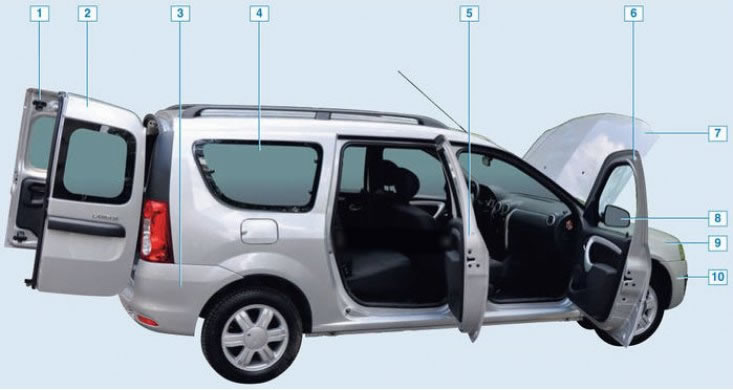
Body details: 1 – left luggage compartment door; 2 – right luggage compartment door; 3 – rear bumper; 4 – right side glass of the rear compartment; 5 – rear door right; 6 – front door right; 7 – hood; 8 – outside rear view mirror; 9 – right front fender; 10 – front bumper
The Lada Largus body is a single welded structure. It is welded on a robotic line. All body parts that are susceptible to corrosion are galvanized. The main method of joining body parts together is contact welding, and electric welding is used in hard-to-reach places. All welded seams and joints of parts are coated with mastic. When manufacturing a car body, after connecting its main parts, it is immersed in a special bath with an anti-corrosion compound. After which a primer and paint coating are applied. Hidden cavities are treated with wax auto preservative, and the bottom is covered with anti-corrosion mastic.
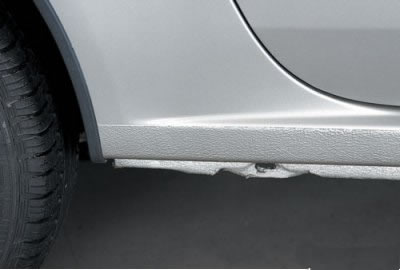
The volume of anti-corrosion mastic applied to the bottom has been increased by one and a half times compared to Renault Logan.
The body is designed taking into account the most advanced requirements for passive vehicle safety. One of the most important elements of passive safety is the front subframe, which has the property of redistributing the impact energy. Car bumpers are made of impact-resistant material that absorbs impact energy. The car doors have stamped metal reinforcements in case of a side impact.
Due to the fact that the body has a very rigid structure, and the plastic interior parts have a gap between them and are attached with special fasteners, there are practically no vibration noises (the so-called "crickets") in the cabin.
The LADA Largus windshield is three-layered, it is glued into the body frame and is part of its power structure. All other car windows are tempered. Side door windows are drop-down and, depending on the configuration, have either manual or electric drive.
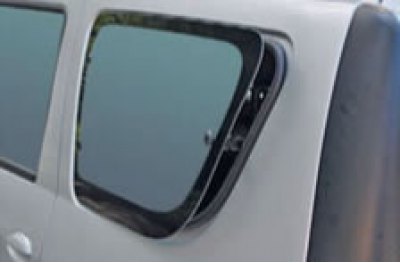
The side windows of the rear compartment can be opened slightly (7-seater version).
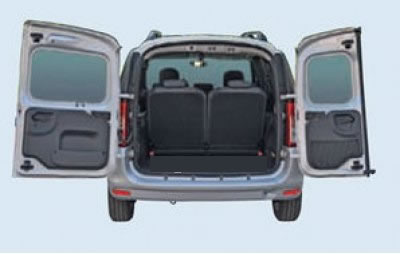
The luggage compartment doors can be opened fully, or to two fixed positions provided for this purpose, which is very convenient if the car is in a confined loading/unloading space.
The modification of the car called LADA Largus Cross has unpainted front and rear bumpers of black color, as well as protective pads on the wheel arches and on the thresholds made of black plastic.
About choosing paint to match the body color
Theoretically, paint can be selected by the code that is indicated on the car's nameplate or punched in VIN code. However, very often the resulting color differs significantly from the body color. This is due to two factors: production features and the abundance of color matching systems (programs).
The problem is that there is no single production of paint of certain shades. At automobile factories, the desired tone is obtained using a specific recipe: a packet of pigments is added to a barrel with the base color. A new batch is made for each batch of cars. And just as parts may differ from each other by the tolerance value, so paints may differ slightly in shade.
At the car factory, you won't find two barrels with a 100% match in color - even cars from neighboring batches have different tones. Factory-prepared paint is not supplied to the secondary market, and when performing body repairs at any service center, the tone has to be selected. There are color matching systems for this purpose.