



Removal
Place the vehicle on a two-post lift, apply the parking brake and turn off the ignition.
Remove the engine crankcase guard.
Unscrew the two nuts 1, Figure 10-1, securing the expansion tank.
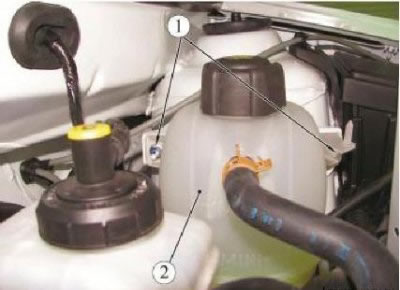
Figure 10-1 - Removing the expansion tank: 1 - expansion tank mounting nut; 2 - expansion tank
Remove and set aside expansion tank 2 without disconnecting the hoses.
Article based on information from the website: www.Ladaman.ru
Disconnect connector 1, Figure 10-2, of the brake fluid level sensor.
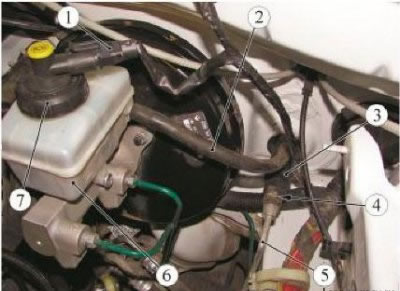
Figure 10-2 - Removing the clutch hydraulic line: 1 - brake fluid level sensor connector; 2 - clutch master cylinder feed line; 3 - clutch master cylinder; 4 - retainer; 5 - pipeline connecting the master and slave cylinders of the clutch drive; 6 - brake hydraulic fluid reservoir; 7 - brake hydraulic fluid reservoir cap
Remove plug 7 of the brake hydraulic fluid reservoir.
Remove the brake fluid from the brake hydraulic drive reservoir 6 using a syringe so that its level is below the fluid supply hole to the clutch master cylinder on the reservoir.
Place a rag under the opening of the brake fluid reservoir.
Disconnect line 2 of the clutch master cylinder from the brake hydraulic fluid reservoir.
Insert plugs into the holes in the pipeline and tank (technological plugs).
Place a rag under the clutch slave cylinder.
Remove plug 1, Figure 10-3, from the air bleed nipple.
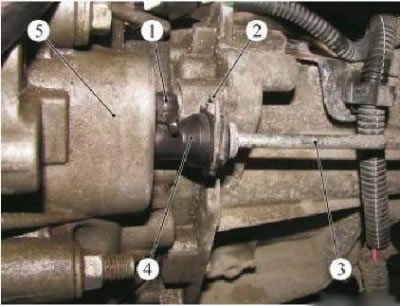
Figure 10-3 - Removing brake fluid from the clutch hydraulic system: 1 - air bleed nipple plug; 2 - retainer; 3 - pipeline connecting the master and slave cylinders of the clutch drive; 4 - clutch drive slave cylinder; 5 - gearbox
Connect a clear hose to the air bleed nipple and place the other end into an empty container located below the air bleed hole.
Press the lock 2 and pull the pipe 3 out one click to open the air bleed hole.
Press the clutch pedal by hand to remove fluid from the clutch master cylinder and line.
Place a rag under the clutch master cylinder.
Raise the retainer 4, Figure 10-1, securing the pipeline 5 connecting the master and slave cylinders of the clutch drive, on the master cylinder.
Disconnect line 5 from the clutch master cylinder.
Insert plugs into the holes on the pipeline and the clutch master cylinder (technological plugs).
Press on the holder 2, Figure 10-3, of the clutch drive slave cylinder.
Disconnect pipeline 3 from clutch slave cylinder 4 and install plugs in the openings of the slave cylinder and pipeline.
Disconnect the pipe connecting the master and slave cylinders from the mounting brackets on the body and gearbox.
Remove pipe 3 connecting the master and slave cylinders of the clutch hydraulic drive.
Installation
Check the condition of the sealing rings on the pipeline connecting the master and slave cylinders of the clutch hydraulic drive; replace if necessary.
Remove the technological plugs from the holes of the hydraulic drive elements.
Install the pipeline connecting the master and slave cylinders of the clutch hydraulic drive.
Secure the pipeline connecting the master and slave cylinders of the clutch hydraulic drive to the mounting brackets on the gearbox and on the body.
Connect pipeline 5, Figure 10-2, to the clutch master cylinder 3.
Install clamp 4 of the pipeline between the master and slave cylinders on the clutch master cylinder.
Connect pipeline 3, Figure 10-3, connecting the master and slave cylinders of the clutch drive to slave cylinder 4 of the clutch.
Install expansion tank 2, Figure 10-1, and tighten expansion tank mounting nuts 1 to a torque of 8 N·m (0.8 kgf·m) (spanner 10, replaceable head 10, extension, torque wrench).
Pour brake fluid into the reservoir and bring its level up to normal. The brake fluid level should be between the "MAX" and "MIN" marks (brake fluid according to the current "Codifier of main and auxiliary materials used in maintenance and repair of LADA vehicles" K 3100.25100.00018).
Remove air from the clutch hydraulic system.
Check the functionality of the clutch.
Install engine crankcase protection